Nothing Has Changed, Yet Everything Has Changed
The Santa Cruz Branch Line corridor didn’t change, but the RTC’s options did.
By Will Mayall
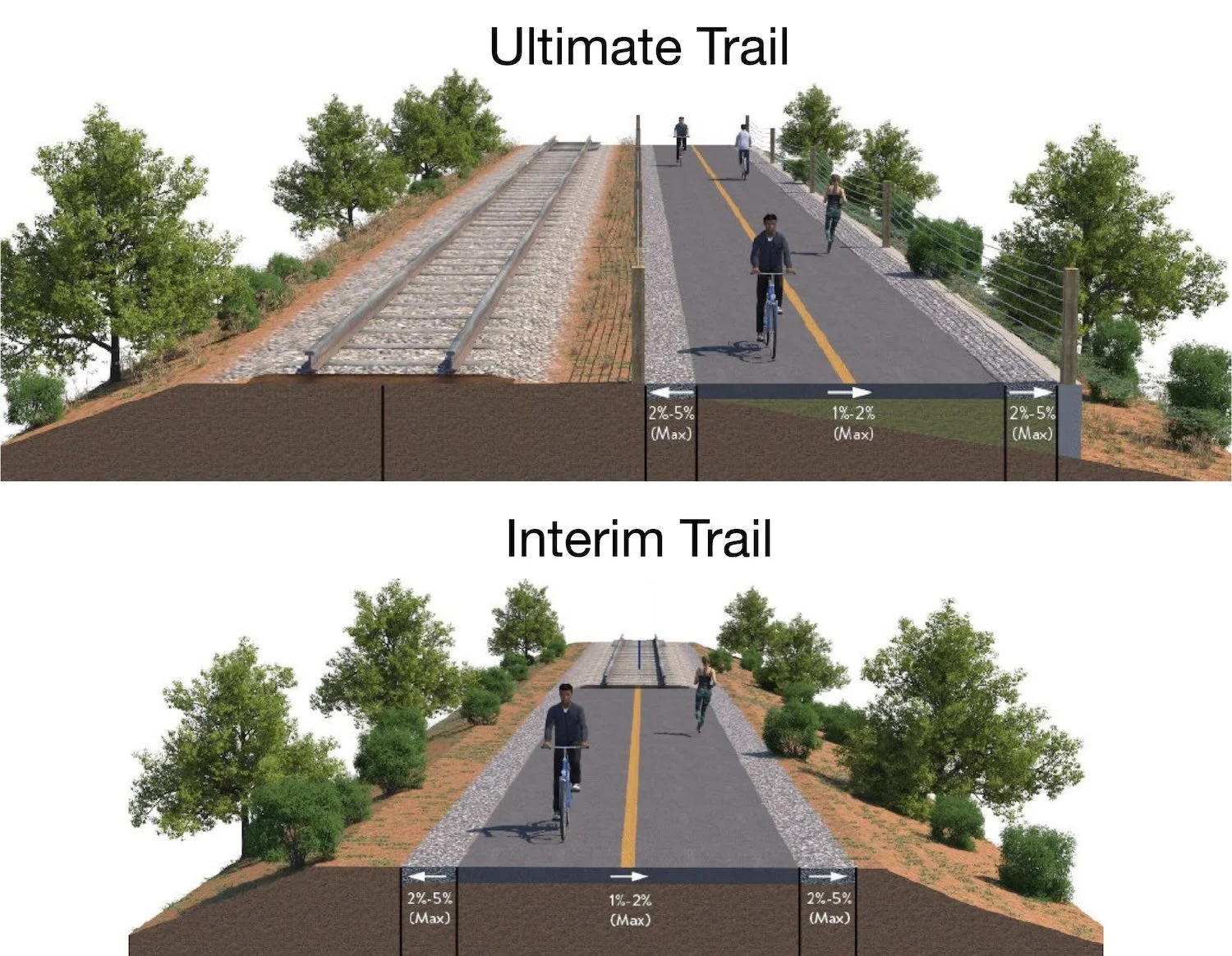
(Santa Cruz County Regional Transportation Commission)
At first glance, it may look like the Santa Cruz County Regional Transportation Commission (RTC) has suddenly reversed course. The common carrier contract with Progressive Rail is being terminated. The so‑called “Ultimate” rail‑next-to‑trail design is currently off the table. And the RTC is now moving decisively toward building the Interim Trail, the very trail configuration many of us have argued for all along.
But the deeper truth is this: nothing fundamental has changed about the corridor itself. What has changed is that the RTC can no longer avoid the realities it has long struggled to reconcile.
Nothing Has Changed
The Santa Cruz Branch Line has always been an extraordinarily difficult place to build a modern passenger train.
That reality predates Progressive Rail. It predates the Zero Emission Passenger Rail and Trail (ZEPRT) study. It predates the purchase of the corridor itself.
The challenges are structural and permanent:
The corridor is narrow, curving, and constrained by adjacent development.
It passes through dense neighborhoods, eroding coastal bluffs, wetlands, bridges, and trestles.
It would require massive reconstruction: bridges, new tracks, signaling, crossings, rolling stock, and maintenance facilities.
None of this has changed.
Just as importantly, a continuous multi‑use trail along this corridor has long been planned, and built segments have consistently seen strong use and support. Public support for a safe, separated trail connecting our communities has never been in doubt.
In other words: the corridor has always been hard for rail, and the trail has always made sense.
Everything Has Changed
What has changed is that two realities have finally collided.
First, the cost of a passenger train has become impossible to ignore. Current estimates place the cost in the multiple-billion-dollar range. Even supporters increasingly concede that a train, if it ever happens, is decades away at best.
Second, the “Ultimate” trail, a trail built alongside the tracks, has collapsed under its own evident impossibility. This design assumes sufficient width for both rail and trail, extensive bridge replacements, retaining walls, and complex construction. It is too expensive and too slow to deliver within the constraints of available funding. In particular, it cannot be delivered in time to meet the requirements of one of the largest Active Transportation Program (ATP) grants awarded in California.
Faced with these constraints, the RTC ran out of room to maneuver.
Losing the ATP grant was not politically or practically acceptable. Building the Ultimate trail was no longer feasible. And continuing to negotiate with Progressive Rail made timely trail delivery effectively impossible.
The result was not a philosophical shift; it was a forced one.
To preserve the grant and actually build a trail, the RTC had to:
Terminate the Progressive Rail agreement.
Take control of the corridor north of Watsonville.
Pivot to the trail design that can be delivered within cost, space, and time constraints: the Interim Trail.
This is not a change in values. It is an acknowledgment of reality.
About the Future
Much of the current anxiety centers on one claim: that removing tracks means “no train ever.”
That claim is simply not true.
The future of passenger rail in Santa Cruz County has never depended on whether old tracks are left in place. Tracks are replaceable, and the ZEPRT study indicates that any viable passenger rail service would require extensive track reconstruction or replacement to meet modern standards. What determines whether a train happens now or in the future has always been the same set of factors:
Clear public benefit
Sustainable funding
Operational and governance capacity
If, someday, those conditions are met, a train can be built, with or without today’s tracks.
At the same time, it is also true that a wide, safe, popular trail changes the political landscape. A trail that sees heavy daily use will raise the bar for replacing it with a train. That is not a trick or a betrayal; it is how tradeoffs work in a constrained corridor.
The real question, then, is not whether an Interim Trail makes a train less likely.
The real question will be whether a train can justify its costs, impacts, and risks without displacing a successful trail.
Where We Are Now
Nothing has changed about the physical reality of the corridor. It is still hard. It is still constrained. It still demands difficult choices.
Everything has changed in that the RTC is finally making this choice.
After years of delay, escalation, and avoidance, the commission has arrived, reluctantly, at the conclusion many reached long ago: the Interim Trail is not a compromise. It is the only solution that actually delivers public benefit in the foreseeable future.
That does not mean the ZEPRT passenger rail effort has stopped. It has not. The RTC continues to plan for a future train and is currently seeking roughly $15 million to fund the ZEPRT environmental review.
But that future train remains subject to significant hurdles. Chief among them is the need for a public vote to raise substantial local revenue in order to create the matching funds required to secure outside state and federal money. Until that hurdle is cleared, passenger rail remains aspirational rather than actionable.
The Interim Trail should not be understood as a victory for any side.
It is simply what reality now requires.