Learning or Prompting? A UCSC Senior on AI in School
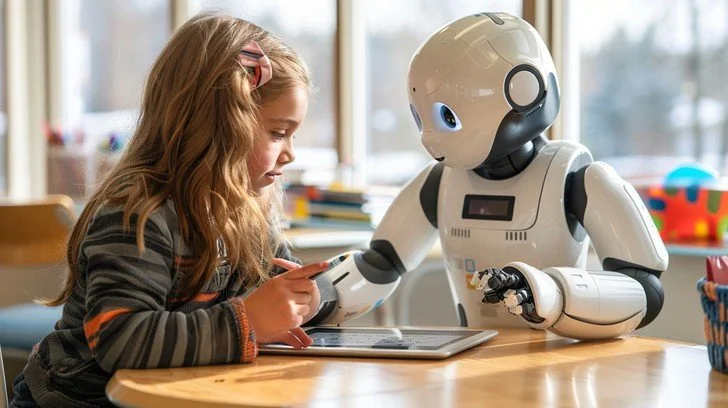
Image Generated by ChatGPT
When reading a recent article from The Economist on how AI is impacting children in school, I was in shock. As a senior in college now, AI was just starting to gain its bearings as I was leaving high school. In the piece from The Economist At home and at school, AI is transforming childhood the author claims children are now using Khan Academy’s AI chatbot to complete their homework for them. Khan Academy, an online learning platform, was one of the reasons why I was able to get through high school math and chemistry. Their tutorials and lesson plans taught me concepts I struggled with heavily. I find it saddening that the use of AI in their platform is watering down the benefits children can receive from their incredibly necessary tutoring services. Critical thinking skills are crucial for children to learn in school; it is a skill I utilize every single day as a literature major. But if children become accustomed to prompting rather than truly creating and developing their own ideas, I fear we might find ourselves with a problem.
As someone who grew up with the advent of technology like Google and social media, I understand just how much technology can help education get better. Learning how to type, utilize search engines to better research topics, and create using technology while in school has greatly benefited me as an adult and in higher education. However, I also understood the limitations and the ethical issues that arise with technology. I had the importance of not plagiarizing from the internet drilled into me while writing, and we need to do the same with the younger generations.
In a recent article from UC Davis titled Risks of AI Mirror Social Media by Alex Russell, Developmental psychologist and professor Amanda Guyer explains, “the structures in the brain that help to manage or control impulsivity don’t fully develop until our early 20s. Also, as teenagers, we are incredibly sensitive to our brain’s release of the chemical dopamine when we experience a reward.” Kids can’t help but give in to the desire to do things they shouldn’t. This is why many believe that social media needs restrictions for kids. UC Davis begs the question – are we seeing the same risks with AI as social media? Kids can’t help but scroll for hours watching TikTok after TikTok, and they also can’t help but use ChatGPT and other AI chatbots to cheat on their homework.
When speaking with Professor Jody Biehl, a literature professor at UC Santa Cruz and opinion editor at Lookout Santa Cruz, I was able to gain insight into how these changes are impacting educators as well as students. When asked how she believes AI has changed both students' and professors' experiences in higher education, “AI has radically affected me and my teaching in the past few years. I am seeing students using AI for most assignments, which means the writing process is no longer individual. It’s a collaboration with a machine. That is a huge shift. Too often, students are relying on AI to do the hard cognitive lifting, and the resulting product is flat and devoid of personality. It’s AI slop.” Biehl stated honestly. “AI has a place, certainly, and we need to explore how to use it effectively as a teaching and writing tool. I worry that too much reliance on AI will make students less creative, less analytical, and less able to synthesize information quickly. I worry they will stop trusting their instincts, which is pivotal for writers and journalists.” As a literature student at UCSC, I have taken classes with Professor Biehl and found collaboration and prompting with a professor, not a computer, to be significantly more valuable in bettering my craft as a writer. On connecting with students, Biehl says, “On another level, AI is making it hard for me to get to know students through their work. I often can’t distinguish their raw ability from their ability to write a good prompt.” Prompting is a skill necessary to make it through this new AI era. If we cannot utilize a new tool, we get left behind. However, after chatting with Professor Biehl, I find it even more important now to understand that we must separate the skill of prompting from the skills of critical thinking and analysis, and develop them all simultaneously.
At UCSC, I have found that many of my literature and history classes contain not just humanities students but many other majors, taking classes in pursuit of their General Education credits. I hear students say all the time, “I’ll just ask chat” but if students from other majors are relying on technology such as ChatGPT to complete gen-ed requirements, it feels like we are defeating the purpose of using these classes to produce more well-rounded higher education graduates. I see it most often used for writing assignments, and I may be biased as a literature major, but I believe that being a strong writer is one of the greatest skills you can exit higher education with.
In a different article from The Economist, How AI is rewiring childhood a wonderful point is made, “AI shows undeniable potential to improve education and enrich entertainment. It may one day let every child live like royalty. But the truly privileged may be those whose parents and teachers know when to turn it off.” Being able to utilize new technology like Artificial Intelligence to push education forward in both lower and higher education is a necessary skill to move into the future. But, as a student who has now experienced both sides, I believe the most well-rounded student must use both and work even harder to preserve their critical thinking and analytical skills, along with utilizing this new technology.