

Energy Storage Is Coming. Santa Cruz Wants It Safer This Time
Santa Cruz County is trying to solve a problem that sounds simple until you live next to it: we need a lot more clean energy, and we need to feel safe while we build it.
Start with the basic physics of modern electricity. Solar is strongest when people are at work. Wind is moody. Demand spikes at dinner. The grid, meanwhile, has to stay balanced every second. If supply and demand drift apart, things break. That’s why energy storage is becoming the quiet centerpiece of the clean-energy transition: it turns a grid that’s at the mercy of weather into a grid that can plan.
Elon Musk put the argument in unusually practical terms on the Moonshots podcast. The U.S. can hit roughly 1.1 terawatts at peak, but average usage is closer to 0.5. His claim is that if you “buffer” supply and demand by charging batteries off-peak and discharging during high demand, you can effectively double annual energy throughput without building a new generation.
California is already living the logic of that claim. The state has built huge amounts of renewable generation, and then… thrown a meaningful chunk of it away. CAISO data cited in Santa Cruz Works coverage shows solar curtailment in 2024 surged into the thousands of gigawatt-hours, with wind curtailment rising too, because the system can’t always use clean power when it’s produced. Storage is the obvious fix: capture surplus, release it when the grid is strained.
But Santa Cruz County also lives with the other side of the story: what happens when storage goes wrong.
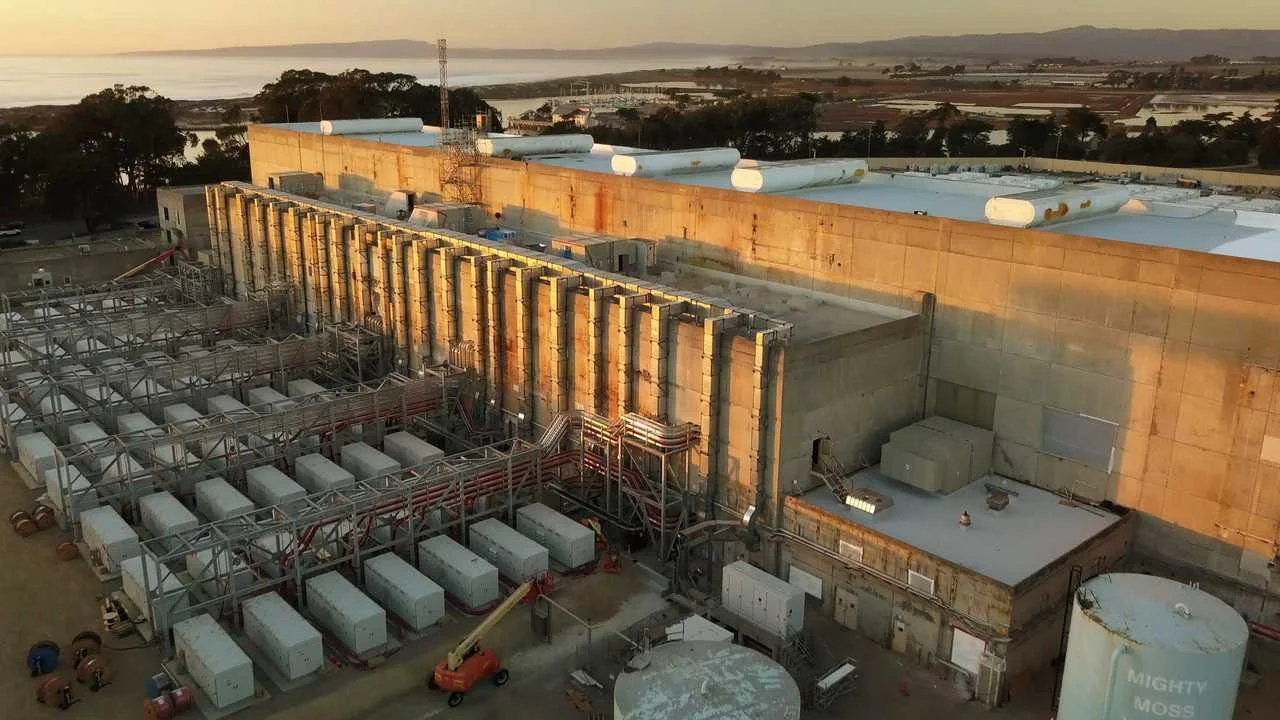
Moss Landing, just over the county line, became a symbol of both ambition and anxiety. A world-scale battery facility meant to stabilize renewables suffered overheating events and fires in the early 2020s, sparking community fears about air quality, environmental harm, and the sheer difficulty of suppressing lithium battery fires once thermal runaway begins. That experience didn’t kill the case for storage. It sharpened the case for regulation.
So last week Santa Cruz County officials advanced a Board of Supervisors-approved draft framework to regulate public utility-scale energy storage systems through a new “ESS” combining district. The idea is intentionally narrow: designate parcels (at least 10 acres) adjacent to existing electrical substations, outside the coastal zone, suitable for facilities storing 200 megawatt-hours or more. In other words: big batteries, in specific places, with fewer surprises.
The ordinance reads like it was written by people who have watched trust evaporate. It prohibits nickel manganese cobalt (NMC) chemistry, the type often associated with higher thermal runaway risk. It requires significant setbacks: 300 feet from sensitive receptors and 1,000 feet from schools, hospitals, and care facilities. It mandates continuous monitoring for smoke, heat, and hydrogen, plus a perimeter PM2.5 sensor network and a nearby meteorological station. It demands emergency training for local fire districts and engineered catchment systems to keep hazardous runoff contained on-site. And it tries to prevent the “build it now, abandon it later” problem through liability insurance and decommissioning bonds.
This is what it looks like when a community learns the hard lesson of clean infrastructure: progress without legitimacy doesn’t scale. The county’s framework is, at its core, a bet that we can get both abundance and reassurance. Batteries can make clean power reliable. Rules can make batteries tolerable. Santa Cruz is trying to prove you don’t have to choose.
Related Articles