

Santa Cruz is not Silicon Valley (and we don’t want to be.)
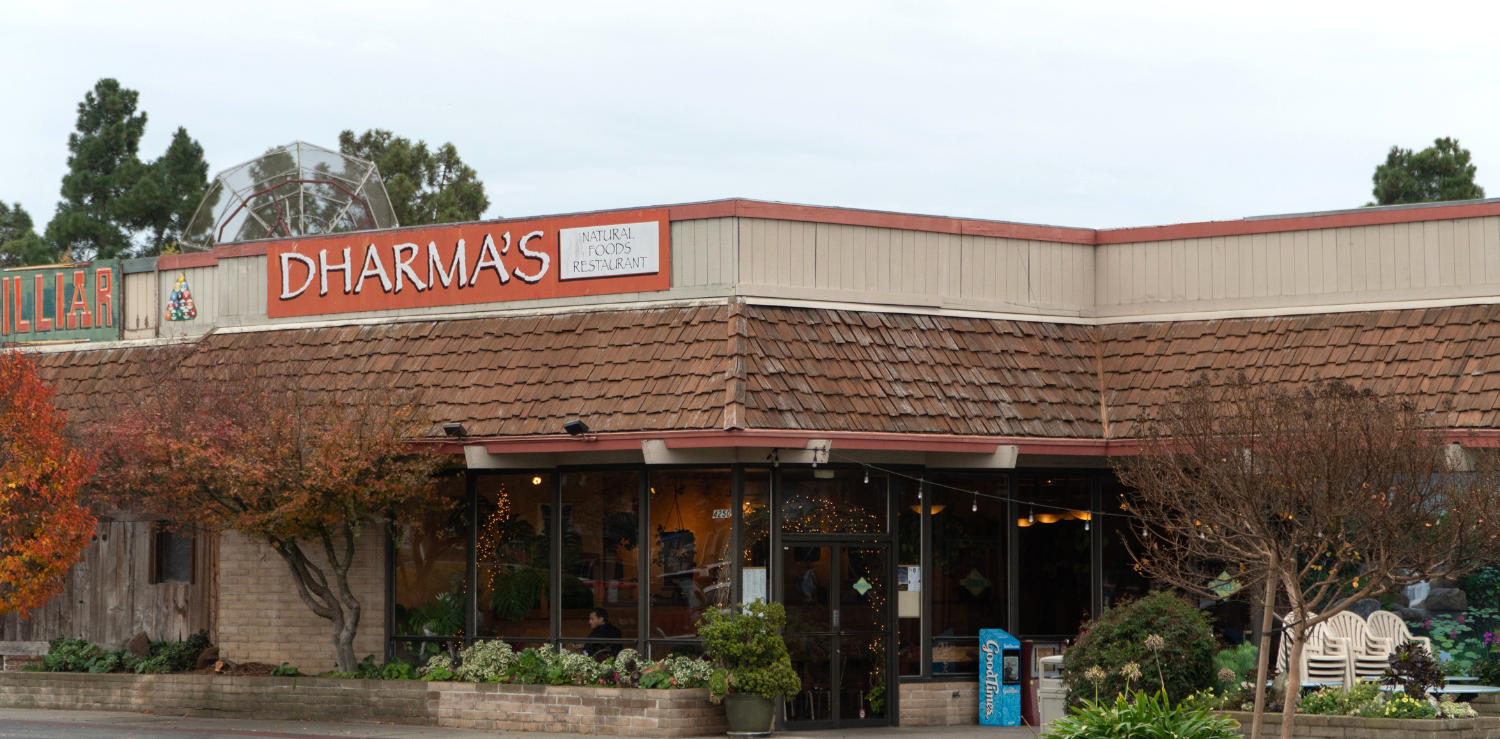
Iconic Santa Cruz Restaurant Dharmas was once called McDharmas.
Dharmas is one of those uniquely Santa Cruz institutions — independent, slightly counterculture, unmistakably local. What I’ve always loved about it, though, is that before it was Dharmas, it was called McDharmas. Like many young ventures, it flirted with something bigger. The name echoed a global giant — maybe tongue-in-cheek, maybe as a way of situating itself in a world dominated by something louder and more established. Startups do that all the time. Communities do too.
But in the 80s they dropped the “Mc.” They stopped referencing the giant and leaned fully into their own vision. Dharmas didn’t shrink when it did that. It didn’t give up ambition. It simply stopped defining itself in relation to something else.
That small shift feels relevant right now.
When I arrived in Santa Cruz in 1988, the town was defined by places like Dharmas, the Saturn Café, and O’Neill. They weren’t just businesses; they were expressions of a point of view. There was creativity here, and independence, and just enough irreverence to keep things interesting. Over time, I watched startups grow in that same environment. I watched Netflix evolve from an idea into a company that reshaped an industry, and I watched Marc Randolph — a Santa Cruz local — continue to show up for founders here even as the company scaled globally. That always struck me. Building something big didn’t require severing ties with where you came from.
We’ve seen mission-driven companies like Zero Motorcycles chart their own path. We’ve watched local innovators experiment with everything from eco-friendly surf wax to advanced clean energy systems. And at the same time, you can still walk into Bookshop Santa Cruz or run into a founder sketching out ideas over coffee and feel that distinctly local mix of ambition and groundedness. Santa Cruz has always held those two things together — global impact and local soul.
Lately, though, I’ve sensed an undercurrent of concern. As Director of Santa Cruz Accelerates, I hear people wonder whether we’re destined to become a smaller, shinier version of Silicon Valley — another coastal town defined by AI hype cycles and venture capital shorthand. It’s a reasonable question. Silicon Valley has a powerful gravitational pull, and its model of innovation is well established. When something works at that scale, it’s tempting to copy it.
But imitation has never been Santa Cruz’s strength.
What I see every week are founders who are building with purpose. Recently, I spoke with two female entrepreneurs developing technology to make natural childbirth safer. Not because it’s trendy, but because they’ve seen the gaps firsthand and believe they can do something about it. I met a founder working on microgrid systems so homeowners can build more resilient energy infrastructure. These conversations don’t feel like they’re chasing the next headline. They feel grounded in lived experience and genuine conviction.
That kind of ambition may not always fit neatly into a Silicon Valley template, but that doesn’t make it small. In fact, it may be more durable.
The real risk for Santa Cruz isn’t that we become Silicon Valley overnight. It’s that we fail to build the support structures our own founders need in order to stay and thrive here. Without intentional mentorship, access to aligned capital, and a network that believes in them, even the most promising companies can stall or relocate. And when that happens, we don’t just lose startups. We lose the compounding effect of experience, talent, and belief that makes an ecosystem resilient.
It’s worth remembering that Santa Cruz has already produced transformative companies — Looker, Joby Aviation, Borland, Seagate, Rainmaker. The capacity for innovation here isn’t hypothetical. It’s proven. What has been less consistent is the connective tissue that helps early-stage founders bridge the gap between good idea and enduring company.
Santa Cruz Accelerates is an attempt to strengthen that connective tissue. Not by importing a prefabricated Silicon Valley playbook, but by building something that reflects this region’s character — ambitious, certainly, but also thoughtful and values-driven. The goal isn’t to scale for the sake of scale. It’s to help founders build companies that can compete globally while remaining rooted locally.
When I think about Dharmas dropping the “Mc,” I don’t hear a rebellious anthem in the background. I see a quiet decision to stop measuring success by proximity to something else. That kind of confidence doesn’t shout. It settles in and does the work.
Santa Cruz has the opportunity to do the same. We can support serious founders, attract serious capital, and build serious companies without becoming an imitation of our neighbor over the hill. In fact, our distinctiveness may be the very thing that makes this ecosystem worth investing in.
If you’re a founder who wants to build something meaningful here, I hope you’ll reach out. And if you’re an investor, operator, or community partner who believes that long-term value is often created in places with strong identity and staying power, I’d welcome that conversation as well.
We don’t need to become Silicon Valley to matter. We simply need to build, deliberately and confidently, as Santa Cruz.
