

CarbonBridge Scores $1.85M ARPA-E Extension, Partners with RTI International
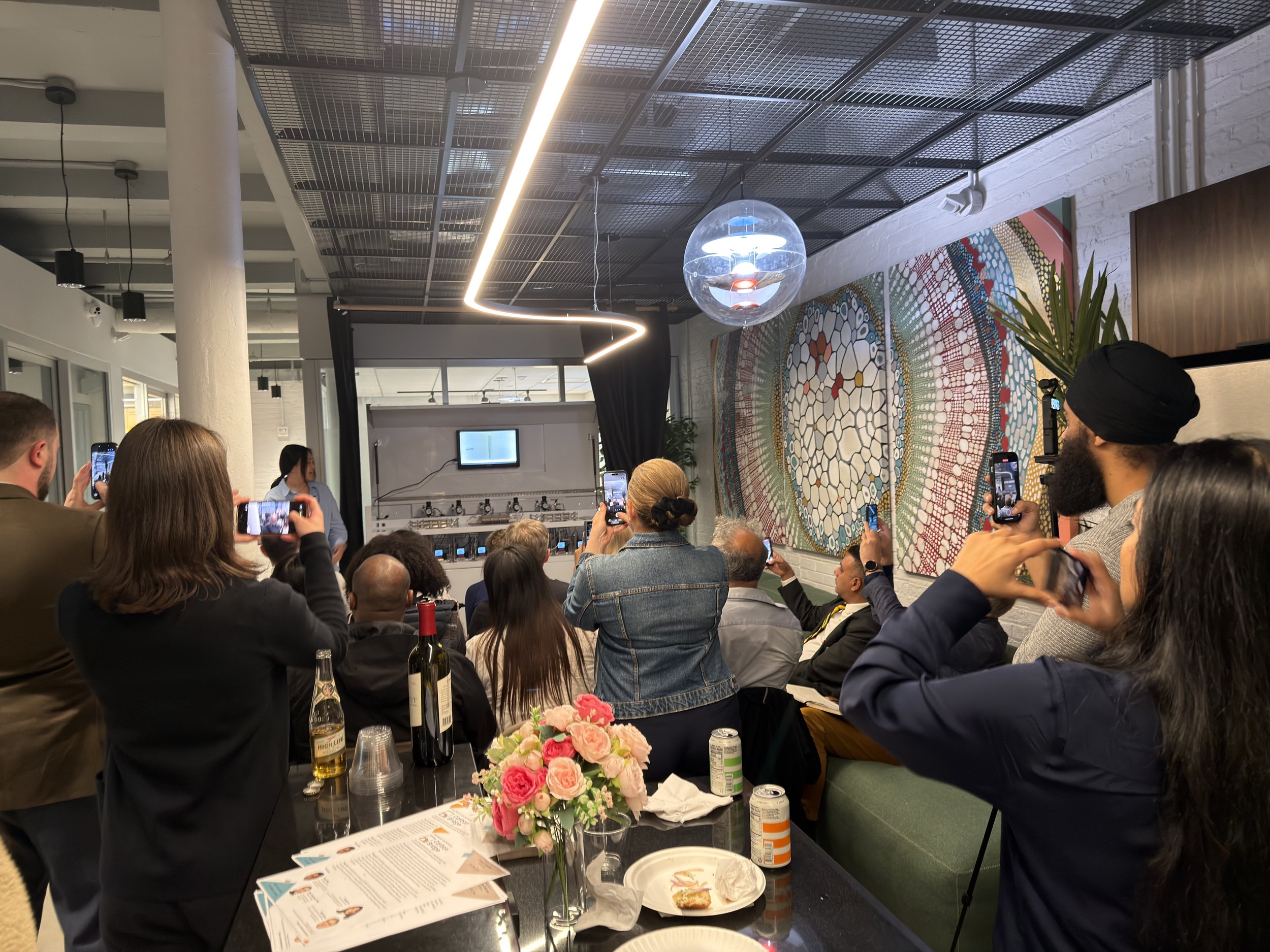
CarbonBridge Reactor Reveal event in Harlem, co-sponsored by Coeus Collective
The wins are stacking up fast for CarbonBridge. The Santa Cruz-founded biotech startup — a graduate of the Santa Cruz Works Accelerates program — has officially secured an additional $1.85M in funding from ARPA-E under its OFF GRID award, bringing the company's total federal award to approximately $2.57M. The extension follows 18 months of intense execution and a rigorous review by ARPA-E of work completed and future plans. In short: the feds looked hard, liked what they saw, and doubled down.
The announcement lands alongside another major milestone: RTI International, a nonprofit research institute with deep roots in applied science and technology, has partnered with CarbonBridge to build and commission a customer-visitable demonstration biomanufacturing platform in North Carolina. That's not a pilot. That's a proof point — a facility where prospective customers can walk in and see Carbon Bridge's technology operating at meaningful scale. It's a critical step on the commercial roadmap the team has been building toward.
The momentum doesn't stop there. CarbonBridge already counts A*STAR in Singapore and Lawrence Berkeley National Laboratory among its paying customers — a customer roster that signals credibility well beyond the startup ecosystem. The company was also showcased at last month's ARPA-E Summit in San Diego, earning a main-stage callout that put their work in front of the nation's leading energy innovators and policymakers.
At the core of CarbonBridge's approach is a modular biomanufacturing architecture designed for scalability and cost control — a technical strategy that appears to be resonating with both government funders and research institutions worldwide.
For Santa Cruz Works, CarbonBridge's trajectory is exactly what the Accelerates program is built for: taking high-potential deep-tech companies and giving them the runway to compete nationally and globally. From demo days in Santa Cruz to main stages in San Diego to demo facilities in North Carolina — this is what the pipeline looks like when it's working.
CarbonBridge is one to watch.
Related Articles
CarbonBridge's CSO Recognized on Forbes 30 Under 30 — Co-founder Sophia Xu lands on Forbes' 2026 Energy & Green Tech list, cementing CarbonBridge's reputation as one of the most decorated startups to come through Santa Cruz Works Accelerates.
Gas to Gold: CarbonBridge's Bioreactors Set New Industry Benchmark — CarbonBridge's proprietary bioreactors achieve a fourfold improvement in methane-to-methanol conversion, setting a new global benchmark as the company launches its seed funding round.
DOE Awards $41 Million for Renewable Energy Projects, Including CarbonBridge — The U.S. Department of Energy selects CarbonBridge among 14 innovative projects to receive funding for Renewables-to-Liquids technology development.
Modular Systems and Reality — CarbonBridge co-founder Manu Pillai explains why "modular" bio-manufacturing is usually just a shrunken full plant — and how the DGF-100's interface-first architecture breaks that trap entirely.
Architecture, Not Just Strain — Pillai makes the case that CarbonBridge's 5x productivity gain over industry benchmarks isn't a biology win — it's an architectural one, with direct-gas reactors doing for microbes what GPUs did for matrix math.
SYS — Hardware Products, Early Stage — The engineering philosophy behind the DGF-100: Pillai's framework for building hardware products that ship on time, meet real metrics, and earn kanseihin — "finished product" — status.