

The Gondola-Train-Bus Thing That Wants to Float Over Highway 1
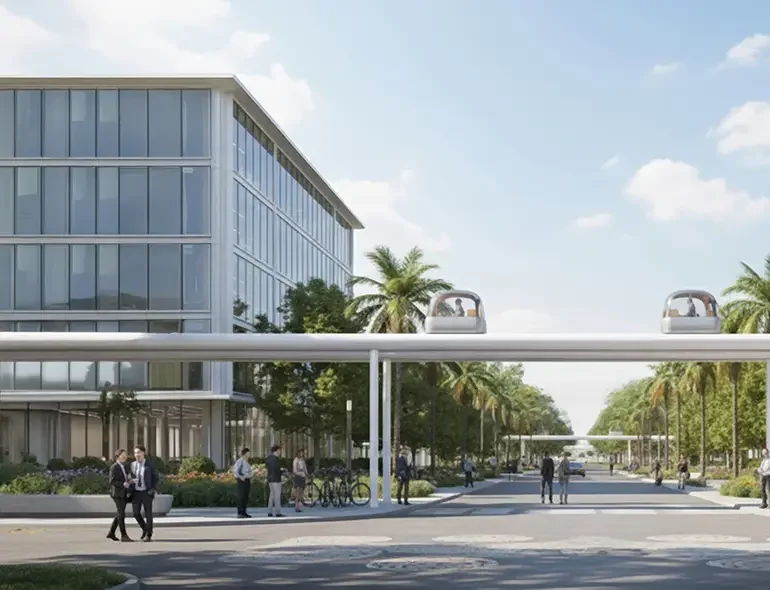
Line Mobility's elevated pod system promises to move ten times more people than a bus at a fraction of rail's cost — and founder Robert wants Santa Cruz to be first in line.
Here's a fun thought experiment: picture every way you've ever gotten from UCSC to downtown Santa Cruz. The bus (character-building). The bike (calf-building). The car (rage-building). Now picture a fourth option: you walk up to a small station, step into a pod, and glide over all of it — no stops, no traffic lights, no guy merging without looking — arriving downtown in minutes.
That's the pitch from Line Mobility, and it's weirder and more interesting than it sounds.
First, the founder. Robert didn't come up through transit engineering. He came from genomics and climate change research — the kind of background where you spend years staring at systemic problems and thinking, "okay, but what actually moves the needle?" For climate, one of the biggest needles is transportation. And one of the most stubborn problems in transportation is this: buses are cheap but slow and low-capacity, and rail is fast and high-capacity but costs approximately one bazillion dollars and takes decades. Everyone knows this. Everyone has accepted this. Robert did not accept this.
His answer sits in an odd middle category most of us don't have a mental folder for: rubber-wheeled electric vehicles running on elevated steel tracks, secured by steel tethers, cruising at 45 miles per hour. Not a train (no giant cars, no massive stations). Not a gondola (no dangling, no slow cable). Something in between — small automated pods, launching constantly, that skip every stop except yours.
That last part is the sneaky-brilliant bit. The stations are offline — off the main track — so a pod pulling over to pick someone up doesn't slow down anything behind it. It's the difference between a highway with exits and a road where the whole line halts every time someone wants a sandwich. This is how Line claims throughput of 5,000 to 10,000 people per hour per direction, or 12,000 per hour maximum. For context, a typical bus corridor moves about 1,000. That's not a 20% improvement. That's a different species.
(The skeptic in you is asking: "If this is so great, why doesn't it exist everywhere?" Fair. Elevated transit concepts have a long history of gorgeous renderings and short deployments. Line's counterargument is cost and construction: prefabricated modular steel guideway, assembled on site — no years of poured concrete and torn-up streets. Whether that math survives contact with reality is exactly the kind of thing worth showing up to interrogate. More on that in a second.)
Robert's proposal for Santa Cruz comes in three phases, and the sequencing is deliberate. Phase one: UCSC to downtown — the densest, most obviously broken corridor in the county, where thousands of students perform the daily bus lottery. Phase two: extend to Aptos. Phase three: connect to Watsonville, finally stitching together a county that has been arguing about how to stitch itself together for roughly as long as anyone can remember. His claim: ten times the people-moving capacity of the current bus system, at a cost that undercuts every rail alternative on the table.
Is it the future, or a beautiful maybe? Come decide for yourself. Line Mobility has been invited to present at Santa Cruz Works New Tech on September 9, 2026 — Robert will be there, the questions will be pointed, and the pods, for now, will remain hypothetical. But so, once, was everything else that moves.
Related Articles
Joby and Toyota Launch Initial Phase of a Strategic Manufacturing Alliance — Santa Cruz's other transportation moonshot takes its biggest step yet toward mass-producing electric air taxis.
The Man Who Built a Better Wheel: Inside Future Motion's Company Spotlight Breakfast — How Kyle Doerksen invented a new category of electric mobility and built it entirely in Santa Cruz.
SCWorks New Tech July 1, 2026 — A recap of the last New Tech before summer break, and a preview of the format Line Mobility will step into this fall.
Onewheel GT, Future Motion's New Flagship Model Now Shipping — Proof that Santa Cruz County keeps finding new ways to put people in motion, one wheel at a time.