

The Secret Math of "Affordable" in Santa Cruz (and why the fancy new housing isn’t the villain)
Affordable housing isn't a vibe — it's a formula. Here's how the 30% rule, hidden $1,160 studios, and a slow-motion machine called filtering actually decide who gets to live here.
Okay, so. "Affordable housing" sounds like an opinion. It's actually arithmetic. The government calculates our county's median income ($132,800 for a family of four), sorts everyone into tiers — very low, low, moderate — and declares housing "affordable" if it eats no more than 30% of your paycheck. That's the whole formula. A "very low income" single person here earns about $69,000 (yes, really — welcome to coastal California), which pencils out to roughly $1,160/month for a studio.
"But the new studios downtown are $3,150!"
Correct! Here's the magic trick: both prices exist in the same building. River Row's 175 units include 20 deed-restricted apartments renting at those regulated caps, invisible on any listing site, right next door to identical units going for triple. And Anton Pacific — the building everyone assumes has affordable units — has zero on-site. Instead, its developers donated land for Pacific Station North and South: 193 apartments, 100% below-market. From the sidewalk, you can't tell which building is doing what. That's kind of the point.
"Fine, but why build luxury towers at all?"
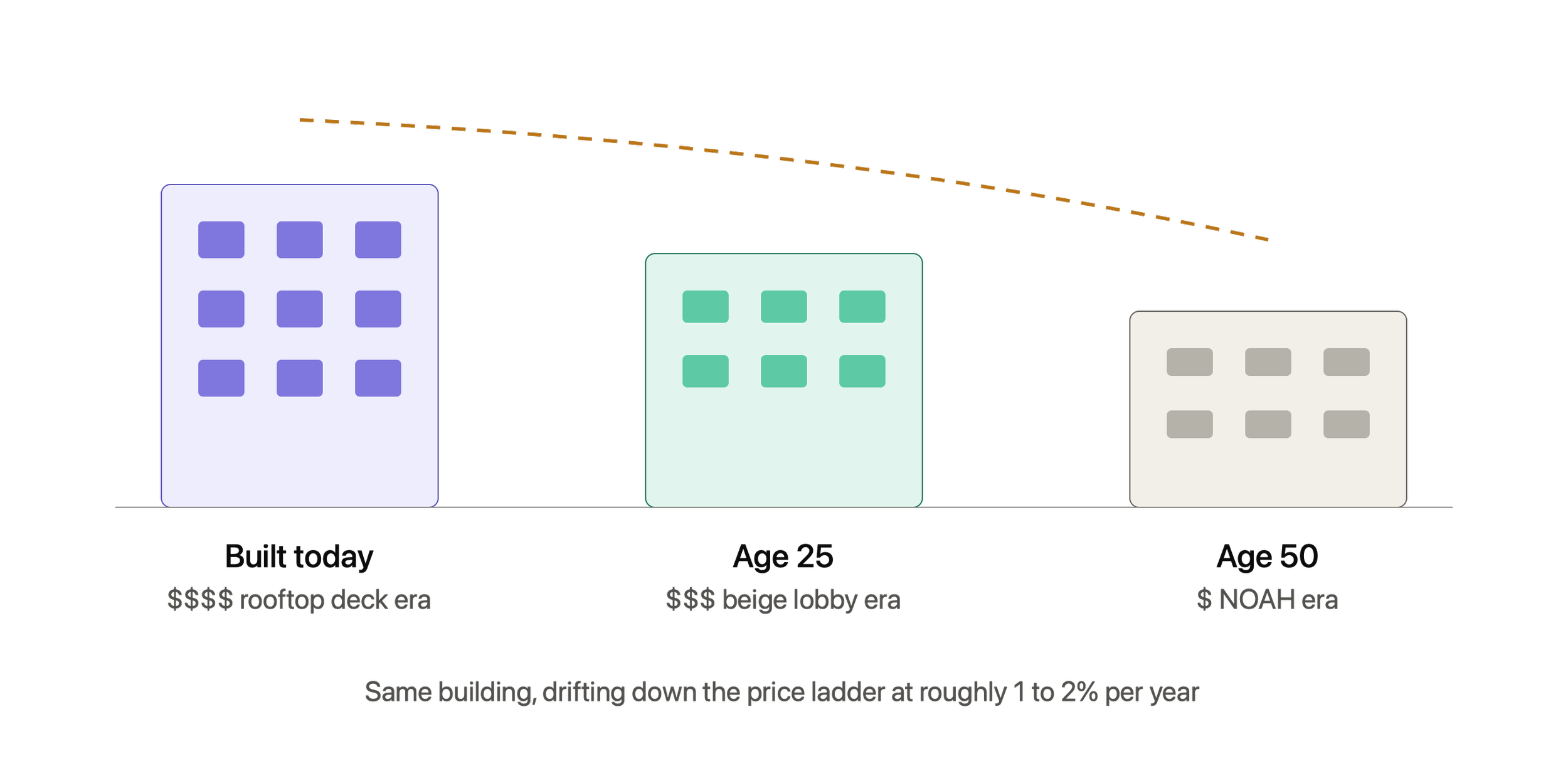
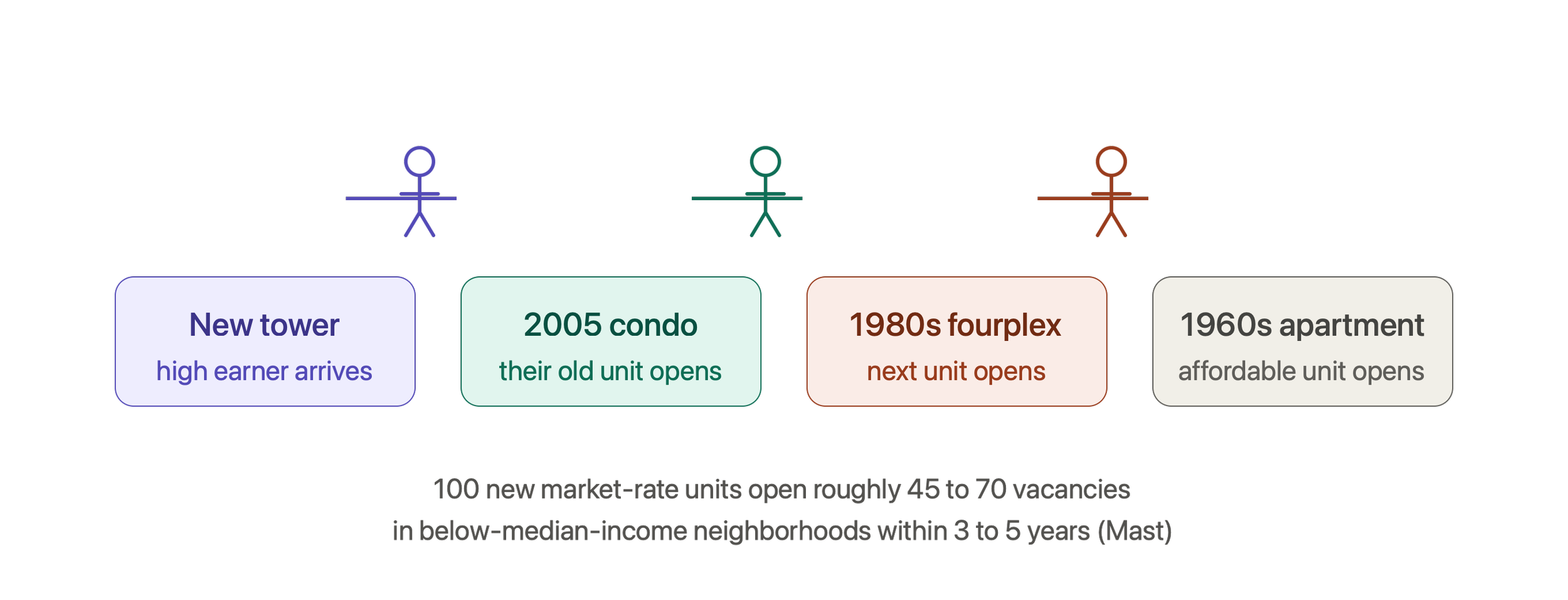
Because of a machine called filtering. Housing depreciates like a very slow car — today's rooftop-deck tower is 2075's naturally affordable complex. And it has a fast mode: moving chains. Every high-earner absorbed by a new tower vacates an older unit, which someone else grabs, vacating theirs. Economist Evan Mast tracked actual movers: 100 new market-rate units open 45–70 vacancies in below-median-income neighborhoods within five years. The tower is a magnet pulling rich renters out of the used-housing market so they stop outbidding your barista for a 1980s fourplex.
Here's the catch
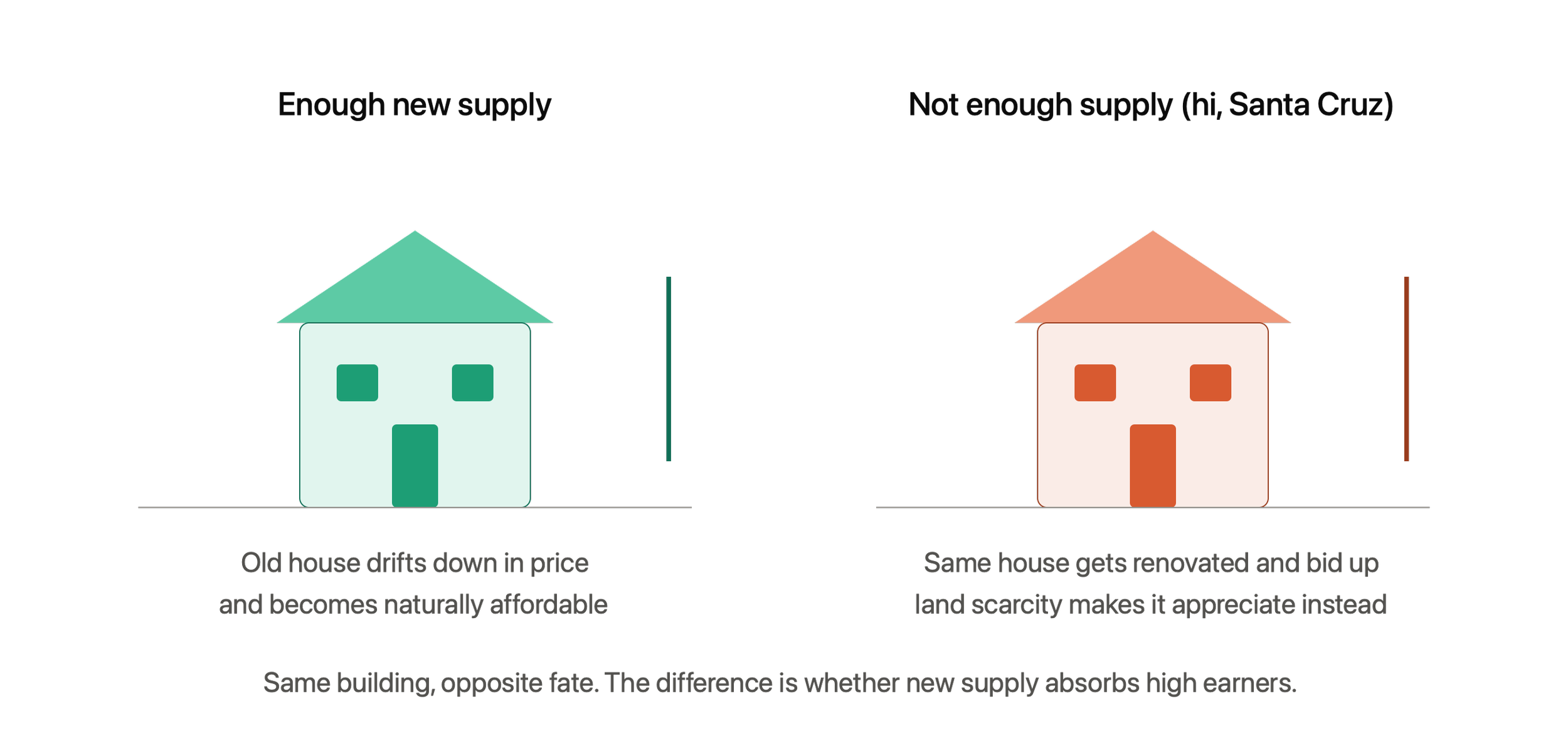
The machine runs in reverse when you starve it. Block new construction for decades and high earners don't leave; they buy the old bungalow that was supposed to filter down, renovate it, and flip "cheap old house" into "$1.5M coastal farmhouse." Santa Cruz has been running this experiment since bell-bottoms were new.
"But the storefronts are empty — nobody actually lives in these buildings!"
Nope: Anton Pacific hit ~85% leased in year one, and retail always lags residents by a few years (restaurants sign leases after the foot traffic exists, not on faith). Dark windows measure the economics of retail in 2026, not the humans upstairs.
The takeaway: market-rate towers and deed-restricted units aren't rivals — they're a two-part system. New supply absorbs high earners today; subsidized units protect the people who can't wait fifty years for a building to age into affordability. Run only one, and the other fails. Run both, and Santa Cruz might finally look like a town where the people who work here can live here.
Related Articles
Santa Cruz Gets the Jump on Affordable Housing — Bonnie Lipscomb on the ~1,400 units coming downtown and why the city is targeting the hardest-to-build income tiers.
City of Santa Cruz Earns ProHousing Designation — How density bonuses, taller downtown buildings, and streamlined approvals put Santa Cruz ahead of its state housing mandates.
New Tech Returns With Fresh Ideas at River Row — The riverfront building at the center of this story, hosting the community it was built for.
Part 3: Santa Cruz's Crisis Is Unique — Why our small market ranks among the least affordable in America, and how out-of-town buyers bid up the old housing stock.