Joby and Toyota Launch Initial Phase of a Strategic Manufacturing Alliance to Mobilize Air Mobility for All
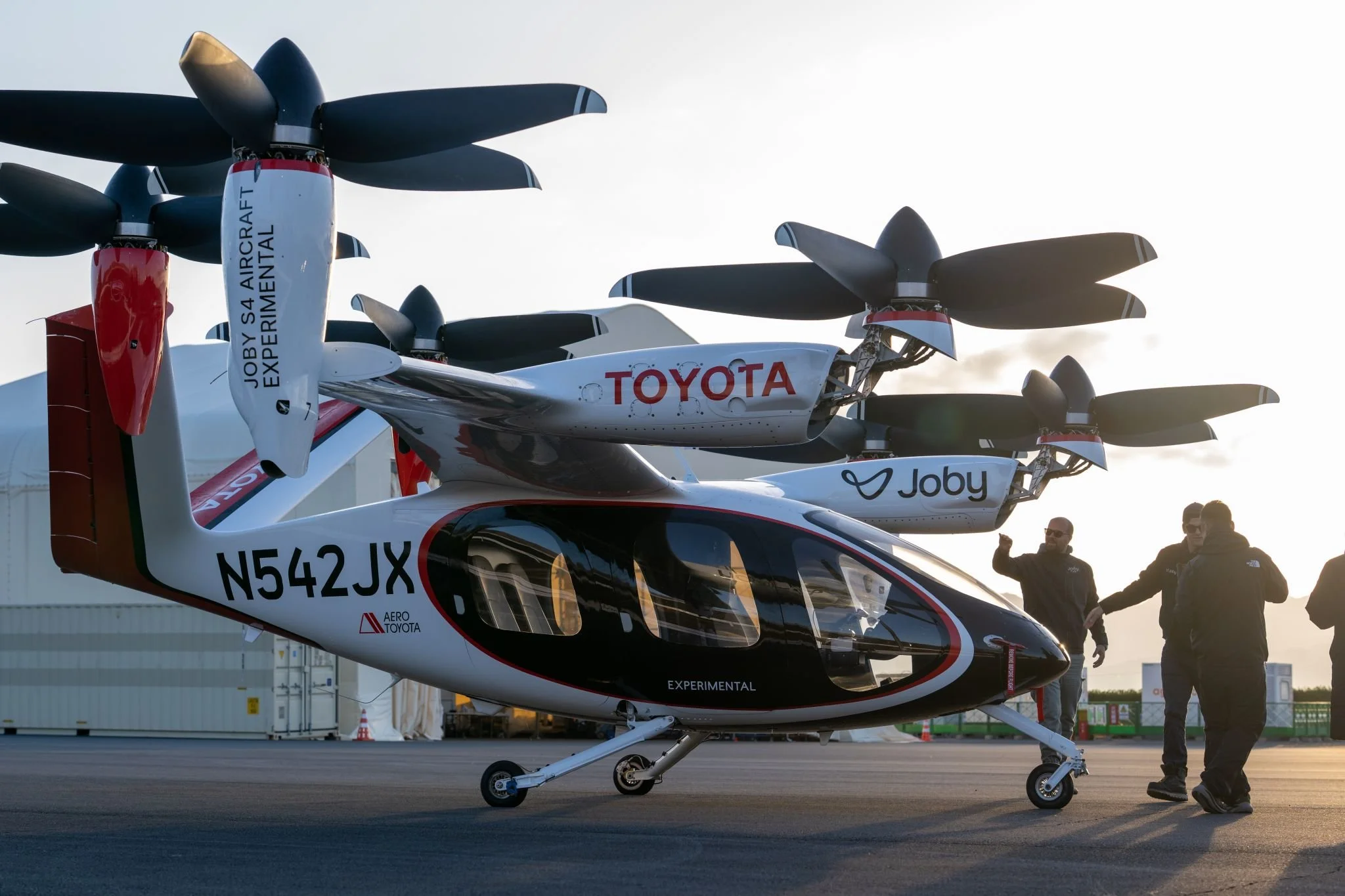
Joby Aviation (NYSE: JOBY) and Toyota Motor Corporation today announced an exciting new chapter in their nearly decade-long partnership: a Joint Venture combining Joby's groundbreaking electric aviation technology with Toyota's world-class manufacturing expertise.
The new venture will lay the groundwork for commercial production of Joby's electric vertical take-off and landing (eVTOL) aircraft, driving improvements in productivity, quality, and cost, and scaling capacity to meet surging demand as certification nears.
"Toyota has been by Joby's side for nearly a decade, providing invaluable guidance and support as we built the foundation for manufacturing our aircraft," said JoeBen Bevirt, founder and CEO of Joby Aviation. "Today's announcement reflects the strength of our relationship and our shared confidence in the opportunity ahead. Together, we share a vision of making aerial mobility an everyday reality, and we look forward to delivering on that promise together."
Akio Toyoda, Chairman of Toyota Motor Corporation, commented: "Since our founding, we've been guided by the philosophy of providing mobility for all. Over time, we've continued to expand what mobility can mean. We see air mobility as a natural extension of that philosophy, from the ground into the sky, and as a way to bring new value to people's lives and to society. It's really meaningful for us to take on this challenge together with Joby, a partner that shares the same vision. We believe this strengthened relationship is an important step forward in realizing the future mobility society."
Going forward, the two companies will work closely together through this Joint Venture, leveraging their respective strengths to bring air mobility to society on a broader scale.
Why it's significant
The headline isn't another Toyota check — it's a change in the kind of relationship. Toyota has been an investor and advisor to Joby for almost a decade, putting in roughly $894 million to support production. Today they converted that into an actual joint venture for manufacturing. As one analysis put it, a formal joint venture is a materially different commitment than prior investment rounds, moving Toyota from investor to manufacturing partner.
The deeper signal is what problem this targets. Joby has largely de-risked the flying part — piloted point-to-point flights in Dubai and across U.S. cities, FAA certification in its final stretch. The open question now is whether anyone can build these things at scale and at cost. The JV is explicitly aimed there: scaling eVTOL manufacturing—not flight technology—is now the critical path to commercialisation, and Toyota's lean production system is the most proven answer in the world to that problem. So the update is essentially Joby saying the bottleneck has shifted from engineering to industrialization, and bringing in the company that wrote the book on industrialization.
One caveat worth flagging for your own read: the entity, named the Joby Toyota Aero Manufacturing Preparation Company (JTAMPC), is more fleshed out than a typical "framework" announcement. An SEC filing confirms Toyota will hold 51% of the venture to Joby's 49%, with a five-member board split three seats to Toyota and two to Joby. Initial cash contributions on both sides are small — just under $1 million each — with larger capital commitments tied to future funding and certification milestones rather than disclosed upfront. The parties still need to negotiate the actual manufacturing supply agreement and finalize IP-licensing terms, so the commercial mechanics (who pays for what, on what schedule) aren't locked in yet. It's a real joint venture with real governance, in other words, but the production-scale financial commitments are still being built out.
Impact on U.S. production
This should reinforce, not relocate, the U.S. footprint. Toyota's framing is production systems expertise — embedding its people in Joby's existing lines rather than moving work abroad. Toyota engineers were already deeply integrated with the Joby team, advising on custom tooling to accelerate production; the JV formalizes and scales that.
Joby's U.S. manufacturing network is the thing being optimized: the expanded Marina, CA plant (~435,500 sq ft) that is expected to be able to produce up to 24 aircraft/year and holds its initial FAA production certification; Santa Cruz HQ for system architecture; San Carlos for powertrain; and the Ohio operation, where Joby began producing propeller blades at its current Dayton, Ohio, location in October and in January 2026 added a second Ohio facility — more than 700,000 square feet in the Dayton area — to support its plan to double aircraft production to four per month in 2027, with long-term capacity for up to 500 aircraft per year.
That's the gap the JV is meant to close: getting from roughly one aircraft every other week toward four a month and eventually hundreds a year is a Toyota-Production-System problem, not an aerospace-engineering one. The political framing around it is also notable — Joby is leaning hard into a "build it in America" / Dayton reindustrialization narrative, tied to the start of propeller blade production in Ohio and defense-aerospace ambitions. So if anything, the JV likely deepens the U.S. base rather than offshoring it.
Related Articles
Joby Receives CalCompetes Grant to Support California Facility Expansion and 690 New Jobs — A $9.8M state grant backing Joby's Marina factory expansion and hundreds of local clean-manufacturing jobs, the homegrown production base this Toyota alliance is built to scale.
The Central Coast Is Playing a Long Game. Most Regions Don't. — How Joby, DART, UCSC, and Hartnell are quietly assembling a full advanced-air-mobility ecosystem of aircraft, corridors, and workforce that most regions are too fragmented to pull off.
DART Awarded CA Jobs First – Uplift Central Coast Catalyst Grant — State funding for regional vertiport planning, a Joby aircraft-maintenance apprenticeship, and the LIFT Summit, building the operational infrastructure that commercial eVTOL service will run on.
CNBC: How Joby & Delta Are Making Flying Taxis a Reality — An inside look at Joby's dual ambition to both build eVTOLs and operate an Uber-like air-taxi service, framing the production-scaling challenge this manufacturing alliance is meant to solve.
Monterey Bay DART and Hartnell College Launch Drone and Aerospace Program — A two-year, Irvine-funded initiative connecting Central Coast residents, including veterans and first-generation students, to FAA-certified aviation careers alongside Joby.