The Half You Weren't Told About
Life's second half arrives without ceremony — and the strategies that built your first half will quietly sabotage it. Drawing on Jung, Rohr, and one business owner's discovery of "eternity," this is the case for trading achievement for attention, role for soul.
There is a fact about your life that no one is eager to tell you, and it is this: at some point, quietly and without ceremony, its second half begins. No letter arrives. Nothing changes on the calendar. And yet everything relevant to your happiness has changed — because the strategies that built your life will now, if you keep applying them, begin to unbuild it.
Bill and Dave at Fully Alive by Design put their finger on the problem in a recent piece, drawing on Jung's famous warning that we enter the afternoon of life "thoroughly unprepared." What was true in the morning, Jung said, becomes a lie by evening. This is not poetry. It is a description of a genuine error most of us are making in real time.
Consider what the first half of life demands. You must construct a self — a career, a reputation, a family, a set of accomplishments you can point to. Richard Rohr calls this building your container. It is necessary work, and there's nothing wrong with it. The mistake is failing to notice when the work is finished. The signals are unambiguous: your body has passed its peak; you have more answers than questions; winning no longer produces the feeling it once did. And what do most of us do when we receive these signals? We accelerate. We optimize harder. We attempt to outrun what is not, in fact, a decline at all — but a change in the nature of the game.
The game-theoretic framing is useful here. The first half of life is a finite game: fixed rules, clear victory conditions. The second half is an infinite game, where the point is not to win but to keep playing — to actually inhabit the moments of which a life is made. Ram Dass compressed the whole transition into three words: from role to soul.
The newsletter offers a case study I found clarifying precisely because it is so ordinary. Trey, a business owner in his fifties — four kids, testing trucks to schedule, eggs to buy on the way home — describes himself as "doing eternity all the time now." What he means is that he has stopped arguing with the life he built. He accepted it — successes, losses, compromises, all of it — and that acceptance freed his attention for the only life that actually exists: the one happening now.
This is the crucial insight, and it is worth stating plainly. The past is a memory, arising now. The future is a thought, arising now. If you are perpetually leaning into the next achievement, you are missing the only thing you actually have. Trey's discovery — that the second half is about getting more out of your life rather than cramming more into it — is simply what it looks like to notice this.
Bill and Dave close with an exercise: fifteen minutes, one question. What am I becoming in this season of life? Not doing. Becoming. It is worth taking seriously — because the people who stumble through midlife are, almost without exception, the ones who never stopped to ask what season they were in.
The reality of your life is always now. The second half is where you finally get to live like you know it.
Related Articles
Meaning Isn't the Prize at the End. It's the Moment You're Actually In. — Dave Evans on Guy Kawasaki's Remarkable People podcast, unpacking the transactional world versus the flow world — the same "eternity" Trey is living in.
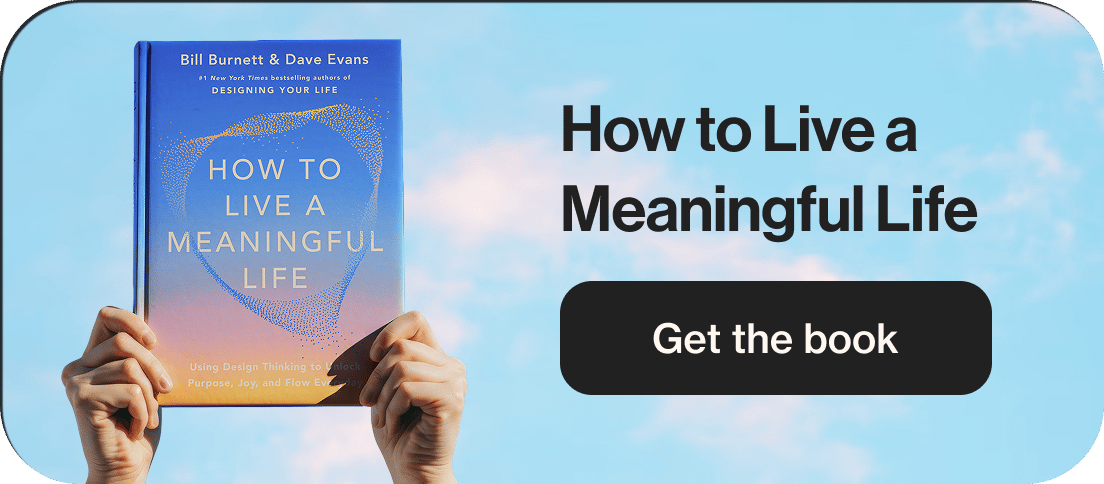
Dave Evans and Bill Burnett's Newest Book "How to Live a Meaningful Life" Coming Soon — The book behind the newsletter: why fulfillment is a dead end, and how wonder, coherency, flow, and community offer a more reliable path to meaning.
Dave Evans & Dean Hovey on Re-Designing Design Thinking — Evans and IDEO co-founder Dean Hovey on design thinking's evolution and its application to wicked, humanity-sized problems — like designing a life.
What We're Reading: Santa Cruz Works Launches a Recommended Books Section — SCW's new curated reading list, featuring Burnett and Evans' How to Live a Meaningful Life alongside titles on hospitality, grit, and what comes next.
CruzHacks 2026 — After eleven years, Doug Erickson steps down as CruzHacks Chairman — a firsthand look at pouring the container you built back into the community.