

Could the Monterey Bay Region Support a Data Center?
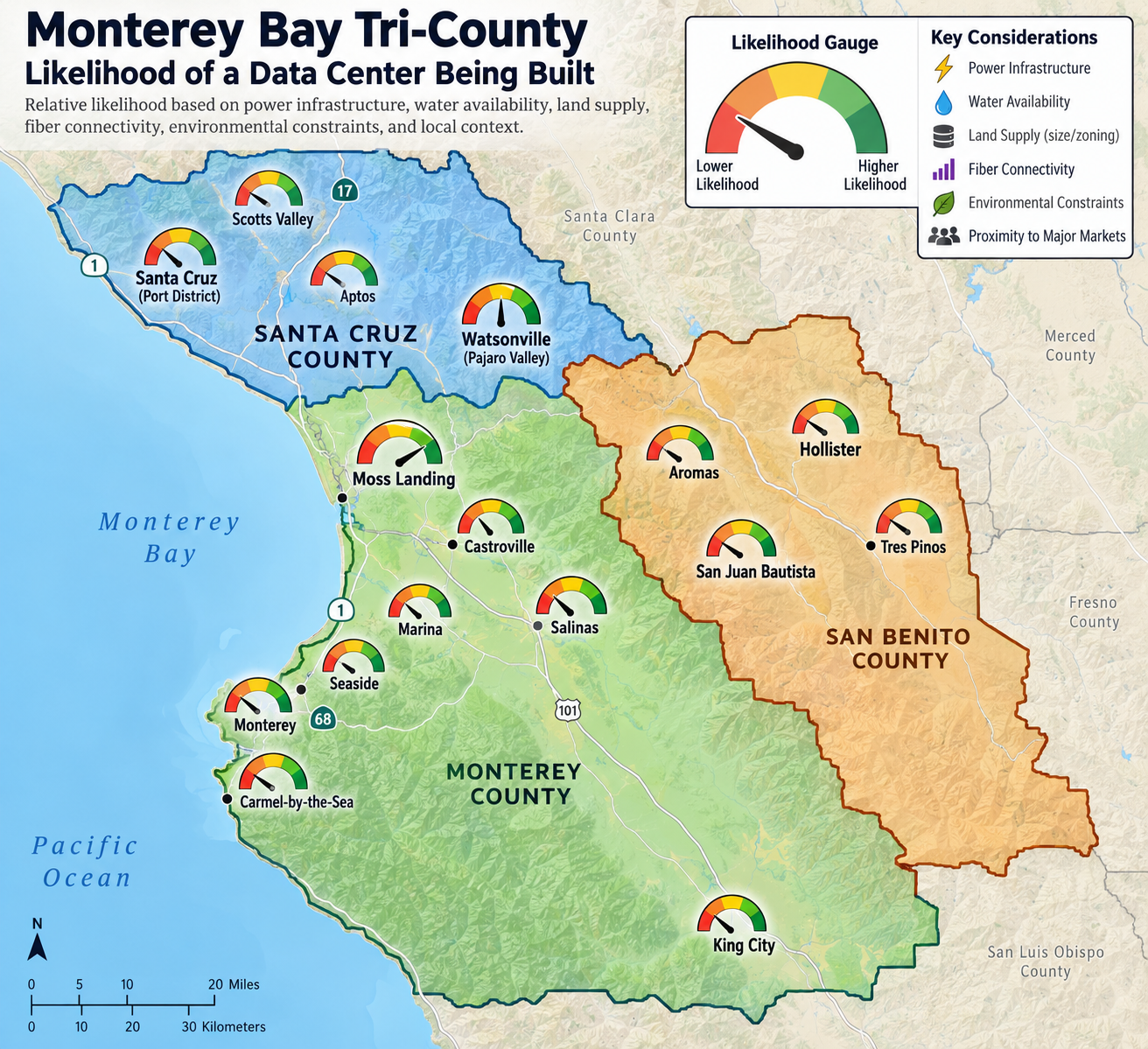
Data centers are becoming a midterm battleground. In the tri-county region, they're a political flytrap: the economics don't work, and our communities' collective will makes them a nonstarter from the start.
Five weeks out from the midterms, a strange thing has happened in American politics. Data centers, the least glamorous buildings in the economy, have become a campaign issue. Republicans and Democrats running ads from Georgia to Iowa are targeting the same opponent: the data centers powering the AI boom. Ad mentions climbed from a handful in January to roughly 164 in August. And the anxiety behind them is real: a June Reuters/Ipsos poll found 77% of Americans worried about data centers driving up electricity costs, with two-thirds of Democrats and half of Republicans saying they'd oppose one in their own community.
It's rare to find an issue where the left and right land in the same place. This is one of them. Which means you should expect candidates here to talk about it too.
So it's worth asking the question plainly, with the rhetoric set aside: could a data center actually be built in Santa Cruz, Monterey or San Benito County?
Start With the Binding Constraint
To understand any data center, you start with electricity. A modest facility might need 10 to 50 megawatts. The large AI campuses being proposed now need hundreds, and some are measured in gigawatts.
So the real question isn't whether we have land. It's where PG&E can deliver that much power, at what price and by what year. Most of our tri-county grid wasn't built for loads like that. Moss Landing is the exception; its history as a generation hub left serious high-voltage transmission in place. But transmission isn't the same as available power, and PG&E and CAISO would still have to decide what could be added and what upgrades it would take.
Then the Physical World Pushes Back
Data centers turn electricity into heat, and the heat has to go somewhere. Some cooling approaches consume a lot of water. In a region where water is already contested, any proposal leaning on potable supply arrives in trouble.
Land is the next filter. You need a large parcel near transmission, fiber and highways. Then subtract wildfire risk, flood zones, seismic hazards, wetlands, habitat, farmland and neighbors. The map shrinks fast. Santa Cruz is short on industrial land. San Benito has acreage but lacks the power and fiber. Monterey has the best options, and the most coastal, agricultural and environmental constraints.
On the economics alone, the case is weak.
The Constraint That Ends the Conversation
But here's what I think matters most, and it's the part that rarely gets said directly. You can design a cooling system. You can build a substation. You can lay fiber. What you cannot build is consent.
And in our region, consent isn't merely uncertain. It's absent. These are communities that have spent decades choosing, again and again, to protect coastlines, water, farmland and the public's right to weigh in. Large projects in Santa Cruz County go through discretionary review and public hearings. Moss Landing, the one place that looks plausible on paper, is still living with the memory of the January 2025 battery-storage fire. A proposal there wouldn't face scrutiny so much as a wall.
That's not NIMBYism in the dismissive sense. It's the collective will of the people who live here, expressed consistently over a long time. And when that will is this clear, it isn't one factor among many. It's a full stop.
Which Is Why the Campaign Talk Rings Hollow
This is where the midterm politics gets strange in our corner of California. When a candidate here vows to stand between voters and the data centers, ask: which data centers? None are coming. The economics don't support one, and the public would never permit one.
Promising to block something that was never going to happen is the easiest promise in politics. It's a voter flytrap: an issue designed to catch anxiety that, nationally, is earned, and redirect it toward a threat that, locally, doesn't exist. The real local questions, like electricity rates, water supply and what kind of economy we're building, deserve more than borrowed outrage.
So What Is Our Advantage?
Developers will go where power is plentiful, land is cheap, water isn't a fight and communities are recruiting. That's not us, and we shouldn't pretend otherwise in either direction.
But a region's constraints tell you something about its strengths. Ours was never going to be cheap megawatts or empty acreage. It's a research university, ocean science, biotech, air mobility and a dense network of people who know how to turn new tools into companies.
Maybe our advantages and resources are not about storing intelligence. It's creating what people do with it.
Related Articles
Santa Cruz Accelerates Announces AI Infrastructure Partner — How Runpod's GPU compute credits let SCW accelerator founders build with AI without owning the hardware.
Santa Cruz AINative Studio: Built for Builders, From the Ground Up — A local startup building AI infrastructure since 2025 with no venture money and a small team shipping fast.
Workbench – Building Our Community: Interview on KSQD 90.7FM — A Santa Cruz builder on why more housing is getting built in the county and how to keep it going.