

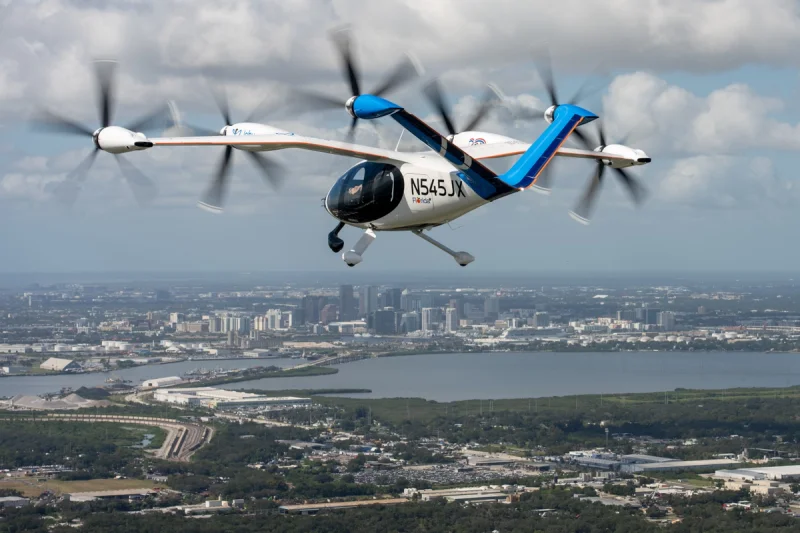
Joby's military logistics work solves real problems, like rushing a spare part to an isolated airfield. As its defense business grows, Santa Cruz deserves plain answers about which missions Joby will serve and where it'll say no.
Some people in Santa Cruz believe no local company should work with the U.S. military. I understand the concern. A company can begin by moving supplies and eventually help develop systems for combat. Once military work becomes a significant source of revenue, it can influence what the company builds and which customers it listens to. Populism had a strong showing in this month’s midterms, but voters also signaled that playing on fear isn’t productive. So let’s look at the facts. I still think there’s a case for Joby’s logistics work, and making it means examining what the technology does, who benefits, and what limits Joby is willing to set.
Start with the scale of the business. In the first nine months of 2026, 94% of Joby's reported revenue came from passenger transportation, primarily through Blade's helicopter and fixed-wing services. Military flight services made up an undisclosed portion of the remaining 6%, which also included engineering and rental income. Joby's pending $500 million acquisition of Resonant Sciences, an established defense supplier, is expected to close in early 2027 and could change that mix considerably. The revenue figures tell us where the business stood in 2026. The acquisition tells us where Joby sees room to grow.
The clearest case for Joby's military work starts with a small shipment that can't wait. In a 2024 Air Force exercise, a Cessna Caravan equipped with Joby's autonomy software carried replacement parts between military bases and public airports, with a safety pilot aboard. In a 2025 Pacific exercise, Joby tested inter-island resupply in Hawaii with crews supervising flights from Guam. Consider an airfield waiting on a single part. A smaller cargo aircraft could make that delivery and free up a larger transport for a load that needs the capacity. That's a practical problem worth solving.
Ukraine shows why the ability to move a small shipment quickly can matter. In October 2026, Ukraine's government announced a pilot program using drones to carry medicines, medical devices, blood samples, and donor organs between hospitals, including in remote areas. Think about what that means for a hospital waiting on a lab result or a transplant team waiting for an organ. When wartime road conditions slow a trip, a flight could save time that matters to the patient. Ukraine's program gives us a concrete example of the need. I found no public evidence that Joby is involved.
Then there's the question of moving people. The European Union coordinates transfers of Ukrainian patients who need urgent treatment to hospitals across Europe. A patient may need monitoring and care throughout the trip, so evacuation calls for a suitably equipped aircraft and trained personnel. Joby's exercises demonstrate capabilities relevant to medical resupply. Patient evacuation would require its own testing. Ukraine's airspace is also closed to civil aviation, so any proposal to fly a civilian aircraft inside the country would face serious operational constraints.
The Ukraine example doesn't settle the hardest question here at home. A flight carrying replacement parts can help a military unit return to combat. That consequence matters even when the aircraft carries ordinary cargo. Joby and L3Harris are also collaborating on an optionally piloted hybrid aircraft designed to team with crewed military aircraft, with L3Harris contributing sensors, communications, and "effectors," a defense term that can include weapons. As Joby pursues those applications, I'd like the company to say whether it would support weapons integration or targeting, which decisions it would require a human to make, and who inside the company can turn down a proposed use. Joby can explain those principles publicly while keeping sensitive contract details confidential.
My view is that a Santa Cruz company can do valuable work with the military, and its neighbors can ask hard questions about that work. I support developing aircraft and software that can get an urgent shipment to an isolated airfield or help a hospital receive supplies in time. I'd also like Joby to tell us more about what the defense expansion will mean for the people doing the engineering, flight testing, and manufacturing here. Those are decisions with consequences for our community. As Joby grows its defense business, I want to hear from the company, in plain language, which missions it's prepared to serve and where it would say no.
Joby’s Q3 2026 Financial Results
Joby posted Q3 2026 revenue of $55.1 million, up 144% year over year and well above estimates. Nearly all of it came from Blade, which flew a record 44,000+ passengers. Joby raised full-year guidance for the third time, to $135–140 million, though Q4 typically dips seasonally. Net loss narrowed to $212 million from $245 million, and Joby ended the quarter with $2.2 billion in cash. Certification advanced through FAA "for credit" testing, and 17 aircraft are in production, but passenger flights have slipped to 2027. Defense work is expanding: Air Force contracts reached about $37 million, and the Resonant acquisition should close in early 2027.
Related Articles
Joby Aviation to Acquire Resonant Sciences To Expand Its Defense Business — The $500 million deal that would give Joby a dedicated defense arm.
Joby Expands Autonomous Flight Contracts with U.S. Air Force to Nearly $37 Million — New Air Force funding shows how fast Joby's military autonomy work is growing.
Joby Completes First-Ever Fully Autonomous Flight Across the United States — The same Caravan autonomy stack crossed 3,199 miles with no pilot input.
Joby's Turbine Electric Demonstrator Aircraft Completes First Flight — The hybrid VTOL platform behind Joby's military "wingman" ambitions.