

Daniela Amodei and the Return of the Humanities
The Silicon Valley Myth: Builders Equal Coders
Silicon Valley loves a simple hero story: the people who shape the future are the builders, and “builders” means engineers. Everyone else is supporting cast. If you studied literature, history, philosophy, languages, you learned to describe the world, not change it.
That story has always been convenient. It is also increasingly wrong.
Daniela Amodei’s Counterintuitive Thesis
Daniela Amodei, a UC Santa Cruz alum and co-founder and president of Anthropic, went on ABC News and offered a framing that cuts against the grain of tech culture: as AI gets more capable, the most valuable skills will be the ones that make us recognizably human. Less emphasis on coding as the singular credential. More emphasis on communication, empathy, and judgment.
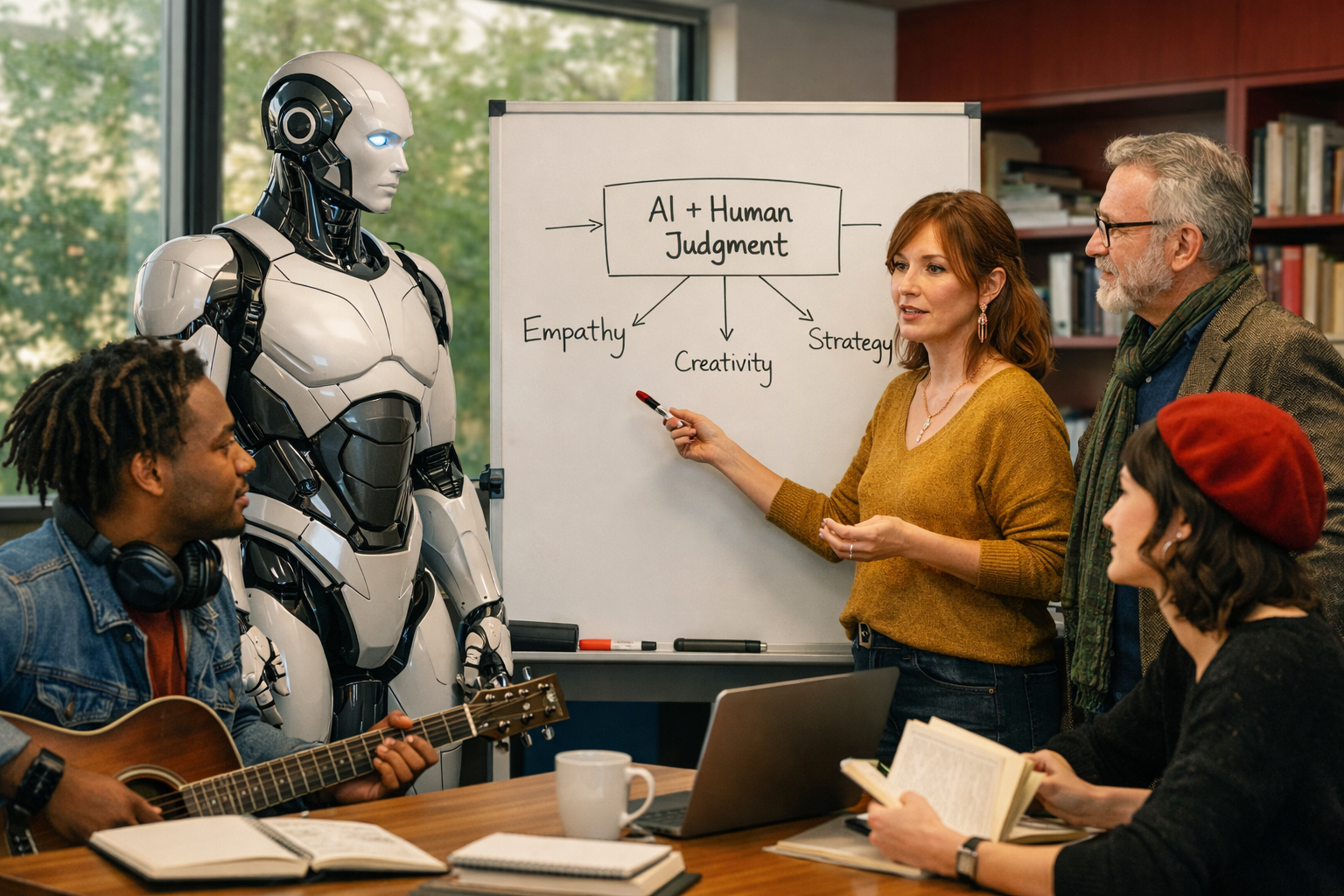
In a moment when AI is routinely described as a replacement engine, she’s describing it as a multiplier. The number of jobs AI can do without people, she argues, is “vanishingly small.” The future is not humans versus machines, but humans plus machines, ideally creating higher-productivity work and better outcomes.
A UCSC Humanities Grad’s View From Inside Tech
I’m Doug Erickson, the author of this blog, and I was an English and Latin Literature major at UC Santa Cruz. Over a 38-year career in tech, I’ve held onto a belief that has only gotten more obvious with time: startups are not just coders.
They’re people trying to build something fragile under pressure, with incomplete information, tight timelines, and real emotional stakes. Code matters, but it’s rarely the whole problem, and often not the hardest one. That’s why in every hackathon I’ve hosted, CruzHacks, SugarHacks, and the rest, I push teams to look beyond pure engineering: include builders who can shape the story, understand users, design the experience, market the idea, and make the team function.
When Execution Gets Cheap, Alignment Gets Expensive
AI changes what’s scarce.
When technical execution becomes faster and more accessible, the bottleneck shifts to what organizations chronically underinvest in: alignment. The hard part becomes deciding what to build, communicating it clearly, coordinating a team to move in the same direction, and doing all of that while reality keeps changing.
In that world, “builder” starts to mean something bigger than “person who can ship code.” It means person who can ship clarity.
Interpretation as a Core Technology
This is where the humanities stop being a nice-to-have and start looking like infrastructure.
Humanities training is basically structured practice in interpretation: reading subtext, tracing incentives, recognizing contradictions, holding multiple meanings at once, and understanding how people behave when they’re afraid, ambitious, cornered, or inspired. Those are not decorative skills in a high-velocity environment. They’re navigation tools.
AI can generate options. Humans still have to choose.
Culture Is the First Product
Anyone who has lived inside an early-stage company knows the secret: the first product is not the codebase. It’s the team.
Can you disagree without splintering? Can you give and receive feedback without performing politics? Can you talk to customers without hearing only what you want to hear? Can you build trust quickly, repair it when it breaks, and keep momentum when morale dips?
These are not “soft skills.” They are the load-bearing beams of execution. The most important architecture in a startup is often communication: how decisions get made, how truth travels, how accountability works, how people feel safe enough to be honest before things get expensive.
EQ as Governance
Amodei’s hiring lens at Anthropic reflects that reality. She’s emphasized great communicators with strong EQ, kindness, compassion, curiosity, and a desire to help others.
That is not corporate wellness fluff. Those traits are governance. When you’re building systems that will increasingly mediate education, work, healthcare, and relationships, you want people who can think clearly about consequences, communicate under stress, and treat other humans like they are real.
Intelligence Everywhere, Wisdom Scarce
We’re entering an era where intelligence is increasingly cheap and available. The question is what we’ll do with it.
If Amodei is right, the humanities aren’t a refuge from the AI age. They’re part of the operating system that keeps it livable.