

Why That Earthquake Woke You Up (And Why Your Brain Refused to Go Back to Sleep)
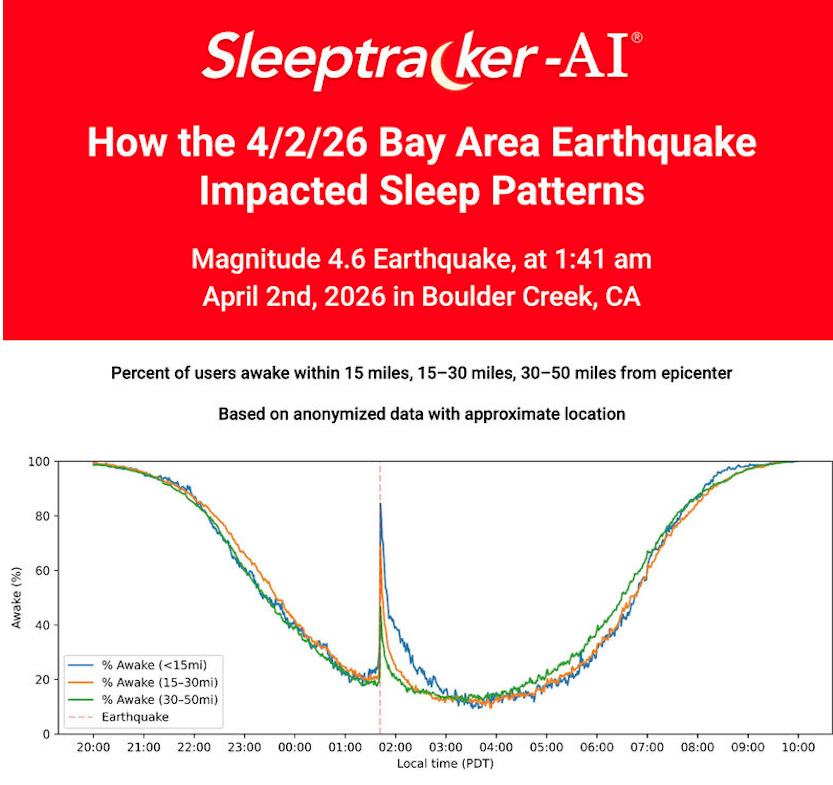
Based on thousands of sleep recordings from our database of 250,000,000+ nights of fully anonymized sleep data, no PIl. © Copyright 2005-2026 Fullpower® Technologies. All rights reserved.
So here's a thing that happened.
On April 2nd, at 1:41 in the morning, the ground near Boulder Creek decided to just... do that thing it does sometimes. You know. Move. Violently. Without asking anyone's permission first.
And somewhere in the region, thousands of people who had been peacefully unconscious — drooling on their pillows, locked in dreams about whatever weird stuff human brains cook up at 1am — suddenly weren't anymore.
All at once.
Which, if you think about it for a second, is actually kind of amazing. So does Philippe Kahn, CEO of Fullpower-AI Inc.
The World's Worst Alarm Clock (A Brief Detour)
Imagine you designed an alarm clock that:
Gave absolutely zero warning before going off
Affected every single person within a 50-mile radius simultaneously
Made the floor shake
Left people lying awake staring at the ceiling for hours afterward
You would be fired. Possibly sued. Definitely not invited to CES.
And yet! Mother Nature has been shipping this product for 4.5 billion years, completely unconcerned with user experience.
What the Data Actually Showed
Here's where it gets interesting.
The folks at Fullpower's Sleeptracker-AI platform were sitting on sleep data from a huge swath of the region that night, and they did what any good scientist would do when nature accidentally runs an experiment for them: they looked at it really, really carefully.
Finding #1: Nobody saw it coming.
And I mean nobody. Not consciously, obviously — but the interesting question was whether human bodies might have some subconscious seismic spidey-sense. Like, do heart rates tick up slightly before a quake? Do people start tossing and turning?
The answer, it turns out, is a hard no. The data before the quake looked completely normal. Flat. Boring. The signal didn't exist.
This is either comforting (your body isn't secretly stressed about earthquakes all the time) or mildly disappointing (we don't have secret earthquake superpowers), depending on your outlook.
Finding #2: Everyone woke up at exactly 1:41 a.m.
Like, everyone. The synchronized wakefulness spike across the region was essentially instantaneous. One moment: asleep. Next moment: extremely, collectively awake.
Picture a giant map of the Bay Area, with little sleep-indicator dots slowly pulsing like a calm heartbeat. Then — blink— every single dot flips on simultaneously.
It looks like someone hit a switch. Because someone did. It's just that the "someone" was a tectonic plate and the "switch" was a fault line releasing decades of accumulated stress in about three seconds.
Finding #3: The closer you were, the longer you lay there suffering.
This is the part that's genuinely fascinating.
It wasn't just that people woke up — it's that they couldn't go back to sleep. And the duration of that miserable ceiling-staring phase was directly proportional to how close they were to the epicenter.
Far from the quake? Maybe 10 minutes of grogginess before drifting off again.
Close to the epicenter? You were in for a significantly longer, darker journey.
What's Actually Happening in Your Brain (A Slightly Technical Detour Your Brain Won't Let You Skip)
Here's the thing about your nervous system: it has a department called the Sympathetic Nervous System, and that department has one job. One job.
DANGER DANGER DANGER.
When the earthquake hits, the SNS absolutely loses its mind. It floods your body with stress hormones, jacks up your heart rate, and essentially screams "SOMETHING IS HAPPENING, WE NEED TO BE AWAKE AND ALERT AND READY TO RUN FROM THE THING."
This is great if the thing is a predator.
It is less great if the thing was a 4-second seismic event that is already over.
Because here's the problem: your SNS doesn't have an "okay, we're good now" button. It just gradually... winds down. And how long that takes depends largely on how loud it was screaming in the first place. If the shaking was intense — if your house was moving, if things fell off shelves, if your lizard brain genuinely believed for a moment that the world was ending — it's going to take a long time to calm back down.
This is what the researchers called a physiological "echo." The earthquake lasts seconds. The nervous system's reaction to the earthquake lasts... considerably longer.
The Takeaway (In Case You Skimmed Everything Above)
Earthquakes are a perfect natural experiment in sleep science because they're essentially a universal, involuntary, synchronized "WAKE UP" button pushed on an entire population at once.
What the data shows us is this:
Your body gives you zero warning before a quake. You do not have seismic intuition. Sorry.
The wakeup is instantaneous and universal — everyone in the region flips from asleep to awake at the same moment, which is wild.
The recovery time is a function of distance. The more intensely your nervous system was activated, the longer it takes to calm back down and let you sleep again.
In other words: the earthquake doesn't just wake you up. It leaves a residue. A physiological hangover that your poor, confused nervous system has to metabolize before it'll let you rest again.
Which means if you were lying in bed that night, unable to sleep, heart pounding, brain spinning up increasingly catastrophic scenarios about The Big One™ —
That wasn't anxiety.
That was science.
You were fine. Your nervous system was just doing its job.
Go back to sleep.
Related Articles
The Cosmic Journey of Philippe Kahn — A $25M Series C, a 10-year global deal with Tempur Sealy, and 300,000 smart beds already running Fullpower-AI's Sleeptracker platform. Not a bad week for Santa Cruz.
Beyond Hours: Philippe Kahn and the New Science of Sleep Quality — Sleeping 8 hours but still exhausted? Kahn argues the field has been measuring the wrong thing entirely — and that objective data needs to meet subjective experience.
Fullpower Launches the World's Largest Sleep Dataset — The same platform that mapped your earthquake wakeup now powers clinical trials, synthetic data generation, and real-time vitals monitoring at scale.
Portrait of a Titan: Philippe Kahn — From inventing the first camera phone in a Santa Cruz delivery room to 235+ patents in AI, IoT, and biosensing — the origin story of the man behind Fullpower-AI.