

The Air Taxi Wars: Two Stocks, One Throne
Two companies. One sky. And a $1 trillion prize sitting up there with the birds.
Joby Aviation and Archer Aviation are racing to own urban air mobility — the eVTOL market that promises to make your Uber look like a horse-drawn carriage. The pitch is intoxicating: electric aircraft that take off and land vertically, whisking you from Santa Monica to Malibu in eight minutes. The reality, as of Q1 2026, is considerably more pedestrian.
Let's talk numbers. Joby posted $24 million in quarterly revenue. Archer? $1.6 million. Those aren't comparable figures — that's a gap you could fly a Joby aircraft through. Joby's head start is real, boosted in part by its acquisition of Blade, which gave it an actual revenue engine rather than a PowerPoint deck. The company is now guiding toward $105–$115 million for the full year. That's still rounding error against a $10 billion market cap, but it's revenue, which is the difference between a company and a science project.
Archer is the science project, for now. Zero revenue through 2024. $300K in Q4 2025. $1.6 million this quarter. Its Midnight aircraft is working through certification in the UAE — which is either visionary global diversification or evidence that domestic regulators aren't rolling out the welcome mat.
Here's the brutal math neither company can escape: both are burning cash at frightening velocity. Joby bleeds $222 million per quarter. Archer: $181 million. Together that's $1.6 billion annually lighting on fire, chasing a market that doesn't yet exist at scale. The FAA moves at FAA speed. Welcome to the aerospace regulatory machine, where urgency goes to die.
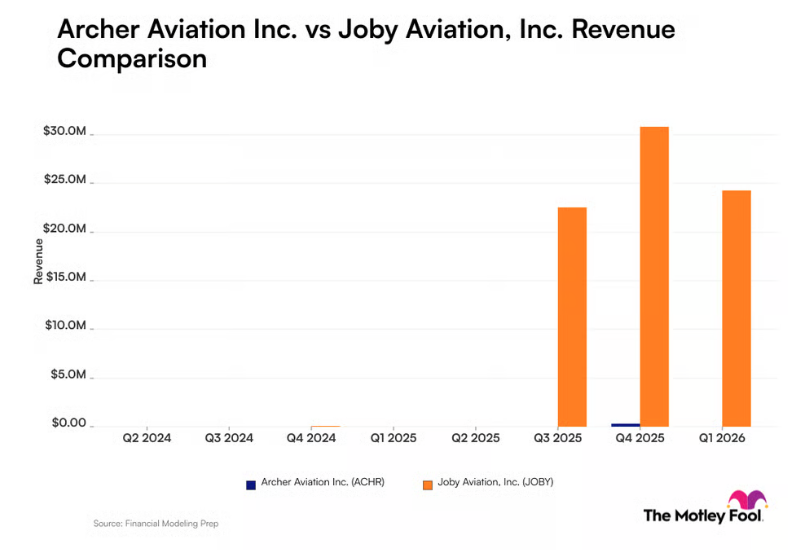
Image source and credit: The Motley Fool.
This isn't a stock pick — it's a bet on which team survives long enough to matter. Joby has the head start. Archer has the architecture argument. One will pull away. The graveyard of transportation moonshots suggests they both might not.
Strap in.
Related Articles
Archer Aviation's $700 Million Cash Burn Is Preventing Its Liftoff — A deep look at why Archer's spending pace remains its biggest obstacle to scaling eVTOL operations.
Should You Buy Archer Aviation Stock While It's Under $7? — An investor's guide to whether ACHR's depressed price represents an entry point or a warning sign.
Prediction: Buying Archer Aviation (ACHR) Stock Today Could Set You Up for Life — The bull case for ACHR as a generational long-term hold in the emerging air taxi market.