

How Open Culture Science Is Rewriting the Future of the Petri Dish
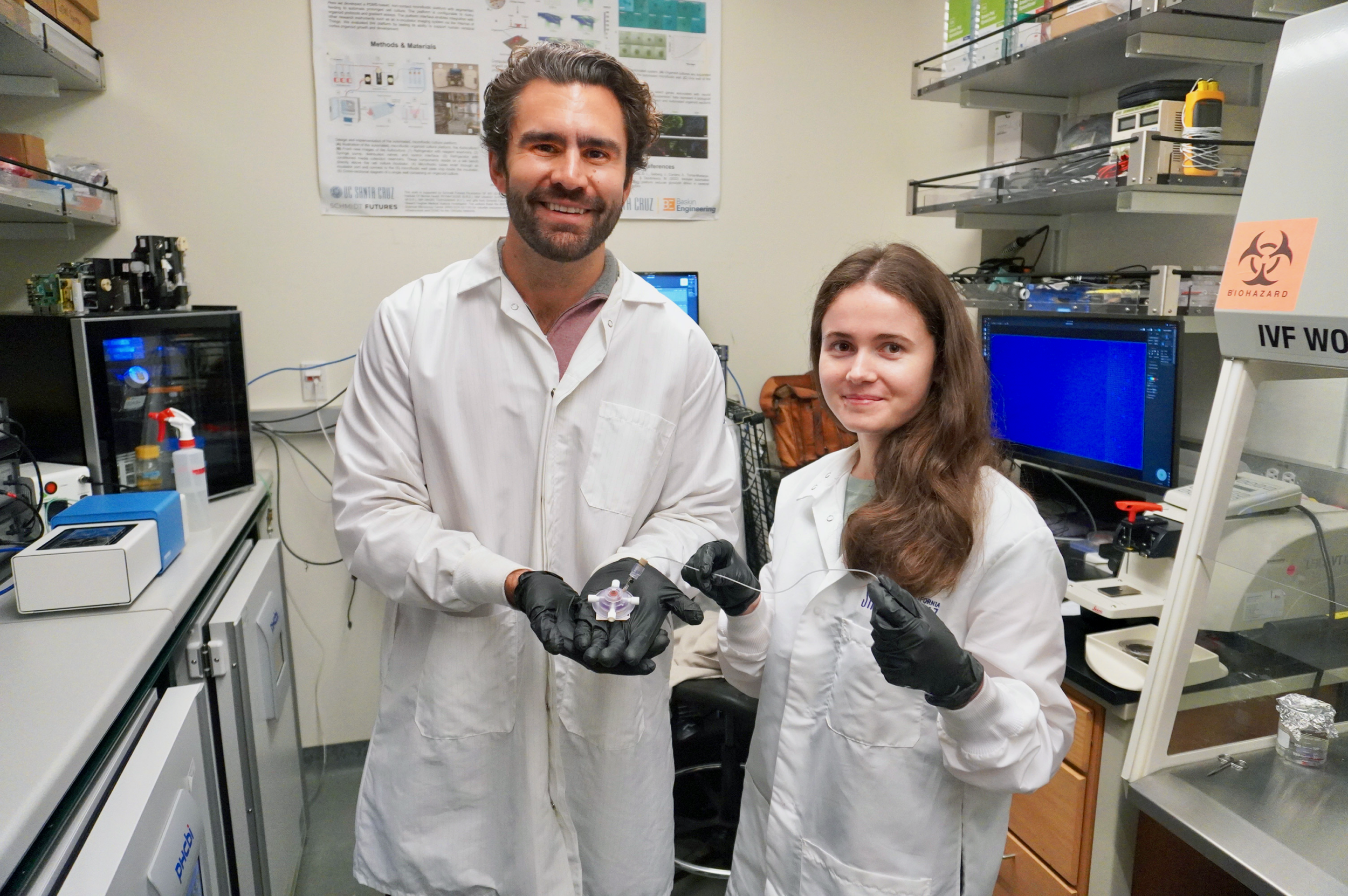
Image Courtesy of UCSC: Spencer Seiler and Kateryna Voitiuk
Open Culture Science, founded by Genomics Institute Ph.D. graduates Spencer Seiler and Kateryna Voitiuk, is reimagining the humble Petri dish. Built on patented technology developed within the UC Santa Cruz Genomics Institute Braingeneers research group, their platform automates the quiet, repetitive labor that keeps cell cultures alive. The founders sometimes describe it as a “Petri Dish 2.0,” less a dish, more a programmable ecosystem, that bypasses the error margins of pipettes and other tedious lab work.
Seiler joined the Braingeneers in 2019, as Voitiuk was transitioning from an undergraduate research assistant to a graduate researcher focused on recording neural activity from organoids. The idea then took shape, organoids are tiny three-dimensional models grown from stem cells that mimic aspects of the developing human brain. These organoids are powerful tools for studying neurological disease, but they are notoriously difficult to maintain.
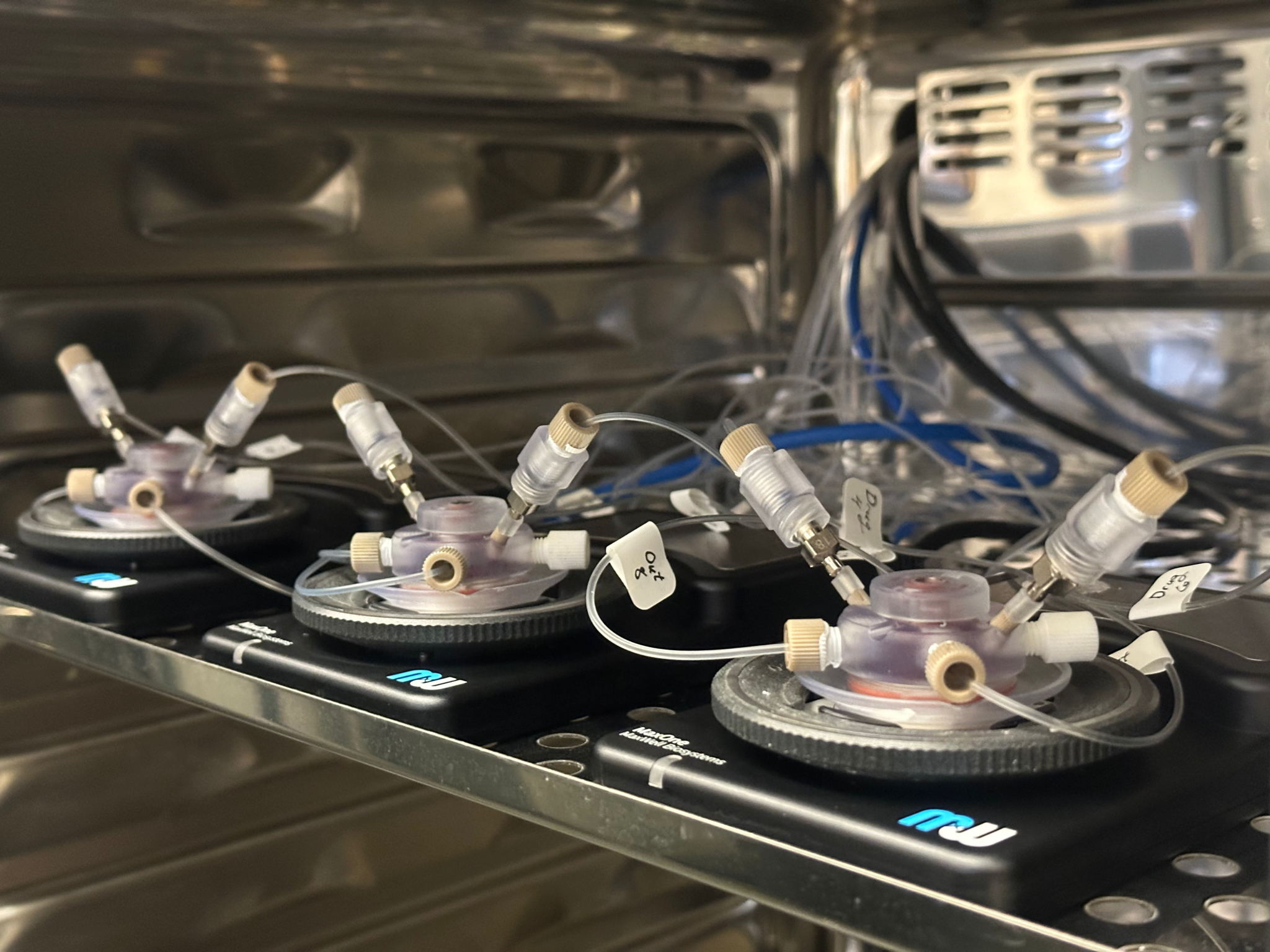
Image courtesy of UCSC: Three single culture chambers in a row inside a cell culture incubator.
Early experiments required constant manual feeding and monitoring, with small mistakes carrying major consequences. Frustrated by the limits of existing equipment, the team began building their own automated systems—devices that could deliver nutrients precisely, monitor conditions, and even coordinate with other lab technologies. In doing so, they began to close the gap between biology and engineering, treating living cells not as unpredictable burdens, but as systems that could be carefully supported.
What emerged was an “Autoculture” platform that not only improved cell health, but also hinted at something larger: the possibility of turning cell culture into a reproducible, shareable process rather than an artisanal practice. After speaking with researchers across the country, Seiler and Voitiuk realized the same bottleneck existed everywhere—labs were limited not by ideas, but by time and labor.
Now based on Santa Cruz’s Westside, Open Culture Science is preparing pilot products and building a cloud-based system where labs can share experimental protocols like software. Open Culture holds an exclusive IP license from UC Tech Transfer to commercialize technology derived from UC Santa Cruz’s Genomics Institute. Their first office has opened in the Wrigley Building on the Westside of Santa Cruz, intended for manufacturing and research development.
Their vision is ambitious but simple: make biology less about manual maintenance and more about discovery—transforming the lab into something closer to a collaborative space where knowledge circulates as freely as data and innovation compounds with every shared experiment.
