

Opinion: The Holodeck Wasn’t Built Overnight
This article submitted by Isaac Dye
I’ll get to the Holodeck shortly. I want to start with the collective assumption of the oncoming cataclysm of Artificial Intelligence. Being broadcast far and wide is the supposed onslaught of AI’s negative effects: accelerating unemployment, devaluing college degrees, creating uncertainty with what is real and fake. AI is going to make most everyone broke and the rest of those poor lives no fun causing swarths and swarths of humanity as we know it to perish!
So, I’d like to step back from the ledge to consider some positive possibilities; things that can make us optimistic about artificially intelligent technology, humanity and future generations. First, our lives are about nuance. The spicy variety of life relies on the complicated intersection of variety subjects (politics, science, finance, art, weather, etc.). That’s where I firmly believe that’s where AI is our friend. For fun, But what I really want to defend is knowledge, experience, interpersonal understanding, human intelligences.
AI also brings us a moment in time where we can dare to imagine things we think are pure fiction. I’m going to throw in the fictional, as-of-yet impossible, yet wondrous Star Trek invention of luxury and entertainment: The Holodeck. But even these creative pursuits give us human advancement. Whether it’s Jules Verne first dreaming of submarines or Michael Crichton recreating extinct species, humans create great value from executing the dreams of others. Others decry the end of capitalism because of AI. But for generations now, the truth is that new technology creates more work, “There’s no law these things have to be one-for-one balanced, although there’s been no period where (new technologies) haven’t also created new work.”
Consider how still very ignorant we are of fourth dimensional challenges like space and time. More practically I mean outer space and human longevity, industries we pour immense amounts of capital into currently. We’re in an era that believes it can live upwards of a hundred and fifty years and terraform Mars. The industries made from the human ingenuity required to defy those physics or beat ‘old age’ should create countless more tasks for ourselves. To expand wages, opportunities, industries and finance we must never act as if we’ve figured it all out; like we know everything already. I find it safe to say we have not done that (otherwise, where’s my Holodeck?).
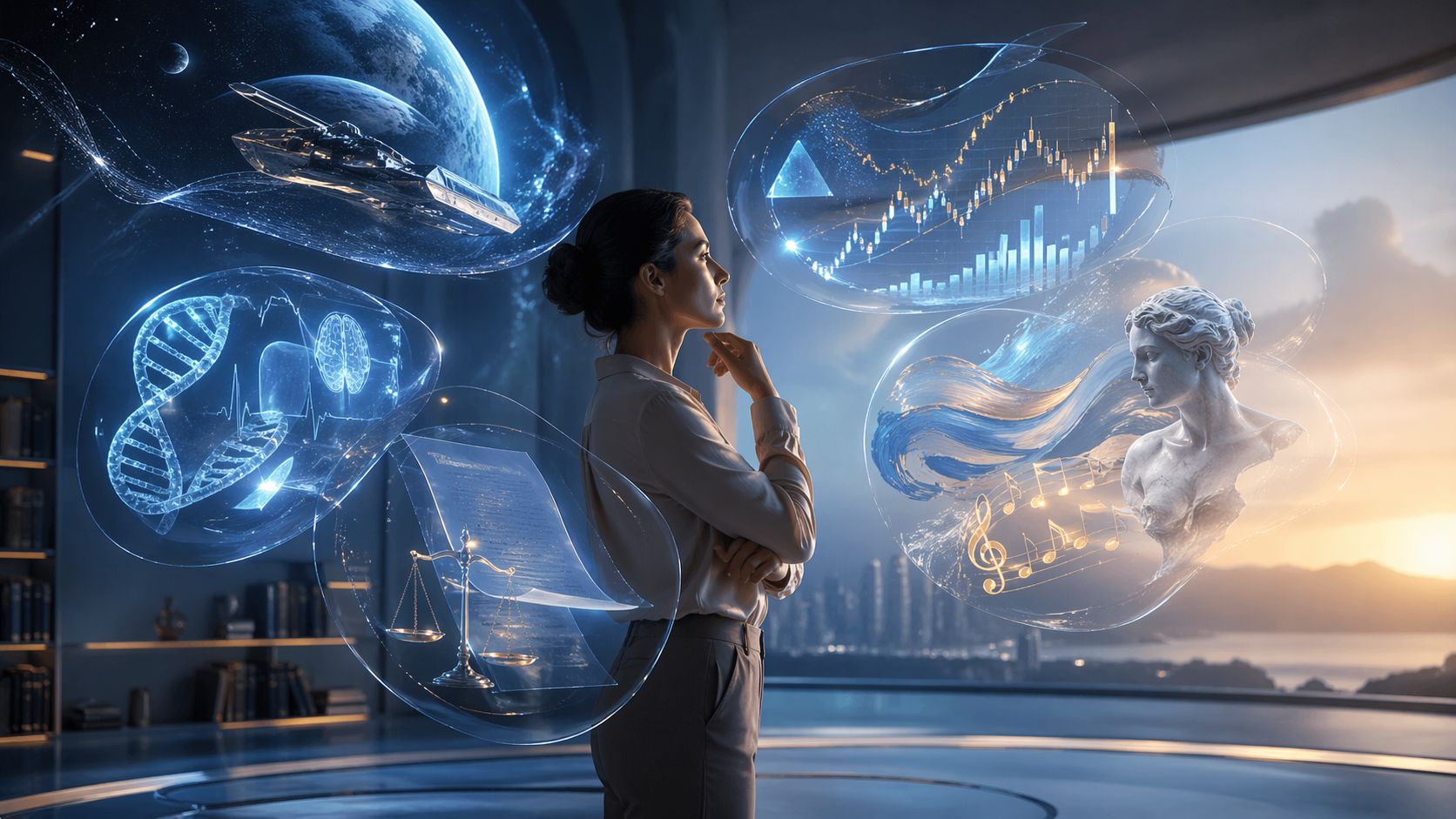
Whatever inventions may come, they will not be simple. Today’s great advancements require vast, multi-disciplinary teams. In such a distracted yet informed world, technology needs a variety of specific knowledge sets to brand, market, sell and scale up great new products. Just because Artificial Intelligence can vastly streamline those efforts, doesn’t mean experience or expertise won’t work in confluence with AI. In fact, I strongly suggest we not consider the lowest common denominator where AI eliminates all the mundane tasks that require human labor. Can’t we consider something far greater, where AI lets more humans develop things for one another more quickly and expansively, with more input from more smart people?
In fact, I think there are still great relevancies and advantages for the well trained. Are our doctors, lawyers accountants so close to extinction? To the contrary. With AI so rapidly improving there are things human eyes will want to double check intricate because life is complex and constantly changing. We shouldn’t expect AI to put us all out of work. Where’s that infections go-getter attitude and that entrepreneurial spirit?
I’d rather hope our human doctors and scrutinizing lawyers and up-to-date accountants are learning other skills, expanding their own knowledge base (with the help of AI) in order to help solve more and more complex problems. Shouldn’t we all be hoping to hold humanity to a higher standard of learning?
We can always be learning more. AI is built to work with us to exactly that end.
Since AI is built to help us operate smarter and more efficiently, then expertise is certainly not dead. Training, learning, specializing - fastening a broad base of technologically advanced skills - should only help a person amidst rapidly advancing technology. But to think mental discipline and broad sets of specific knowledge are no longer valuable does a disfavor to everyone.We shouldn't be so quick to dismiss anyone’s experience, degrees, certifications or other accomplishments, even a modern candlemaker or basketweaver, just because of AI’s undisputable brilliance. To the contrary, the depth with which people can understand disparate, more niche disciplines should actually help business and innovation achieve loftier and loftier heights.
I think the hubris of thinking our problems have been solved by AI could be the greatest threat against the innovative successes of new businesses. I watch Star Trek looking for all of the things that could be, stuff I’ve never thought of before, and ideas that currently seem too fantastic. AI offers us a chance to take a long new look at what actually could be. How far off are those crazy inventions?
Some of the things imagined in recent Science Fiction isn't even far off such. Consider terraforming other planets, having artificially intelligent co-workers or deeply immersive 3D virtual reality experiences through machines (like an early, early, early Holodeck prototype). Or maybe we’ll think of other, less monetary but maybe more lofty goals that the humans have dreamed into existence like ending global hunger and poverty. Regardless, I hope people use AI to learn deeper, greater, specificities about human existence instead of as an excuse to stop learning at all.
About the Author
Isaac Dye is a novelist and attorney whose career spans high-stakes corporate transactions, intellectual property, contracts, and advisory work across biotechnology, technology, media, and public-interest organizations. In addition to completing the final novel in a trilogy of American Magical Realism and publishing short fiction, Isaac has built a substantial legal career counseling businesses, families, political campaigns, and mission-driven organizations on complex legal and strategic matters. His background includes in-house and contract roles at Pharmacyclics, Rakuten Aspyrian, Accela, Sutter Health, MTV Networks, and his own law practice, with experience ranging from clinical trial agreements and licensing to campaign finance, estate matters, and commercial contracts. According to the information you provided, he also managed the legal end of the 2015 Pharmacyclics-AbbVie acquisition, one of the largest biotech acquisitions in the world at more than $42 billion, and worked on intellectual property deals exceeding $1 billion involving Roche, Rakuten, and the NIH. His writing is shaped by that rare combination of literary ambition, legal precision, and firsthand experience navigating consequential negotiations.