

The Crowded Sky
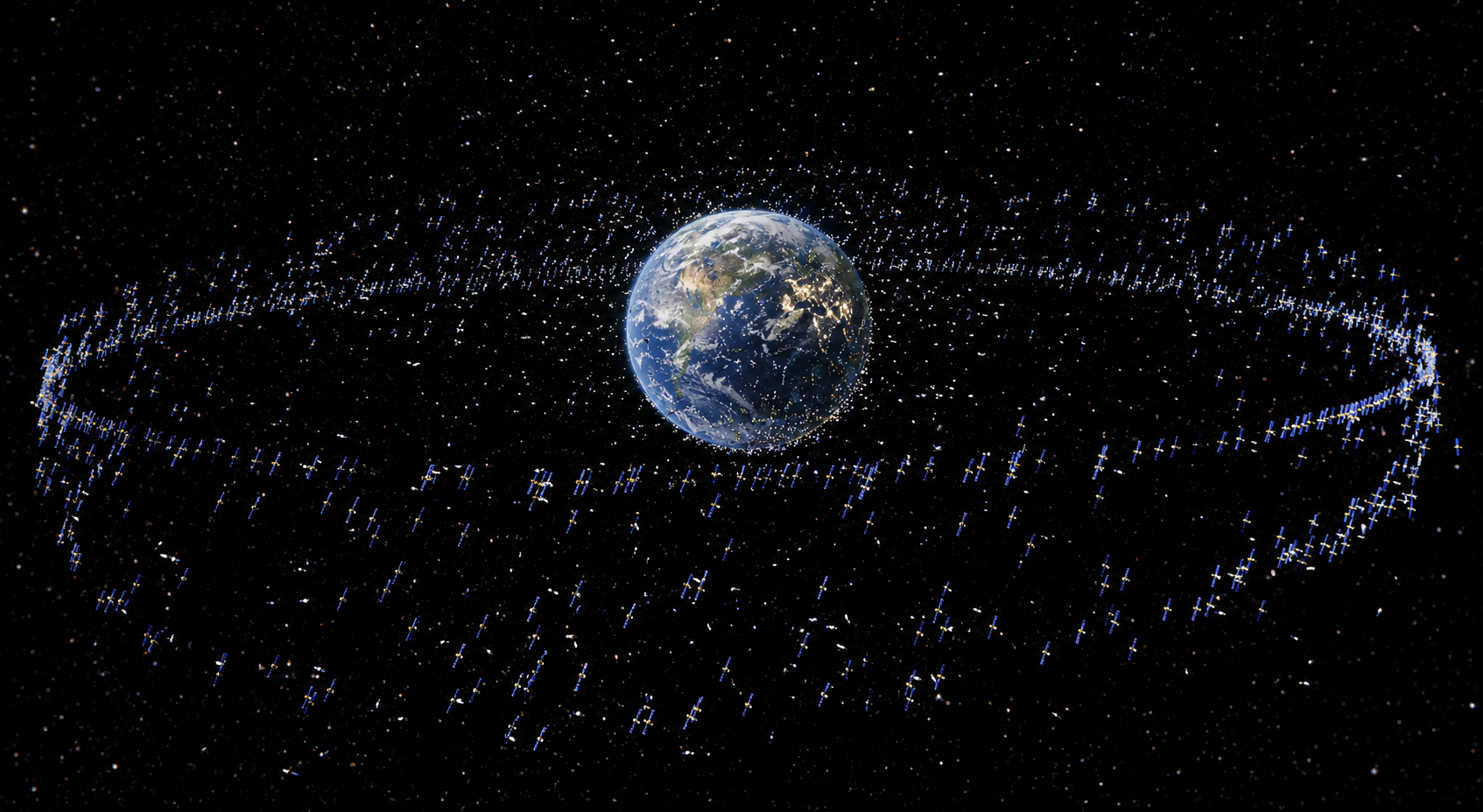
The same hunger that turns a perfect empty surf peak into a zoo is now pointed upward — and this time, there's nowhere else to paddle.
I remember the first time I drove down to a break before dawn and found it empty. Really empty. Just dark water and the sound of sets coming in from somewhere past the horizon, and above me, the kind of sky you forget exists until you're suddenly under it — the Milky Way so thick and close it looked less like stars than like something spilled. You paddled out and you were small and the smallness felt good. That feeling — the ocean below, the cosmos above, everything immense and indifferent and yours for one brief morning — is not something you can replicate. It requires solitude. It requires darkness.
That sky is going away.
SpaceX filed with the FCC earlier this year for authorization to launch and operate a constellation of up to one million data center satellites. One million. The pitch is clean, as these pitches always are: data centers in orbit, where they'll have unlimited access to solar power and the natural cooling of space, powering the AI infrastructure that civilization has apparently decided it cannot live without. AI-related electricity consumption is projected to grow 50% annually through 2030, and someone has to compute all of it somewhere. Why not up there?
The surfer in me understands the logic. The lineup was getting crowded, so you found a new break. You went further out, got up earlier, drove longer. The frontier has always been the solution to the crowd. Except now we've run out of frontier. There's the ocean, there's the land, and there's the sky — and the sky is where we're pointing everything we couldn't figure out where else to put.
The Royal Astronomical Society, the European Southern Observatory, and the International Astronomical Union have all submitted comments to the FCC opposing the plans. Their concern isn't abstract. A December 2025 study in Nature found that if all the proposed constellations were completed, one-third of Hubble Space Telescope images would be contaminated, and more than 96% of exposures from future space observatories would be affected. We would be blinding our own eyes to look for something — some signal from deep space, some ancient light — that we decided we needed to see. If Reflect Orbital reaches its goal of 50,000 mirrors, they will outnumber the real stars visible to the naked eye by more than a factor of five.
Think about that. Paddle out at 5 a.m. and look up and see not Orion, not the Southern Cross, not the patient dial of the cosmos, but five fake stars for every real one. A sky that's been SEO-optimized.
Anyone who surfs knows what happens to a perfect wave when it gets discovered. First it's a few guys who keep it quiet. Then someone posts it. Then the surf schools find it. Then it's a zoo — bodies everywhere, drop-ins, aggression, the thing that made it beautiful destroyed by the very desire to be near it. The lineup gives you nothing it used to give you, because the thing it gave you was space, and space is the one thing that doesn't scale.
As of early this year, approximately 14,000 active satellites are in orbit. The proposals on the table would multiply that number by orders of magnitude. In addition to crowding the night sky with more moving sources of artificial light, the arrival of this technology increases the probability of collisions among satellites or between satellites and other objects, generating further debris. The surf break doesn't just get crowded. It gets broken. The reef suffers. The thing that made the wave what it was gets degraded in ways that don't reverse.
I'm not against computation. I'm not against progress. But I do think there's a category of thing — a dark ocean at dawn, a sky full of ancient light — that belongs to everyone and therefore can be destroyed by anyone, and that once it's gone, no amount of money brings it back. The entrepreneurs selling compute in orbit are not wrong that the resource is there. They're just wrong to think that using it has no cost.
The stars are the original empty lineup. The last one we had.
Related Articles
Santa Cruz Is a Tech Town — SCW's foundational argument for why the Central Coast's innovation economy is no accident.
Kaimarra and BioVeris: Ocean Intelligence Comes Home — How Santa Cruz startups are using technology to protect, not exploit, the coastal environment.
The UCSC Chancellor's Innovation Impact Awards — Recognizing the researchers and entrepreneurs building the next generation of responsible tech.