

Data Centers Are Drinking Your Water. What if We Just... Moved Them Off the Planet?
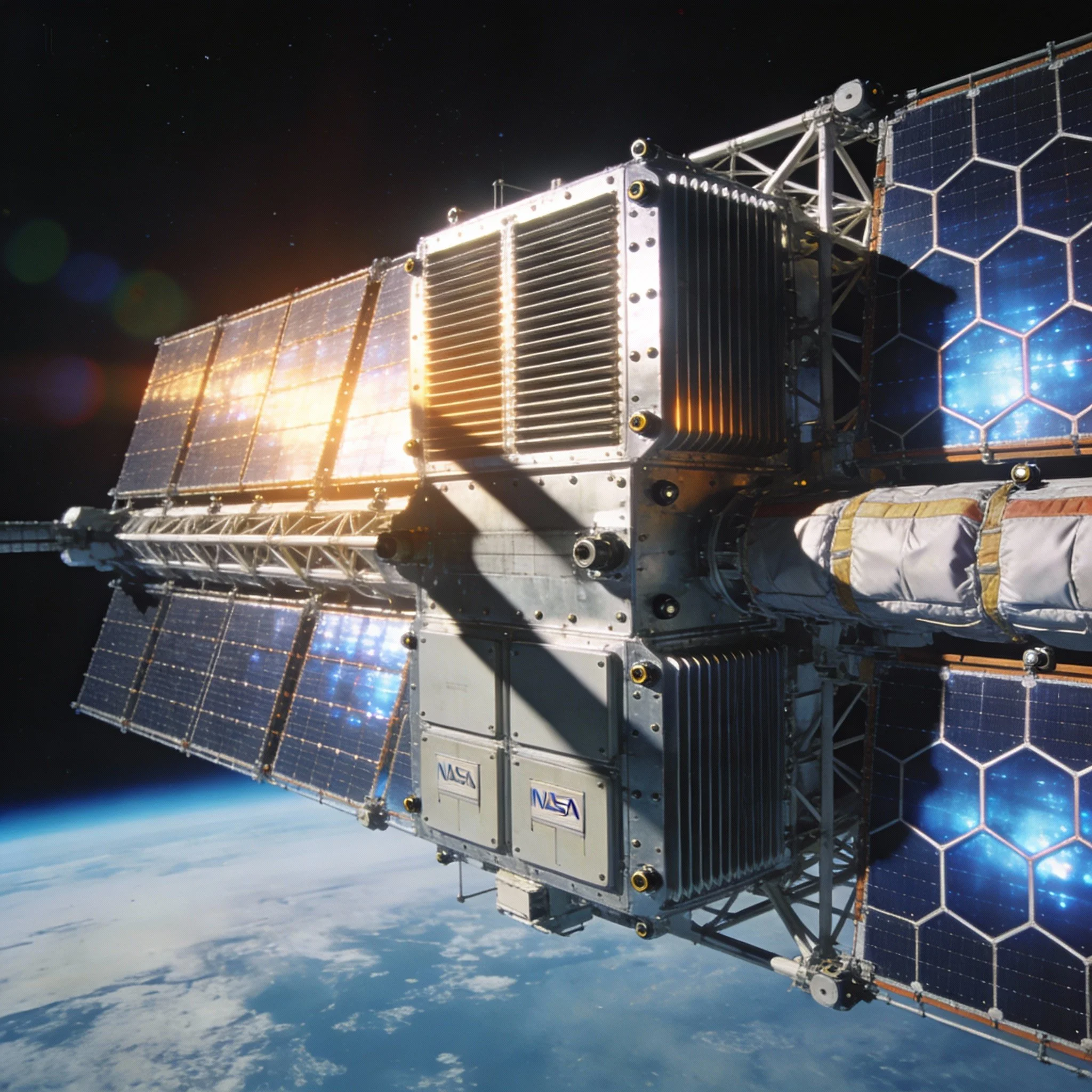
America's AI boom is colliding with America's water bills and power grids — and towns are fighting back. Which makes one company's weird question suddenly serious: what if the data center just... left Earth?
Data Centers Everywhere
Here's a stat that would have sounded made up two years ago: there are now more than 4,000 data centers operating in the US — mostly in Virginia, Texas, and California — with another 3,000 planned or under construction. They're going up in cornfields, in suburbs, next to schools, wherever there's cheap land and a substation. And America has noticed. Loudly.
The complaints are not abstracts. Data centers now consume 6% of all US electricity, up from 4% just two years ago, and a single large facility can draw about a gigawatt — enough to power 750,000 homes. A typical facility drinks roughly 300,000 gallons of water a day for cooling; the big ones can gulp as much as 5 million. And here's the fun engineering catch-22: you can cool a data center without a drop of water, but it's brutally energy-intensive — or you can go all-in on water cooling and compete with the community for its drinking supply. Pick your poison. The town picks up the tab either way.
So the towns started picking option three: no.
In just the first quarter of 2026, local opposition disrupted at least 75 data center projects worth $130 billion. Monterey Park, California became the first US city to permanently ban them by ballot measure. In Festus, Missouri, residents voted out half the city council after it approved a $6 billion data center deal. This isn't a red-state or blue-state thing — it's an everybody thing.
Which brings us to a question that sounds like a joke and increasingly isn't: what if we put the data centers somewhere with no neighbors, no water table, no zoning board, and a free, uninterrupted fusion reactor conveniently parked 93 million miles away?
Space. The answer is space.
Now — the moment you say this out loud, someone (possibly an actual thermal engineer, possibly a guy on the internet doing an impression of one) will tell you it's impossible, because you can't dissipate heat in space. And this is where things get interesting, because the skeptics are actually half right — and the half they're right about is exactly why the other half is wrong.
The "You Can't Cool Anything in Space" Argument, and Why It's Wrong in an Interesting Way
Let's start with the thing the skeptics have correct, because it's genuinely correct and it's important to give them their due before we take everything else away from them.
Space is a fantastic insulator.
Like, the best one we know of. That's not a hot take — it's literally how a Thermos works. A Thermos keeps your coffee hot by wrapping it in a thin layer of nothing, because heat has three ways to travel and vacuum kills two of them:
Conduction — heat moving through stuff that's touching other stuff. Your hand on a cold doorknob. Needs matter. Space has no matter. Dead.
Convection — heat hitching a ride on moving fluid. The fan in your laptop, the breeze on your skin, every data center cooling tower in Virginia. Needs air or water. Space has neither. Dead.
Radiation — heat leaving as electromagnetic waves. Needs... nothing. Works great in a vacuum. Very much alive.
So when someone says "you can't dissipate heat in space," what they're actually saying is "two of the three doors are locked." True! On Earth, we basically only use those two doors. Every cooling solution you've ever met — fans, liquid loops, cooling towers, the sweat on your forehead — is conduction and convection. An engineer who has spent a career on terrestrial thermal management looks at space, sees both of their tools confiscated at the airlock, and reasonably concludes the whole thing is doomed.
But here's the part where the intuition breaks: Door #3 isn't a cat flap. It's a cargo bay.
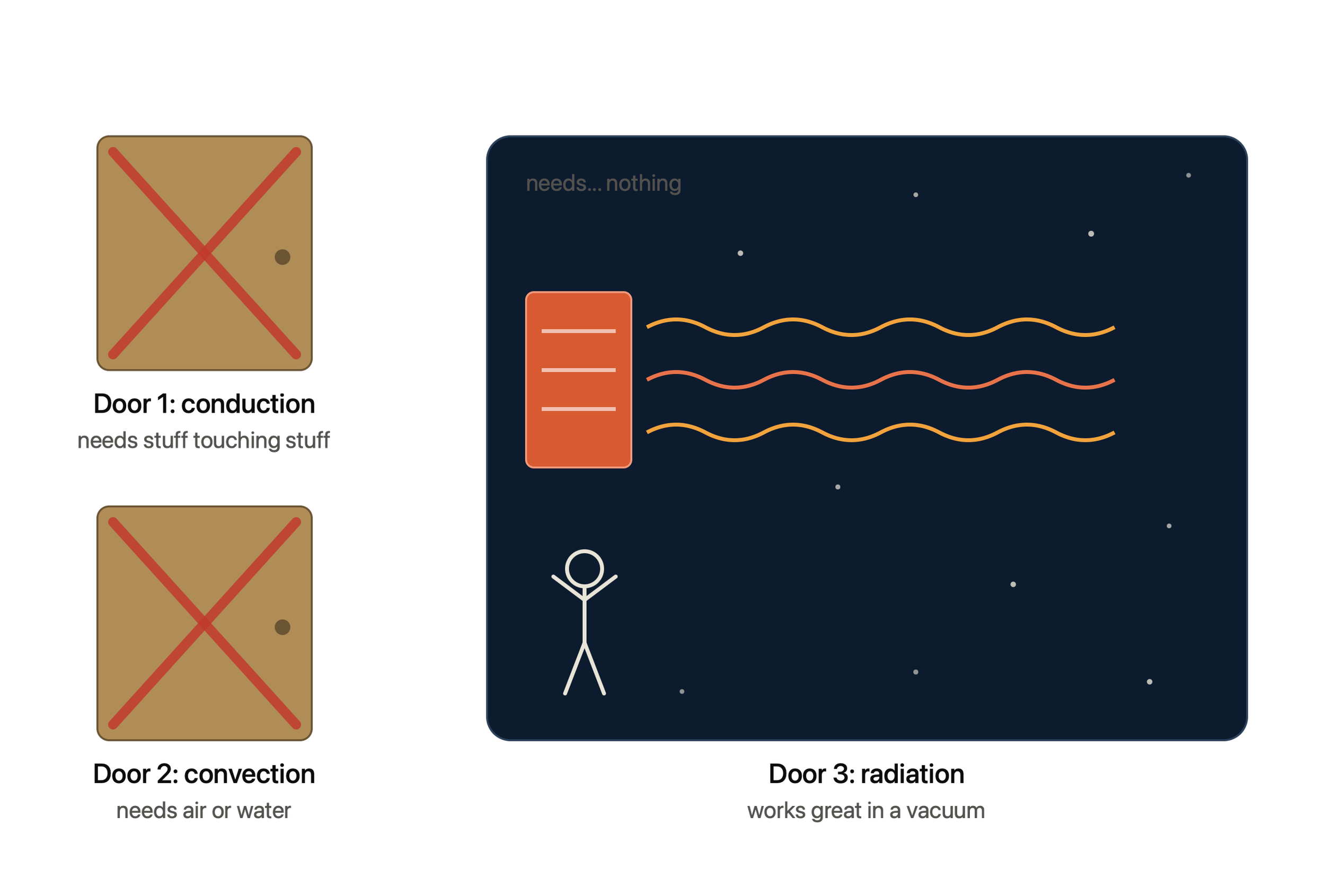
The structure mirrors the article's logic: two locked doors with red X's (conduction needs matter, convection needs fluid — both confiscated at the airlock), and Door #3 isn't a door at all — it's a cargo bay opening straight onto the stars, with a hot server happily dumping heat as infrared waves while a stick figure celebrates.
The Campfire Proof
You already have first-hand experimental evidence that radiation moves serious heat, and you collected it as a child. Stand near a campfire. The air between you and the fire is barely warmer than ambient — but your face is roasting. That heat didn't conduct to you or convect to you. It radiated to you, across a gap, as infrared light.
Now scale up the campfire: the Sun dumps 173,000 terawatts onto Earth continuously — about 10,000 times humanity's entire energy consumption — across 93 million miles of hard vacuum, using radiation alone.¹ Every joule of that eventually radiates back out to space too, which is the only reason Earth isn't a molten ball. The entire universe runs its thermal books on Door #3. The skeptics are pointing at the mechanism that cools literally every star and planet in existence and saying it doesn't work.
¹ (This is also the punchline the Moonshots panel landed on when someone asked about powering data centers with fusion: there's already a fusion plant, it's 93 million miles away, it's been running for 4.6 billion years, and it has never once required a permit from the county.)
Okay But Chips Aren't Stars
Fair. So how do you actually do it? You build a radiator — which sounds high-tech but is conceptually just a big flat panel that you pump hot liquid through so the panel glows in infrared and flings the heat into the void. Point it away from the Sun and it's staring at deep space, which sits at 2.7 Kelvin — about −455°F. That is, and I want to be precise here, an extremely motivated heat sink. The coldest, hungriest, most infinitely absorbent cold reservoir that will ever exist, available 24/7, free of charge.
And this is not speculative. The International Space Station has been running gigantic deployable radiators for over 20 years, dumping the heat from its systems and its extremely warm astronauts² into space the whole time. The physics question was settled decades ago.
² (A human body is roughly a 100-watt space heater that complains.)
There's also a cheat code hiding in the physics, called the Stefan-Boltzmann law: the heat a radiator sheds scales with the fourth power of its temperature. Not linearly — fourth power. Double the radiator's absolute temperature and it radiates sixteen times more heat from the same panel. And it happens to be that GPUs, unlike humans, are perfectly happy running hot — which means you can run the coolant loop hot, and the fourth-power law shrinks your radiator dramatically. The vacuum that took away your fans handed you a superpower on the way out.
So What Was the Skeptics' Actual Point?
Here's the honest version of the objection, and it's the one Starcloud's Philip Johnston would agree with: the question was never "can you dissipate heat in space?" — it was "can you afford to?" The ISS radiators work beautifully and cost approximately one bazillion dollars per watt, engineered to aerospace standards by government contractors in the era when everything that went to orbit was a Fabergé egg.
That's the actual problem Starcloud attacked. On the Moonshots episode, Johnston said their deployable radiator — liquid-cooled through aluminum, already built and through thermal vacuum testing — comes in at 10x less mass per watt and about 100x less cost per watt than the ISS design. It flies in January on StarCloud 2, as the largest commercial deployable radiator ever put in space.
And once the radiator is cheap, the whole comparison flips upside down. Because think about what a data center on Earth actually is, thermally: a building whose cooling apparatus — the chillers, the cooling towers, the water rights, the backup power, the five-year utility interconnection queue — often rivals the computers themselves in cost and complexity. In orbit, that entire stack collapses into two objects: a solar array (fuel included, forever) and a dumb aluminum panel pointed at the coldest thing in the universe.
Related Articles
NASA: ISS Active Thermal Control System Overview — NASA's engineering documentation of the system that has cooled the Space Station for two decades: pumped ammonia loops carry waste heat to large exterior radiators, which release it to space by radiation. NASA
NASA: State-of-the-Art Thermal Control for Small Spacecraft — NASA's continuously updated survey of flight-proven thermal hardware, including pumped fluid loops and deployable tracking radiators now being miniaturized down to CubeSat scale. NASA
NASA Technical Reports: Thermal Radiator Pointing for the ISS — The peer-level engineering paper on the station's radiator wings, whose real operational challenge is telling: the system must be actively managed to prevent the ammonia from freezing under low heat loads — space rejects heat so effectively that not-cooling is the harder problem. NASA Technical Reports Server
Starcloud: "Why We Should Train AI in Space" (whitepaper) — The technical case for orbital compute, arguing that passive radiative cooling in space enables simpler, more efficient cooling architectures than the energy-intensive chillers terrestrial data centers require. Starcloudinc
Google Research: Project Suncatcher — Google's preprint "Towards a future space-based, highly scalable AI infrastructure system design" tackles the foundational engineering of TPU constellations in orbit, including radiation effects and inter-satellite communication, with prototype launches planned with Planet. Google Research
Thales Alenia Space: ASCEND Feasibility Study — The European Commission–funded study by a consortium including Airbus, HPE, ArianeGroup, and DLR validated the technological feasibility of orbital data centers — which would require no water for cooling at all. Thales Alenia Space
Orbital Data Centers: Running the Radiator Math — An astrophysicist's independent back-of-envelope check: a single H100 GPU needs only about 1.1 square meters of radiator — the physics works, though at gigawatt scale the radiators get very, very big. Mikhail Klassen