Why Santa Cruz County Is Winning the Road-Trip Economy

Santa Cruz County hotels just posted their strongest gains in years. High fuel costs are steering travelers toward drivable destinations, and bets on AI trip planning and autism-forward hospitality are helping the county win them.
Here's a puzzle worth sitting with. International travel to California is still soft. Fuel prices are up. Plenty of households are uncertain about the economy. Yet Santa Cruz County's hotels just posted their best revenue gains in years.
How?
Terence Concannon, CEO of Visit Santa Cruz County, has a straightforward answer: "domestic overnight travelers have flocked to Santa Cruz County."
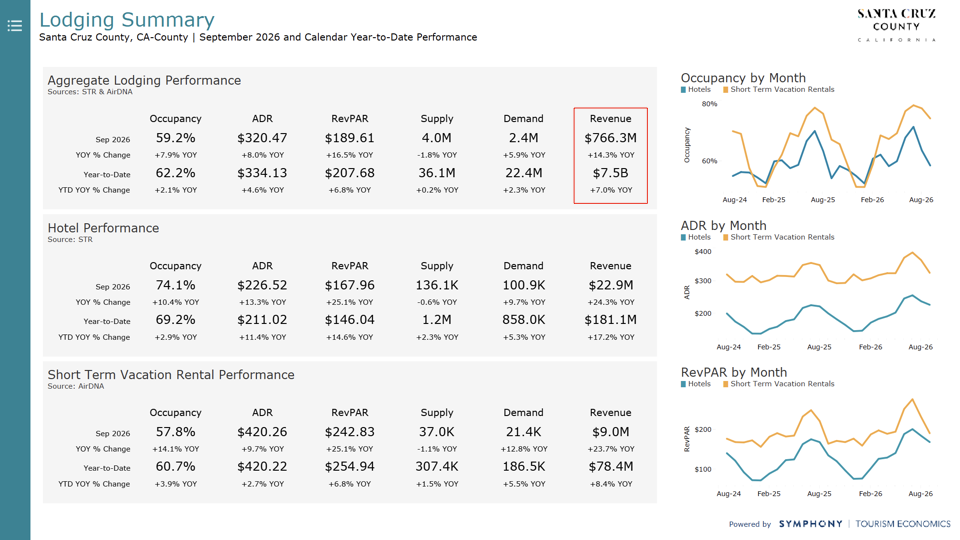
Start with the numbers. According to figures from Visit Santa Cruz County, hotel occupancy in September rose 10.4% over last year. Average daily rates rose 13.3%. Combine the two and revenue per available room jumped 25.1%. No new rooms were added, so all of that growth came from demand. More people came, and they paid more to stay.
This isn't a one-month spike. Since January, Concannon reports, occupancy is up a modest 2.9%, but rates are up 11.4%, RevPAR is up 14.6%, and total hotel revenue is up 17.2%. Short-term vacation rentals tell a quieter version of the same story: occupancy up 3.9%, rates up 2.7%, and revenue up 8.4%.
Taken together, Visit Santa Cruz County puts combined lodging revenue for September at $766.3 million, 14.3% above last year. Year to date it stands at $7.5 billion, up 7%.
So what's driving it? Concannon points to a substitution effect. When flying gets expensive, people don't necessarily stop traveling. They travel differently. They trade the cross-country flight for the drive, and the unfamiliar destination for the one they already know. Santa Cruz County sits within a few hours of millions of Californians, which makes it a natural beneficiary of a road-trip economy. There's a second-order effect, too, Concannon notes. Money a family doesn't spend on airfare doesn't disappear. Some of it gets spent at the destination, on a better room, a nicer dinner, or an extra night.
That's the macro story. But it's not the whole story, because a destination still has to give people a reason to choose it.
Under Concannon, Visit Santa Cruz County has been making two interesting bets. The first is on technology. Last month the organization launched MindTrip, an AI platform that turns a traveler's own questions into a personalized, end-to-end itinerary. Concannon says website traffic has surged since. The broader point is that trip planning is shifting from browsing to conversation, and destinations that meet travelers inside that conversation will have an edge.
The second bet is more unusual, and I think more revealing. The county's new Visitor Center on Front Street, next to the Museum of Art & History, is described by Visit Santa Cruz County as the only autism-forward visitor center in the country. It includes a quiet room for moments when stimulation becomes too much, a county map rendered in inclusive colors, tactile exhibits, and an immersive room where 180-degree video projections surround visitors with the county's landscapes. For someone on the spectrum, or someone with limited mobility, that room offers a way to experience the coast and redwoods safely and comfortably. Concannon reports strong gains in both visitors and residents using the center since it opened late last year.
This is a commitment with a track record. In 2023, Visit Santa Cruz County earned Certified Autism Center status from IBCCES, which means every employee is trained to recognize and support autistic visitors and their caregivers. This year the California Travel Association gave the Visitor Center its 2026 Diversity, Equity, Inclusion and Accessibility Champion Award. This is the first award won by this organization. Concannon calls the center "the hallmark of Visit Santa Cruz County's commitment to inclusion and welcoming neurodivergent visitors and residents."
Data provided by Terence Concannon, CEO, Visit Santa Cruz County.
Related Articles
Downtown Santa Cruz Housing Fast Facts — Why new Downtown housing fills almost as fast as it's built, in a district that draws millions of visitors a year.
Santa Cruz's Next Economic Opportunity May Already Live Here — The county's most valuable economic asset may be the skilled workforce already living here.
Santa Cruz Has the Talent, but Can We Build the Careers? — A new workforce report shows the gap between local wages and living costs, and where the county can grow next.