

Steve Fortunato: Why Hospitality Might Be the Missing Leadership Skill
The trouble with leadership advice is that it usually arrives dressed as inevitability.
Be bold. Be decisive. Be relentless. Be visionary. Be the person who knows the answer before the question is fully formed.
It is a familiar script, especially in tech and entrepreneurship, where certainty is rewarded and hesitation is treated like a character flaw. We lionize founders who seem to bend reality through force of will. We quote keynote speakers who turn ambition into something resembling a moral duty. We leave conferences with a notebook full of verbs. But every so often, someone walks onto a stage and makes you realize you have been listening to the wrong story.
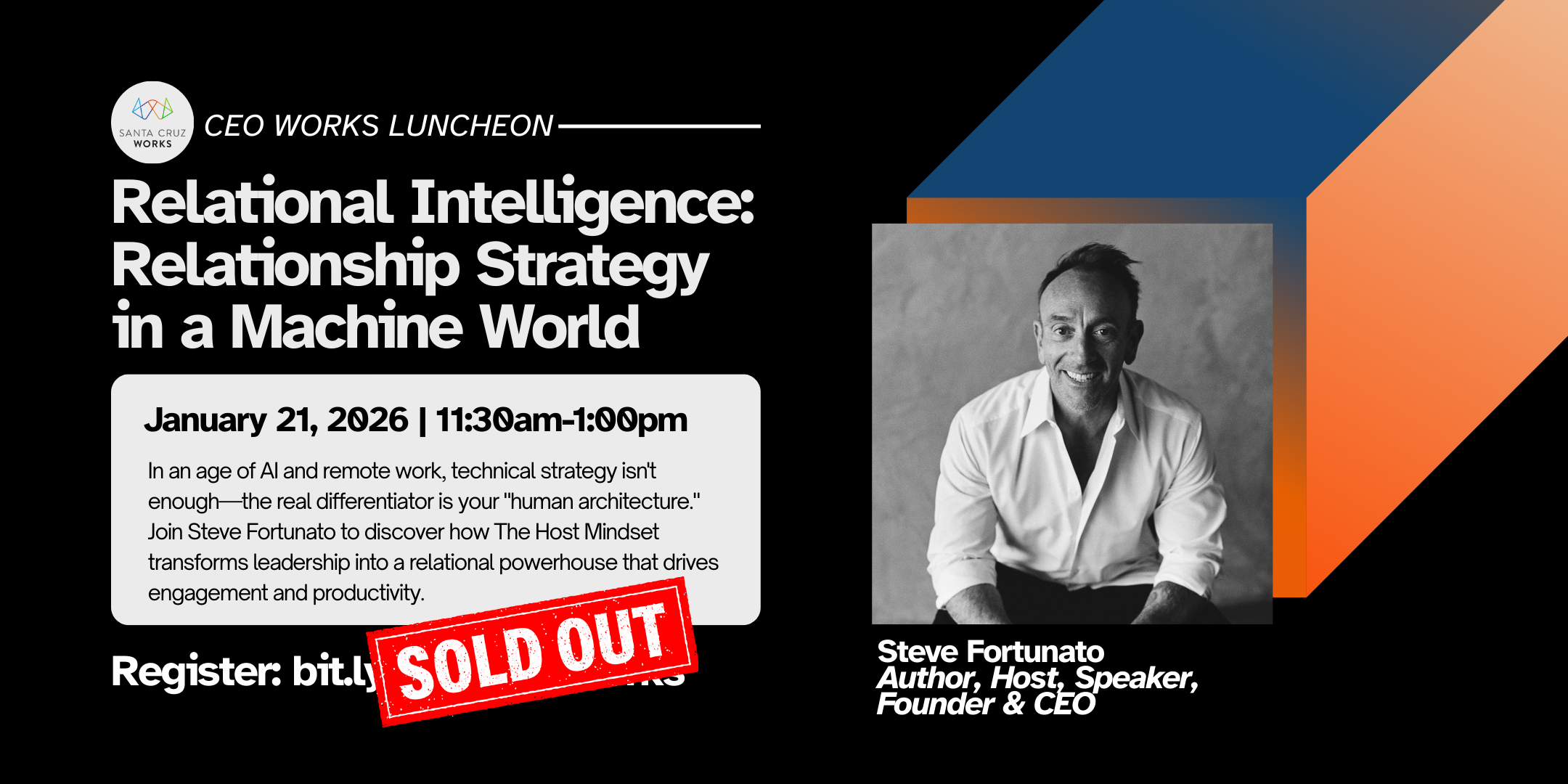
At a Santa Cruz Works CEO Works Luncheon, Steve Fortunato gave a talk that landed differently. Not because it was louder or more theatrical, but because it was clearer. More precise. More human. It did not ask the audience to inflate themselves into superheroes. It asked them to become something rarer in corporate life: a host. And that might sound like a small idea until you sit with it for a minute and realize it rewires everything.
I have attended presentations for decades. I have heard the legends: Steve Jobs, Steve Benioff, and a long list of executives, authors, and thought leaders who can fill a ballroom and hold a crowd. I have watched the best of them turn business strategy into theater. I have seen charisma used like a tool, persuasion built like a product. And I can say, without hesitation, that Steve Fortunato is the best speaker I have ever seen for corporate events and retreats. Not because he performs. Because he connects. He does what most speakers claim to do: he changes how you see the room you are sitting in.
A Leadership Talk That Starts in the Real World
Fortunato’s background matters here, because his framework does not come from a whiteboard. It comes from people. From stress. From high stakes, high emotion, high expectation environments where failure is not an abstract learning moment but a night someone will remember for the rest of their life.
He grew up in Santa Cruz, the first graduating class of Gateway School, and built his career in hospitality. His ambition was to create “the French Laundry of catering,” which is an audacious goal because it implies a level of care most people do not think is possible outside the walls of elite restaurants. Hospitality at that level is not about feeding people. It is about designing the emotional experience of an event.
After decades in Los Angeles, after serving thousands of weddings and once-in-a-lifetime gatherings, he sold his businesses and returned home. He described coming back to Santa Cruz and learning the community again “for the first time.” That line stuck with me because it is the opposite of the leadership posture many of us slip into. We assume familiarity means mastery. He treated it as permission to listen.
And that set the tone. This was not a talk built on dominance. It was built on attention.
The Framework: Hero vs. Host
Most leadership models orbit power: how to claim it, wield it, protect it, scale it. Fortunato’s model begins somewhere else. It begins with the question of what people feel like when they are around you. He described two mindsets that show up everywhere in organizational life:
The hero mindset
The host mindset
The hero mindset is, in many ways, the default setting of modern work. Heroes are focused on achieving outcomes. They are solving problems, driving performance, overcoming resistance, chasing the win. The hero sees leadership as a test of competence and force. If things are not moving, push harder. If people are not aligned, persuade them. If results are not landing, sharpen the message. The hero mindset is seductive because it sometimes works. It can produce short-term wins. It can make someone look effective. But it carries a hidden cost: it turns relationships into transactions. Under the hero mindset, you start asking the quiet question that shrinks everything: What am I getting out of this?Loyalty. Productivity. Respect. Compliance. Buy-in. Applause.
That question is not evil. It is human. But it is corrosive. It reduces people into means rather than ends. It makes the room colder. The host mindset flips the orientation. A host is not trying to extract value. A host is trying to create it. Hosting, Fortunato argued, is the universal space between someone who has something and someone who receives it. It is not limited to dinner parties. It is a way of showing up in every interaction.
“If you are breathing,” he said, “you are a host.”
And what makes that idea powerful is that it reframes leadership as a practice of generosity that creates strength, not softness.
Why This Matters Now
It is tempting to treat “hospitality” as a nice-to-have. A layer of politeness you add after the strategy is done. But in 2026, hospitality is not an accessory to leadership. It might be the foundation.
Think about the world teams are navigating:
AI is reorganizing roles, workflows, and identity
Remote and hybrid work make connection harder to sustain
Multi-generational teams are carrying different expectations about communication and authority
Change is constant, and fatigue is normal
Trust in institutions is brittle
In an environment like that, leadership is not just about decisions. It is about atmosphere.
People do not burn out only because the work is hard. They burn out because the work is hard and they feel alone in it. They disengage because they do not feel seen. They resist change because they do not trust the person asking them to change.
The host mindset addresses the hidden emotional mechanics of performance. It builds the conditions where people are more willing to try, more willing to fail in public, more willing to collaborate, more willing to stay.
It makes the organization feel livable.
Three Shifts That Change Everything
Fortunato offered three practical moves that separate a hero leader from a host leader. They sound simple. They are not easy.
1) Respect the power of words
He talked about “speaking the good,” which might sound like motivational fluff until you realize he means it as a discipline. The way leaders talk becomes the emotional weather of the team. It shapes what people believe is possible, what mistakes feel survivable, and whether effort is noticed.
The host leader uses words to build, not just critique. That does not mean avoiding hard conversations. It means understanding that constant negativity is not rigor. It is erosion.
Even more importantly, he turned the lens inward: inventory your self-talk. If the voice in your head is always hostile, you will eventually export that hostility outward.
A host cannot make other people feel at home while treating themselves like an enemy.
2) Honor the other
Honor is an unfashionable word in modern business. It feels old-world, almost uncomfortable. But Fortunato used it in a very direct way: honor is the act of raising the dignity of the person in front of you.
In leadership, this is the difference between managing people and seeing people.
Fortunato described how quickly trust collapses when an “expert” shows up and talks down instead of listening. Many leaders believe their job is to be the smartest person in the room. Hosts understand their job is to make the room smarter.
Honor shows up in small behaviors:
asking real questions, not performative ones
remembering what matters to someone
applying what you learned later
treating every interaction as consequential
The paradox is that honoring the other does not diminish authority. It increases it. People follow leaders who make them feel valued, not leaders who make them feel small.
3) Earn respect instead of expecting it
In high-stakes environments, it is easy to lean on policy and procedure as a shield. “Technically, I’m right” is the fastest way to lose a relationship. A host leader listens, contains emotion, and makes the other person feel understood even when the answer is no. They do not confuse firmness with coldness. This is especially relevant in moments of tension, when a team member is frustrated, a client is demanding, or a partner is disappointed. The hero wants to win the argument. The host wants to preserve the relationship. And here is the thing: the host often ends up getting better outcomes anyway. People accept boundaries more readily when they feel respected inside them.
The Question That Made the Room Laugh
Near the end, someone asked a question that made the room smile: “What if you really are a superhero?” It was funny, but it also revealed something real. Many leaders carry an identity built around being the person who can handle everything. The fixer. The savior. The closer. Fortunato’s response landed because it did not reject competence. It simply distinguished confidence from arrogance and reframed power. He contrasted:
power over
power against
with:
power with
power on behalf of
That is the host model in one sentence. You are not leading at people. You are leading with them. You are not trying to prove something. You are trying to build something.
Why Fortunato Is a Perfect Speaker for Retreats
“Over the decades of attending presentations by speakers ranging from Steve Jobs to Steve Benioff, this “Steve” is the best speaker by far for corporate events and retreats”
Most corporate events have the same problem: they mistake stimulation for transformation.
You get a speaker. People clap. They feel inspired. The next day, the inbox returns and the adrenaline fades and the organization goes back to whatever habits were already in place.
Fortunato is different because his talk is not a performance about leadership. It is an intervention into leadership.
He gives teams language for what they are already experiencing but have not named:
why meetings feel tense
why trust feels fragile
why feedback feels personal
why conflict spirals
why good people disengage
And once you name those dynamics, you can change them.
That is what makes him so valuable for corporate events and retreats. Retreats are supposed to create alignment, cohesion, energy, and clarity. But those things are not created by strategy slides. They are created by relationship quality. Fortunato speaks directly to the relational core of organizational performance.
And he does it with humor, humility, and the kind of grounded authority that only comes from having done the work in real rooms with real stakes.
The Takeaway: Leadership as Atmosphere
Fortunato closed with a simple idea that feels almost radical in a world obsessed with scaling, optimizing, and extracting:
Plant the seeds. Pick the fruit.
Relationships are not a soft skill. They are the infrastructure of every serious outcome. They determine whether a strategy survives contact with reality. They determine whether change feels like momentum or like threat. They determine whether your people feel like assets or like humans.
The host mindset is not about being nice. It is about creating conditions where people can do their best work, together, without losing themselves.
In 2026, that might be the most practical leadership strategy there is.
Related Articles
Steve Fortunato: Why Hospitality Might Be the Missing Leadership Skill
https://www.santacruzworks.org/news/steve-fortunato-why-hospitality-might-be-the-missing-leadership-skillCEO Works Luncheon: Relational Intelligence: Relationship Strategy in a Machine World
https://www.santacruzworks.org/news/ceo-works-relational-intelligence-strategies-for-humans-in-a-machine-worldComing Full Circle: Steve Fortunato’s Return to the Santa Cruz Mountains
https://www.santacruzworks.org/news/coming-full-circle-steve-fortunatos-return-to-the-santa-cruz-mountains