

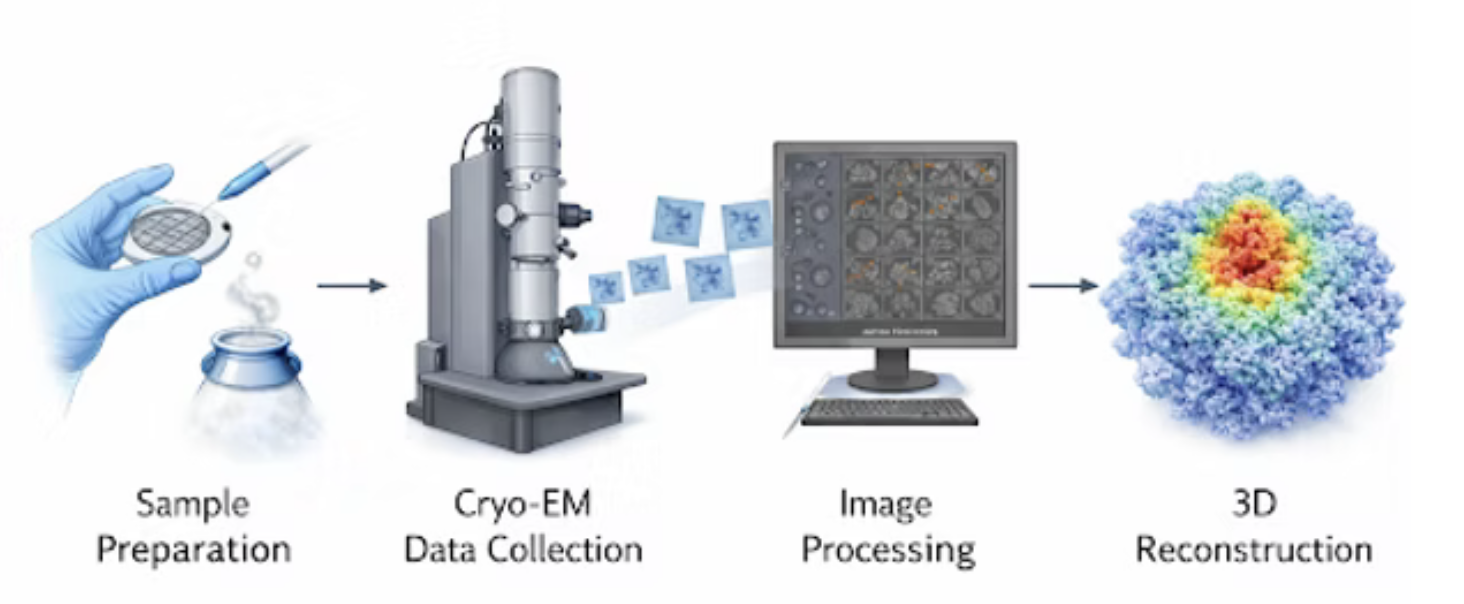
UCSC's Biomolecular cryo-EM facility can image molecules and materials at near-atomic resolution. Director Vitor Hugo Balasco Serrão is now open to local companies ready to push their research and products further.
Let's start with a problem.
Say you're building something tiny. Really tiny. A gold shell designed to carry drugs through the bloodstream. A fat bubble (scientists call it a liposome) that delivers a vaccine. A protein your company bet its Series A on.
You'd want to look at it, right? Make sure it's actually shaped the way you think it's shaped?
Here's the bad news: you can't.
A light microscope hits a wall at around 200 nanometers, because light waves are too fat to bounce cleanly off anything smaller. Your liposome is about 100 nanometers. Your protein might be 10. To a light microscope, your entire product is a rumor.
Enter the electron.
Electrons have a far shorter wavelength than light, so they can resolve things down toward individual atoms. Problem solved! Except (Problem #2) biological stuff hates being blasted with electrons inside a vacuum. It dries out, collapses, and generally behaves like a sandcastle in front of a leaf blower.
So scientists did something kind of insane. They freeze the sample so fast that the water never gets the chance to form ice crystals. It turns to glass instead, and your molecules end up suspended mid-pose, like a million tiny Pompeii residents.
Then the microscope takes thousands of pictures of those frozen molecules, each stuck at a random angle, and a computer stitches all those 2D shadows into a single 3D model. That's cryo-electron microscopy. It won the Nobel Prize in 1986 and 2017, and it has quietly rearranged how drugs, vaccines, and materials get designed.
And there's one up the hill at UCSC.
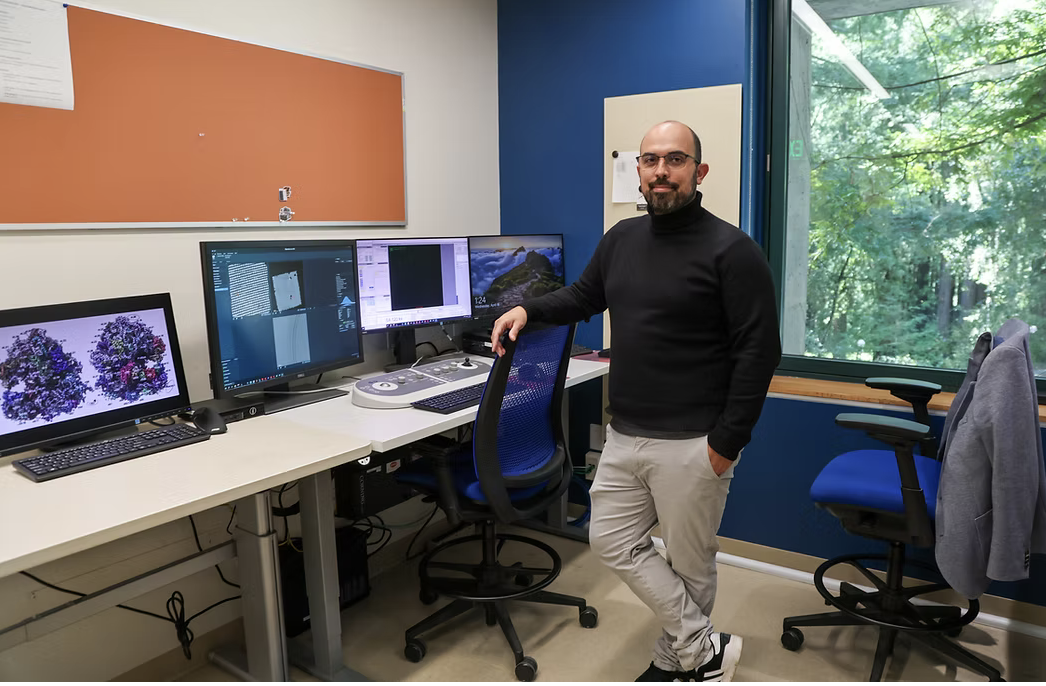
Director Vitor Hugo Balasco Serrão
Meet the guy who runs it. Vitor Hugo Balasco Serrão is a Brazilian physicist who wandered into structural biology, picked up an MBA along the way, and now directs UCSC's Biomolecular Cryo-EM Facility, built with an NIH S10 instrumentation grant and UCSC funding. Since 2022, the facility has helped solve 53 biological structures and supported research on influenza, RSV, and other disease targets, producing 18 publications and new leads for vaccine development and cancer treatment.
The lab is now expanding its work with companies, and the offer goes well beyond microscope time. The facility handles sample preparation, data collection, and processing on its own GPU-powered computing infrastructure. In plain English, you bring the question, and Vitor's team helps you get to the answer.
Your 3D-printed part broke. Now what?
When a printed part cracks, delaminates, or performs differently batch to batch, the real cause usually lives at a scale you can't see: a resin that didn't fully cure, additives that clumped instead of dispersing, microscopic voids between layers, or defects hiding along the grain boundaries of a printed metal.
Vitor's lab can find them. For printed polymers and resins, freezing protects samples that would otherwise melt under the beam. For metals, the lab cuts an ultra-thin slice right through the failure point and images it at room temperature, down to the nanoscale.
That gives you failure analysis that tells you why, not just where, and a faster path to a stronger next print.
What this does for your roadmap
Local companies are already putting the lab to work. One uses it for quality control of gold nanoshells. Another inspects liposomes during vaccine development. Battery and advanced-materials teams can see electrode structures that other methods destroy.
The common thread is that these companies get to stop guessing. They validate designs earlier, catch problems before they become recalls, and walk into investor meetings with images of their product at the molecular level. And because the lab is local, you can hand-carry a sample up the hill instead of shipping it out and waiting weeks.
Who should call
Medtech teams designing tiny geometries that go inside a human heart. Aerospace engineers are obsessed with structural integrity. Additive manufacturers are chasing stronger parts. Battery developers. Biotech founders whose next milestone depends on seeing what they've built.
Learn more at ucsccryoem.org, contact Vitor directly at vbalasco@ucsc.edu, or reply to this newsletter and we'll set up a lab visit.
Related Articles
Santa Cruz Ventures Invests in Versa Vascular — How a local medtech startup building heart-valve repair tools earned backing from SCW's venture fund.
QB3 UCSC Biotech Mixer to Connect Innovators and Industry Leaders — Where campus researchers and Central Coast biotech companies come together to build connections.
Can Startup Sandbox Make Santa Cruz a Biotech Hub? — A look at the Westside wet-lab incubator launching the region's next wave of biotech companies.
Santa Cruz Ventures Invests in Versa Vascular — How a local medtech startup building heart-valve repair tools earned backing from SCW’s venture fund.
QB3 UCSC Biotech Mixer to Connect Innovators and Industry Leaders — Where campus researchers and Central Coast biotech companies come together to build connections.
Can Startup Sandbox Make Santa Cruz a Biotech Hub? — A look at the Westside wet-lab incubator launching the region’s next wave of biotech companies.
New International Collaboration Poised to Unlock More Health-Related Discoveries — How UCSC opened its cryo-EM facility to institutions worldwide, with two dozen campus labs and 15 companies across six countries already using it. ucsc
New Cryo-Electron Microscopy Facility a Boon for UCSC Structural Biologists — The origin story: how NIH grants and campus support brought a state-of-the-art cryo-EM microscope and camera to Santa Cruz. ucsc
Researchers Snap Pics of Proteins at New UC Santa Cruz Facility — The Sentinel’s look at UCSC scientists putting the new cryo-EM facility to work imaging proteins.