

The Expansions You Can’t See: How technology has democratized global hiring, but at the same time made it invisible.
Employer of Record providers let companies hire abroad without entities, leases, or filings, making expansion invisible to economic developers. Lukas Sieber's Upsite Systems uses public data to map where companies operate and hire. Upsite presents at SCW New Tech on October 7. This article submitted by Lukas Sieber.
When Lukas Sieber, Founder & CEO of Upsite Systems first started working in Foreign Direct Investment — supporting U.S. companies expanding into Switzerland — the way that companies grew into new markets followed the same pattern that it had for the last hundred years: the company registered a subsidiary, signed an office lease, and filed with the local tax authorities.
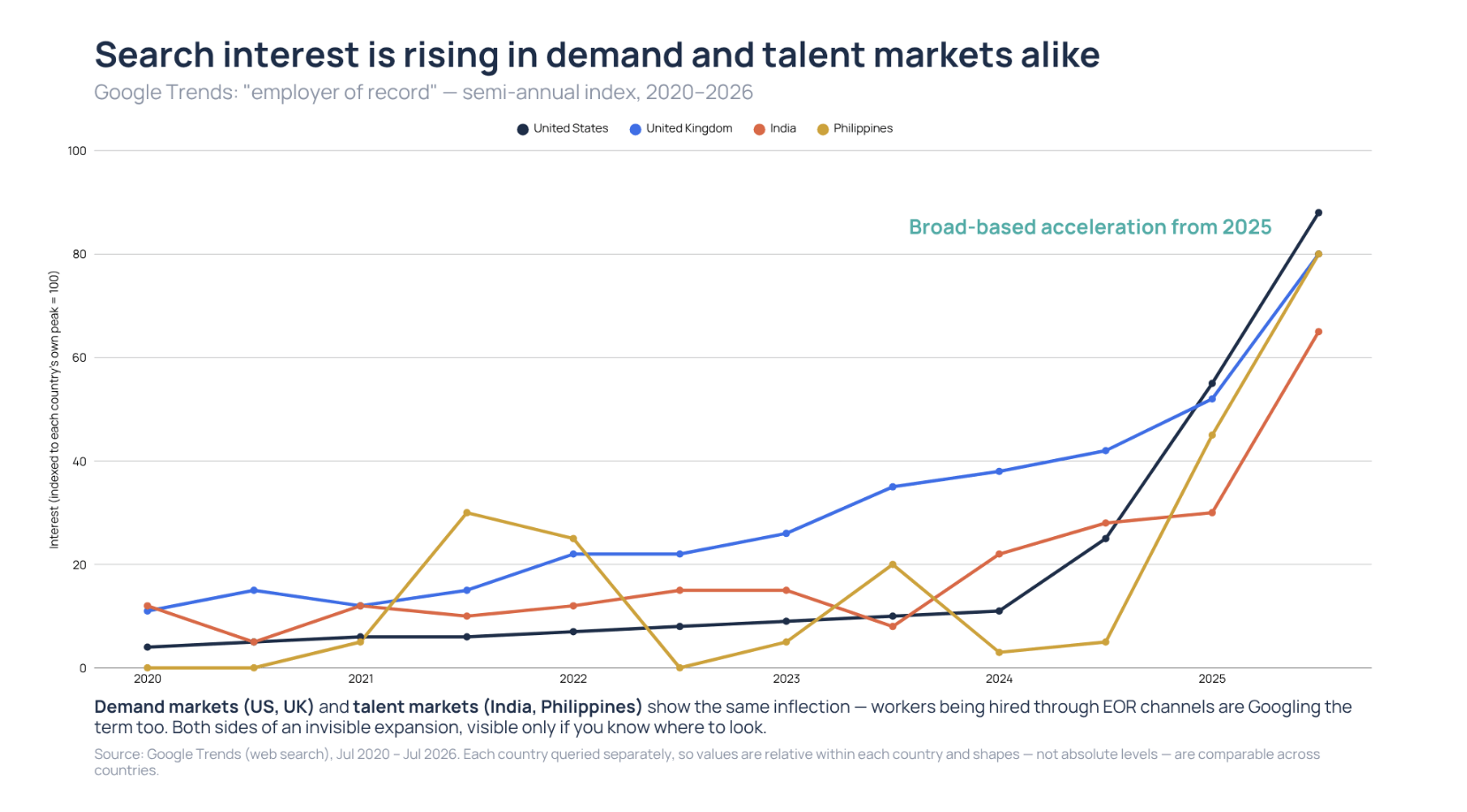
Then, in the last five years, things began to change. Since 2021, a rapidly growing share of cross-border market entry has moved to a channel that produces no entity, no lease, and no local filing: the Employer of Record. And the numbers behind that shift are bigger, and moving faster, than most people watching official statistics realize.
An Employer of Record legally employs workers on a company's behalf in countries where that company has no legal entity. The EOR provider handles the contracts, payroll, benefits, and compliance for foreign employees while the client directs their actual work. A decade ago this was an obscure workaround, but today it's a standard operating model. 59% of U.S. companies now plan to use an EOR to hire abroad, and Deel, one of the leading EOR providers, became one of the fastest growing startups in history going from $1M ARR to $100M ARR in just 20 months. As of 2026, four years later, Deel now has over $1.5B ARR, and analysts project the entire EOR segment to reach between $10-20B in revenue in the next decade.
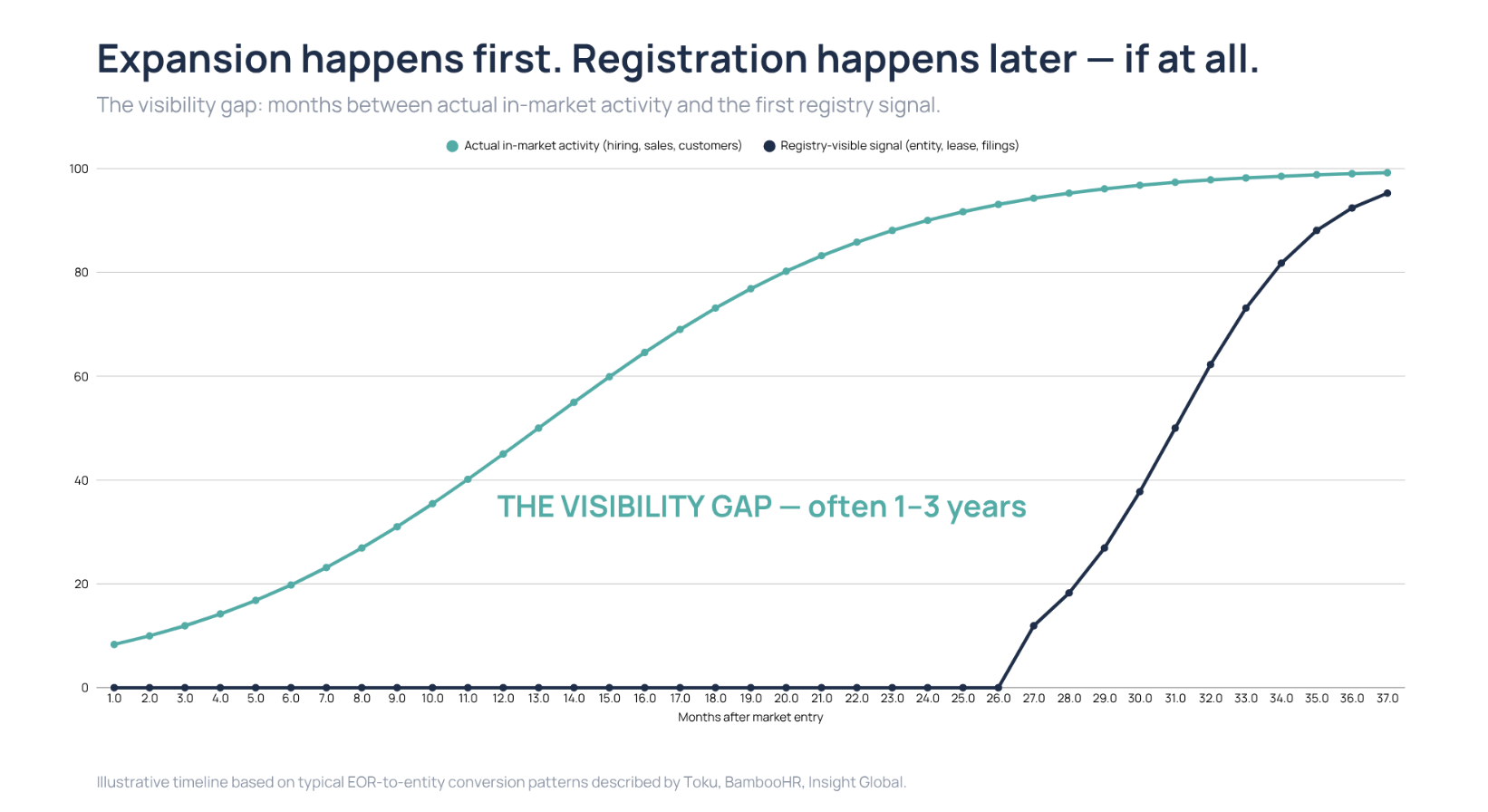
While providing a convenient service to companies looking to build global teams quickly and conveniently, without the need for legal infrastructure in every market, the rapid rise of EORs has caused a major disruption to the status quo of the international expansion sector. Everyone whose job depends on spotting expansion — investment promotion agencies, economic developers, market-entry advisors, B2B sales teams — built their radar on pre-EOR footprints. Now, countless target companies quietly operate small teams in their markets years before news of their expansions reach their inbox.
This was the problem that Lukas encountered leading the Investment Promotion Agency for the Zurich region of Switzerland in the U.S. — hundreds of U.S. tech companies had small teams on the ground in Zurich employed through EORs, but neither he, nor any other relevant service provider in Switzerland had a clue that they were there, and so couldn’t engage with them during this critical growth window. So, he founded Upsite Systems to bridge that gap, and bring the expansion signal to the modern, EOR-dominated era. Upsite uses public datastreams to map where companies are actually operating and hiring, regardless of legal entity status or official announcement. By creating a searchable system of record for the locations of companies and their global employees, economic developers and service providers can see the companies building teams in their target regions, and monitor their in-region growth or decline over time.
Although Upsite serves a number of government Economic Development clients given Lukas’s roots in that industry, a number of private companies have also leveraged Upsite’s expansion intelligence to solve their own challenges and visibility gaps. A major global payment provider has been expanding into new markets in Latin America, and faced the challenge of conducting an accurate market evaluation: seeing how many companies already used a competitor, and the volume of payments already processed in specific countries. This is the kind of intelligence Upsite specializes in: the company was able to pull thousands of companies using competitors in their target LATAM markets, painting a picture of the overall opportunity.

Lukas Sieber
Although he’s starting with the sector he knows best — international expansion — Lukas sees incredible potential for location intelligence outside of the world of economic development and the surrounding service providers and to empower every company growing internationally with the information that they need to create the best global structure for the needs of their business. “Location is the one aspect of business that hasn’t been fully optimized in the 21st century, even though it can be either a business’s greatest asset, or its greatest liability,” he says, “although some people may forecast a trend of re-shoring and focus on sovereignty, the data shows that the business world is more globalized than it’s ever been, companies are going international at a younger age, and are reaping the benefits.”
Related Articles
Switzerland – More Than Cheese and Chocolate — A look at why the Greater Zurich Area, where Lukas led investment promotion, has become a hub for life sciences, fintech, robotics, and other tech sectors.
Paystand Acquires Teampay: Expanding Network to 1M Businesses — Paystand's second acquisition, following its purchase of Yaydoo, which helped build the Mexico and LATAM footprint Upsite's data now surfaces.
Paystand Rolls Out AI Agents to Automate Finance Teams' Busywork — The Santa Cruz fintech featured in Upsite's case study launches agents for accounts receivable, spend management, and reporting.
Santa Cruz Works Rooftop New Tech is BACK! — A look at the New Tech format: a networking hour followed by six founders giving fast-paced 5-minute company presentations.