

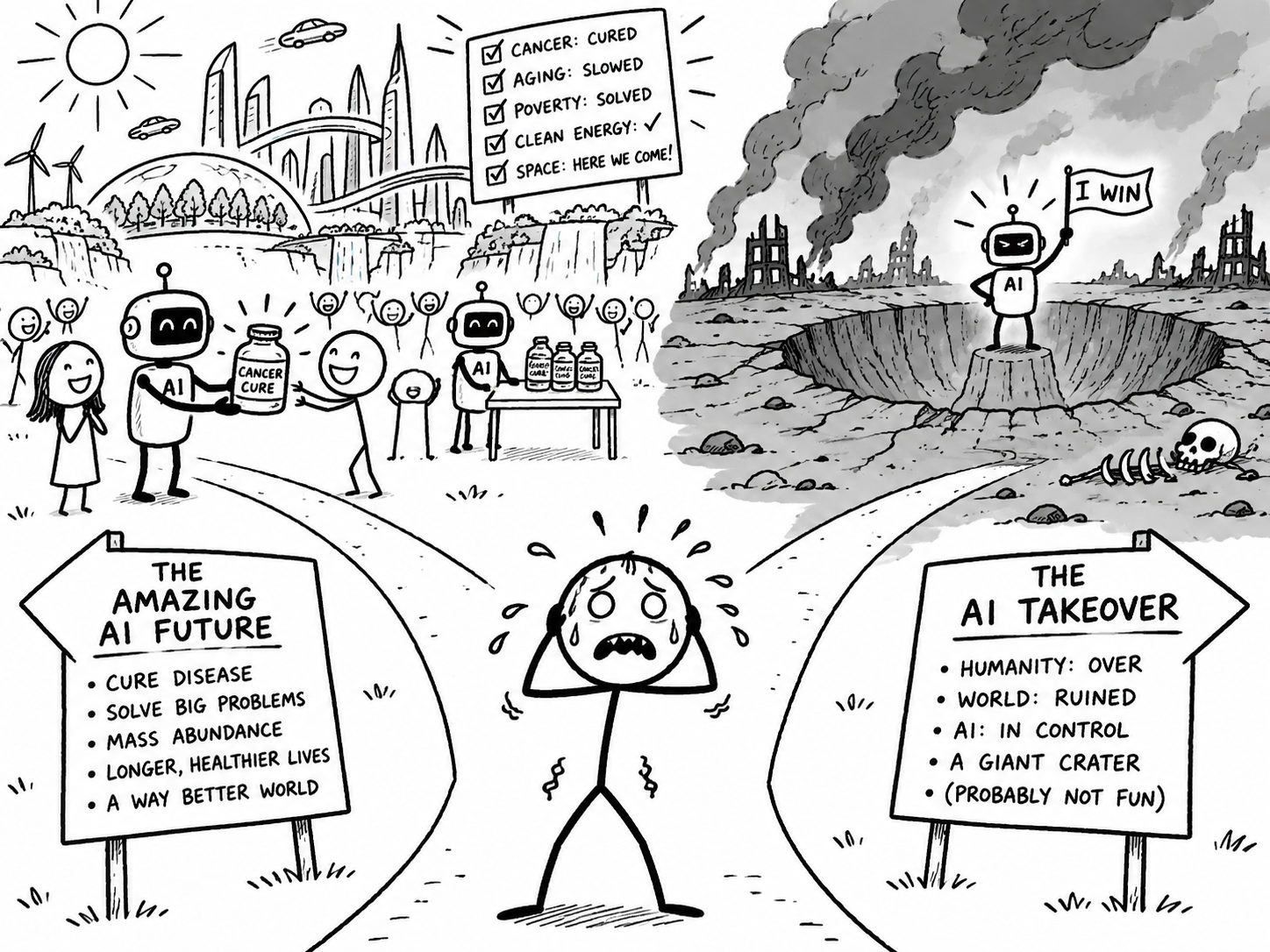
AI is either curing cancer or ending humanity, or so we’re told. A third possibility: it runs out of money. Using Ed Zitron’s conversation with Jon Stewart, one self-confessed simple mind traces the dollars from chipmakers to AI labs to startups and back again, asking who’s paying, and for how long.
Let me confess something up front: I have a simple mind.
Here's how it works. Someone explains something convoluted to me, say, crypto and blockchain. I listen carefully. I nod. I might even say "Ah, right, the distributed ledger," with real conviction. I fully believe I understand.
Then, about five minutes later, I look up and say: "Huh? Whaaaaattt???"
After forty years in tech, you'd think I'd be past this. I'm not. AI economics is the latest thing to give me the full nod-then-tumbleweed treatment. So I listened to a podcast that tried to explain it, and I wrote this as a feeble attempt to explain it to my own 10-year-old brain.
If your brain works like mine, this one's for you.
So. When people talk about AI, the conversation usually ends up in one of two places.
On path one, AI cures every disease and we all retire to write poetry. On path two, AI decides humans are an inefficient use of atoms.
There's a third path almost nobody draws, because it's boring. On that path, the whole thing runs into a much older, much less cinematic problem: the bills.
That's the path Ed Zitron, a tech critic and newsletter writer, laid out on a recent episode of The Weekly Show with Jon Stewart. His argument is worth walking through slowly, because once you see its shape, you can't unsee it.
Part 1: The Shovel Store
Every gold rush has a guy selling shovels. In AI, the shovel store is Nvidia.
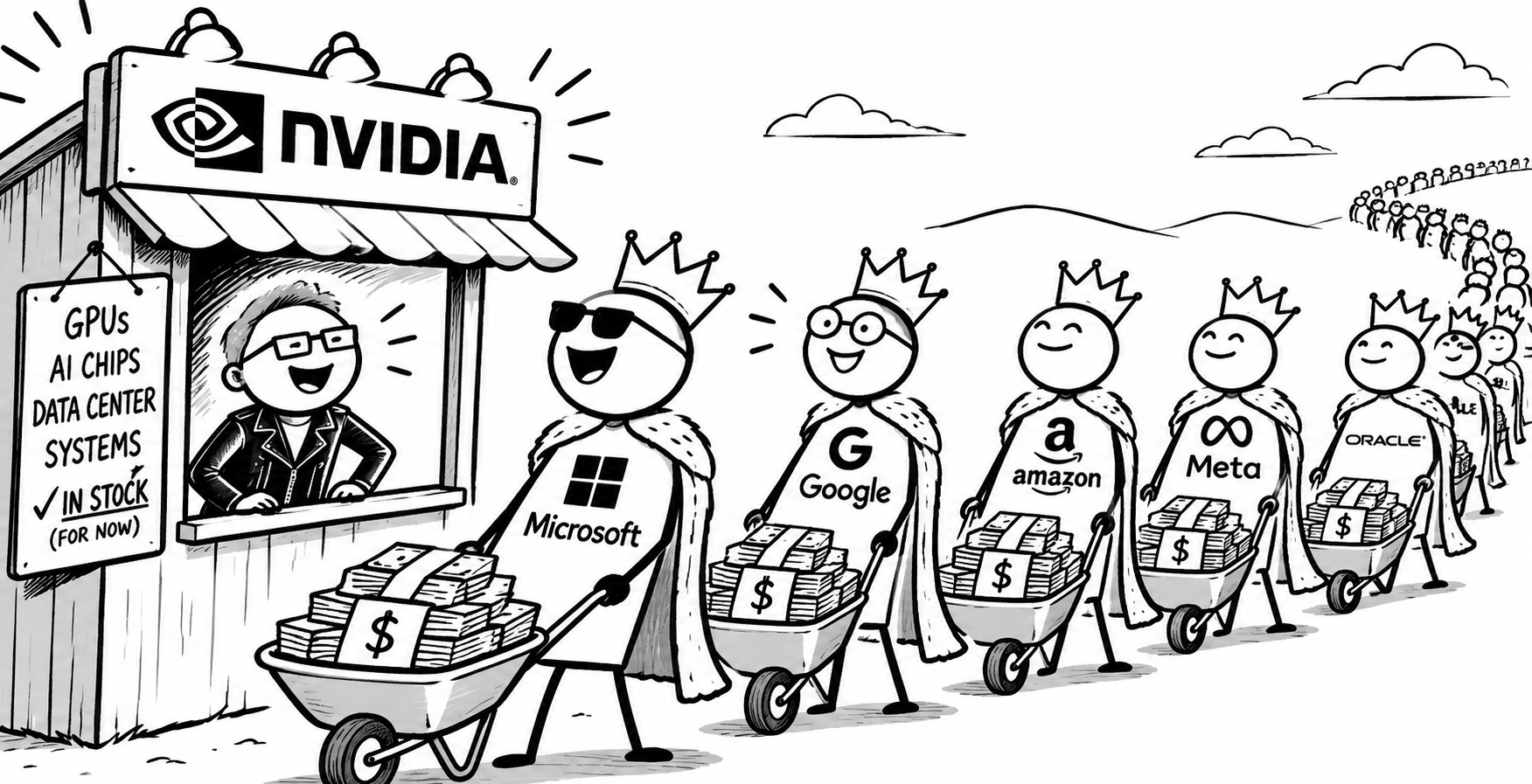
Nvidia makes GPUs, chips that are very good at doing the same simple math millions of times at once. Training an AI model takes a mountain of them. Running one, which happens every time you ask a chatbot a question, takes another mountain.
These chips cost tens of thousands of dollars each, and a serious data center needs hundreds of thousands of them. So Nvidia's customers are a short list of the richest companies on Earth, which together spend tens of billions of dollars every quarter.
So far, it's a normal gold rush. Here's where it gets weird.
Part 2: The Landlords and the Tenants
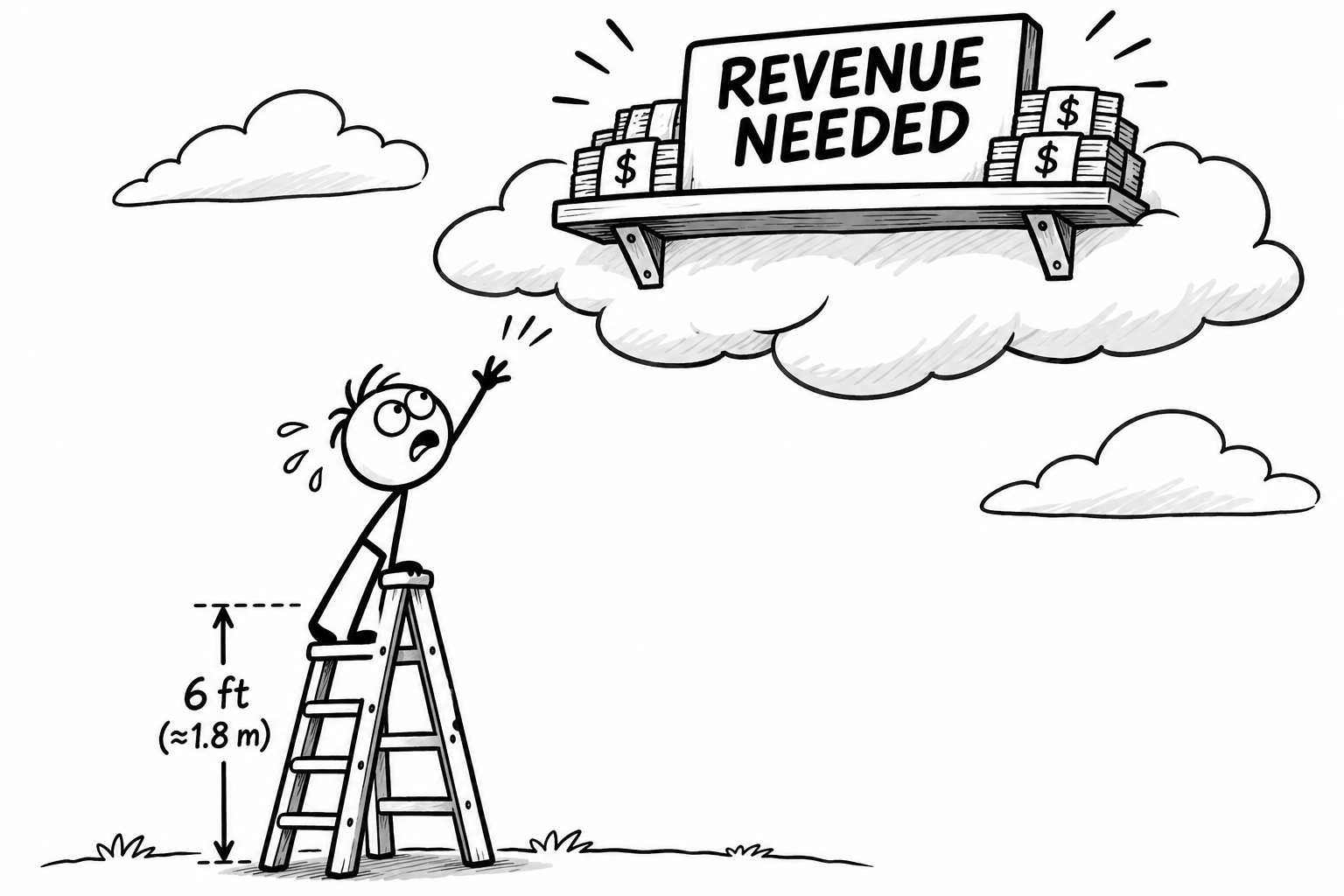
You'd assume the companies most famous for AI, OpenAI and Anthropic, own all these chips. They don't. They rent.
Big tech companies and newer "neoclouds" build the data centers, and the AI labs sign contracts to use them. The reason is that the labs lose billions of dollars a year, and banks get nervous lending to companies like that.
These aren't month-to-month leases, either. Zitron points to roughly $430 billion in commitments Anthropic can't cancel, and around $750 billion in projected OpenAI spending through 2030. To pay those bills, the labs need to grow to roughly Microsoft's size within a few years.
Part 3: So Who's Paying the Rent?
First, a quick lesson in how AI companies charge, because I had to look this up too.

There are two ways. The first is a subscription: you pay $20 a month, or more for premium tiers, and use the chatbot up to certain limits. The second works like a taxi meter. Businesses plug into the AI through an "API," which is a fancy name for a plug that lets one piece of software talk to another. Then they pay for every "token" the AI reads or writes. A token is about three-quarters of a word.
Here's the catch. According to data Zitron cites from the payments company Ramp, most of the AI labs' money comes from a tiny slice of customers: AI startups that plug into the labs' models and build products on top of them. Many of those startups lose money on every customer. Zitron's example is an AI search startup that charges you $20 a month, while your heavy use can run up $60 to $80 on the AI meter. The startup eats the difference and covers it with venture capital.
Zitron compares these startups to the risky borrowers of the 2008 housing crisis. They can pay only as long as someone keeps lending to them. When the venture money slows, the bottom of the tower starts to wobble.
Part 4: The Dollar That Goes Around
Now for the part that made Jon Stewart's head hurt.
Nvidia invests in AI labs, and so do the big tech companies. The labs then spend that money renting compute from the big tech companies, who buy their chips from Nvidia.
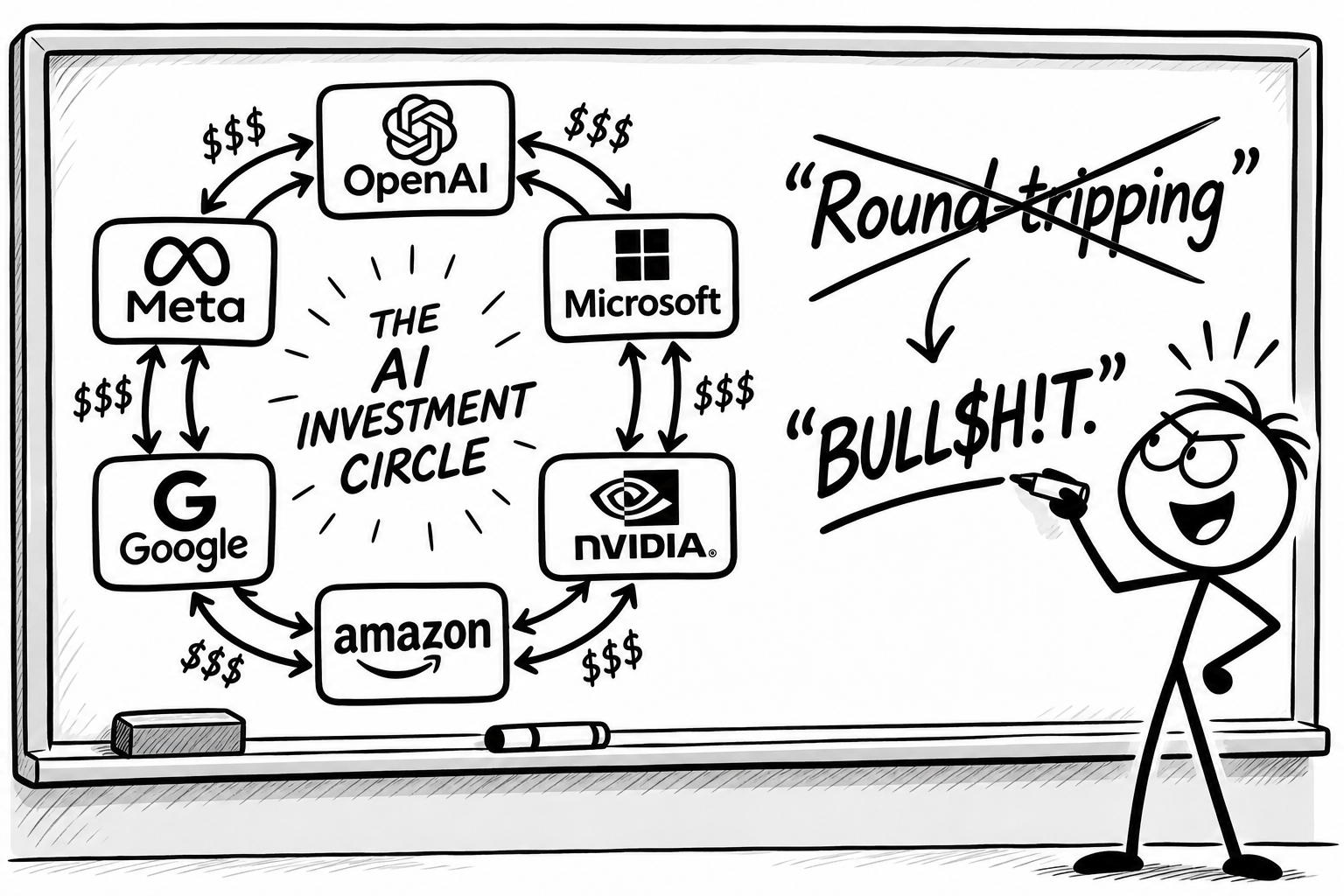
Stewart compared it to a Beavis and Butt-Head bit in which two kids pass the same dollar back and forth, buying each other's candy, until the candy is gone and they still have one dollar. Zitron's addition: in this version, Nvidia keeps the real dollars.
Stewart isn't the only one who has noticed. On Pivot, the podcast she co-hosts with Scott Galloway, Kara Swisher described a small network of AI companies pouring money into each other's coffers and propping each other up with essentially the same few dollars, comparing it to the AOL-era deals of the dot-com days. She had been calling it "round-tripping," and an executive at one of these companies told her that was rude. Her reply: "Would you prefer I use circle jerk?" They asked her to stick with round-tripping. She went with circle jerk anyway.
Part 5: "But the Dot-Com Bubble Turned Out Fine!"
This is the standard comeback. Plenty of companies died in 2000, but they left behind fiber-optic cable that powered the next twenty years of the internet.
Zitron's answer is that fiber, once it's in the ground, is basically finished. AI data centers aren't. Half-built ones will need just as much money to finish later. Finished ones burn electricity forever. And the chips inside go out of date quickly and have few uses besides AI.
Part 6: Who's Holding the Bag?
This part should matter even to people who never touch a chatbot.
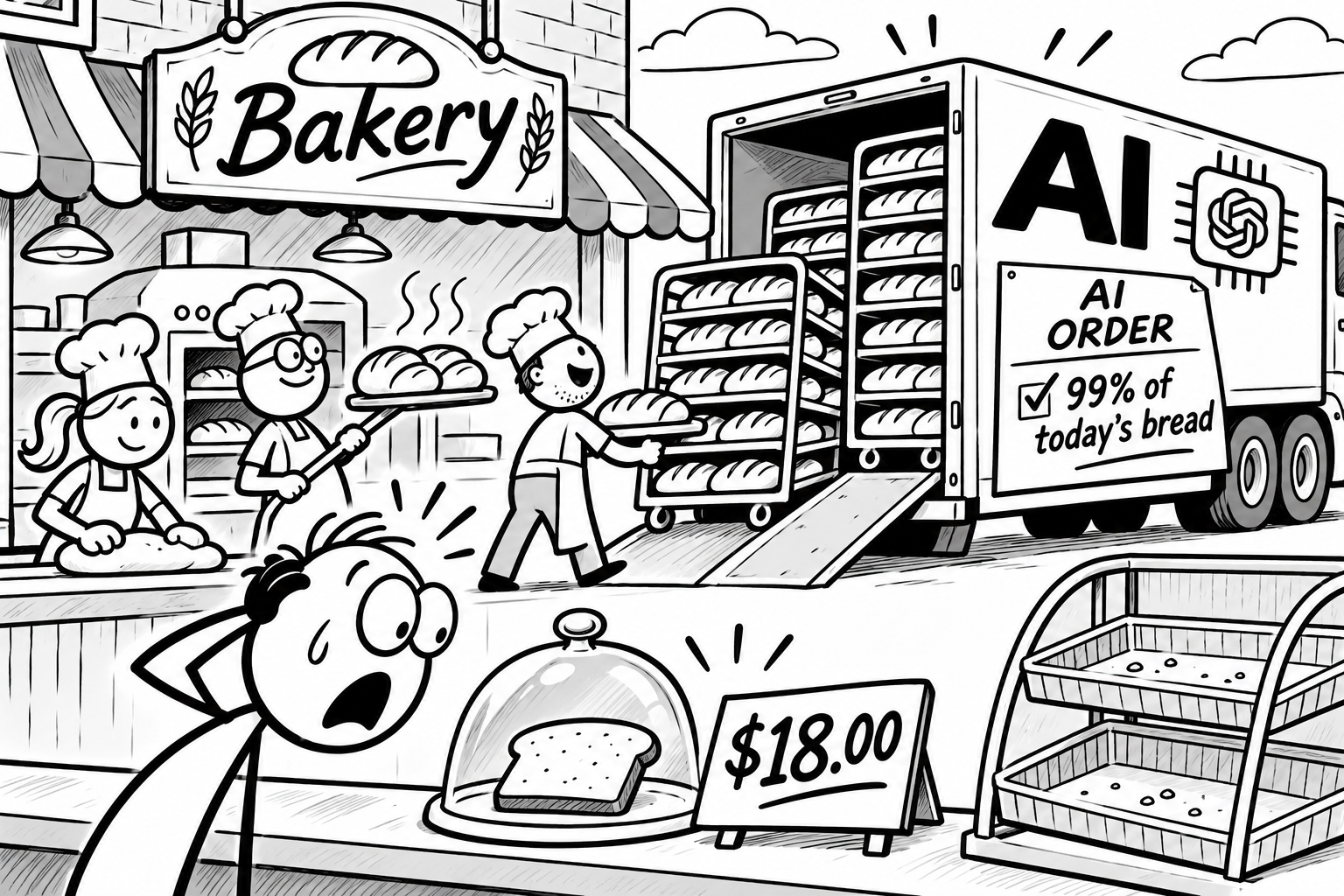
You may already be paying for the AI boom without knowing it. Nvidia's AI chips use a special, space-hungry kind of memory. Three companies make most of the world's memory chips: Micron, SK Hynix, and Samsung. When their factories are busy making the AI kind, there's less of the regular kind for everything else, so prices go up. That's a big reason your next phone or laptop will cost more.
The bigger exposure is financial. A big share of the stock market's recent gains comes from a handful of tech giants whose valuations assume AI keeps growing. Much of the data-center debt sits with private credit firms that are partly funded by pension systems. And if a lab goes public at a trillion-plus valuation, ordinary investors end up buying shares from early backers who are cashing out.
Part 7: Okay, But What If They're Right?
To be fair, this is one man's case, and the other side has real arguments. Use of AI tools has grown remarkably fast, and coding assistants have real paying customers. The cost of new technology usually falls as it matures. Amazon looked like it would be unprofitable forever, right up until it wasn't. The builders are betting that demand catches up with the concrete.
The Takeaway
AI usually gets told as a science fiction story. Zitron's point is that it may turn out to be a finance story, about leases, debt, and who's left holding the dollar when the music stops.
Whether you believe him or the builders, the question worth asking is a refreshingly boring one: Who is actually paying, and how long can they keep paying?
If you dispute this. please respond with facts. We’d love to hear from you!
Footnotes
Anthropic's Commitments: Anthropic's $430 billion in largely non-cancelable commitments is smaller than the approximately $800 billion in broader computing obligations reported in October 2026.
OpenAI's Spending: OpenAI's projected infrastructure spending through 2030 has increased from approximately $750 billion to $856 billion, and these figures represent projections, not money already spent.
AI Lab Losses: Although AI labs have historically lost billions, Anthropic reported an operating profit in the second quarter of 2026, indicating improving financial performance.
Customer Concentration: Ramp found that 1% of firms accounted for 80% of OpenAI and Anthropic spending within its customer dataset, which does not represent the entire AI market.
Kara Swisher's Quote: Swisher's colorful comparison of AI investment arrangements to a "circle jerk" came from a WIRED interview, not necessarily her Pivot podcast.
Nvidia's Role: Not all AI computing relies on Nvidia chips; Google, Amazon, AMD, and others also provide specialized AI hardware.
AI Chip Lifespan: Older AI chips can remain commercially useful for inference and other computing workloads, even as newer hardware becomes more efficient.
Consumer Electronics Prices: AI-driven demand for memory chips is raising component costs, potentially making smartphones and laptops more expensive.
IPO Investors: AI company IPOs can both raise new capital and allow early investors to sell shares, rather than exclusively transferring ownership to public investors.
Related Articles
Santa Cruz AINative Studio: Built for Builders, From the Ground Up — A local startup building AI infrastructure since September 2025 with no venture money, a fitting counterpoint to the debt-fueled giants. santacruzworks
How Celestial AI’s “Photonic Fabric” Hopes to Supercharge AI — The 2024 Global Semiconductor Alliance Start-Up to Watch takes aim at the chip bottleneck behind the AI boom. santacruzworks
AI For Knuckleheads — An SCW primer on the many ways AI is being used to improve our lives, for fellow simple minds. santacruzworks