

AI Isn’t Killing SaaS. It’s Rewriting the Budget.
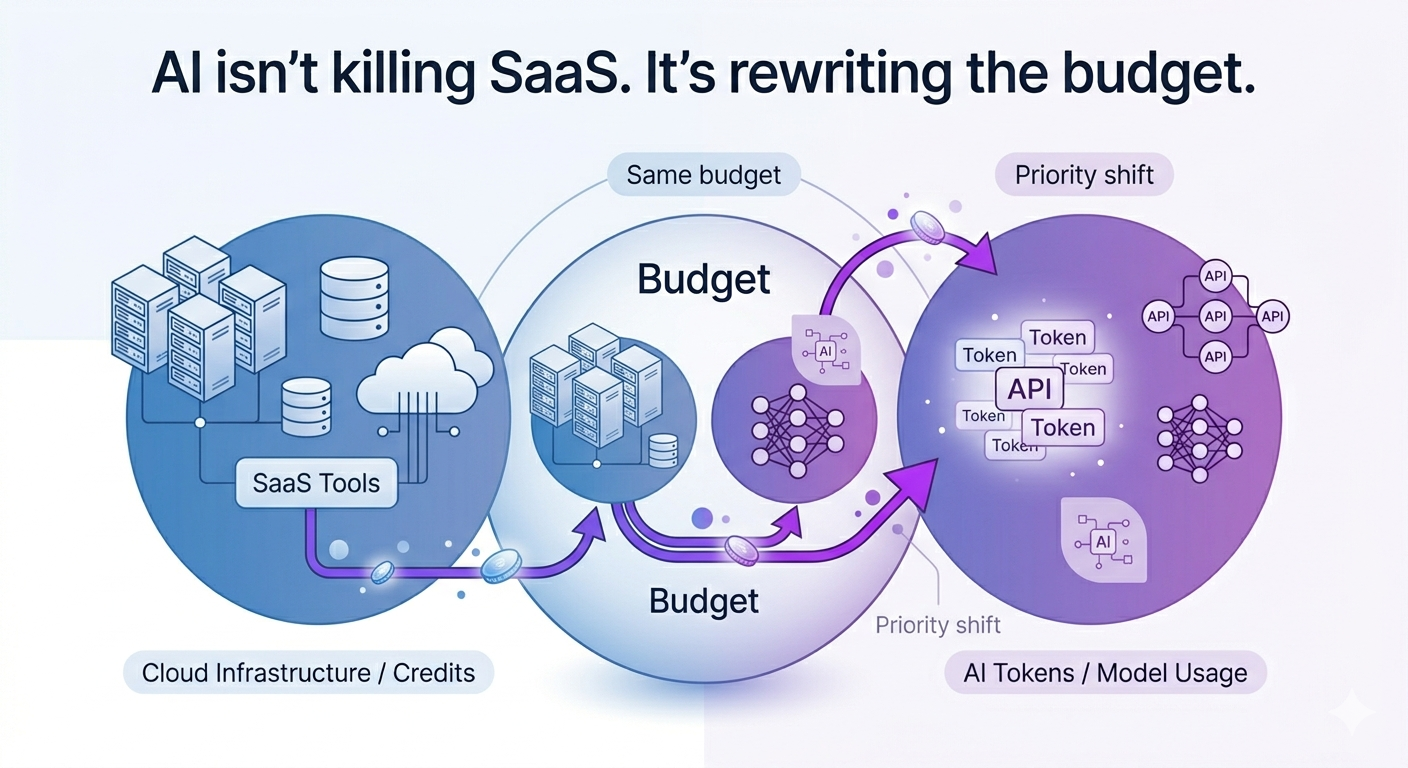
Over the past year, I’ve spent a lot of time talking with founders who are seeing something that doesn’t quite line up with their expectations. Their product is still good. In many cases it is better than it was a year ago. Customers still rely on it. And yet, deals are slower, expansions are harder, and in some cases seats are quietly disappearing.
It’s easy to interpret that as a signal that something is breaking in SaaS. That the model is weakening or that demand is softening.
What I’m seeing points to something much simpler and much more structural. The budget hasn’t grown, but the priority has changed.
Inside most enterprises right now, AI has moved to the top of the list. This is not happening at the team level. It is being driven from the top, often directly from the CEO or board, with an expectation that the company will find leverage, efficiency, and in some cases entirely new capabilities. When something rises to that level of importance, it doesn’t wait for a new budget cycle. It pulls from what already exists.
And what already exists is SaaS spend.
That shift is showing up in ways that can be confusing if you are only looking at your own product. A team that used to justify a tool based on productivity gains is now being asked a different question. Could this workflow be handled by an AI system instead? Could fewer people do the same work if they had better tools? Could we simplify this stack and redirect that spend somewhere that feels more strategic?
From the outside, that can look like churn or weakening demand. From the inside, it often looks like a reordering of priorities.
This is why the narrative that “SaaS is dead” doesn’t hold up. The demand for software has not gone away. If anything, the need for systems that structure data, manage workflows, and integrate across teams is increasing. What has changed is the standard those systems are being held to. They are now being evaluated in the context of what AI can do, not in the context of what came before.
That creates pressure, but it also creates clarity.
If you are building a SaaS company right now, the most important question is not how to defend your category. It is how your product fits into an environment where AI is already assumed to be present. In some cases, that means integrating directly with AI systems. In others, it means doubling down on the parts of your product that are difficult to replace, whether that is proprietary data, embedded workflows, or the trust you have built with your customers.
Related Articles
Startups Need AI Tokens More Than Cloud Credits
Why startup support is shifting alongside the AI stack — and what founders actually need now to build and compete.The $50,000 Mistake Founders Make Before Their First Funding Round
A look at how AI is changing startup execution and why founders need to rethink how they prepare for growth and fundraising.Santa Cruz Founders: Which Accelerator Is Right for You?
A practical guide for founders building in AI, enterprise, and deep tech as they decide where to get support for the next stage.A Santa Cruz Startup Tackling One of AI’s Biggest Blind Spots
An example of how local companies are adapting to the AI shift by building new infrastructure rather than defending old assumptions.UCSC Alumnus-Founded Company Confluent Acquired by IBM in $11 Billion Deal, Bolstering AI and Real-Time Data
A reminder that as AI budgets rise, the systems that manage trusted data and workflow infrastructure become even more strategic.
