

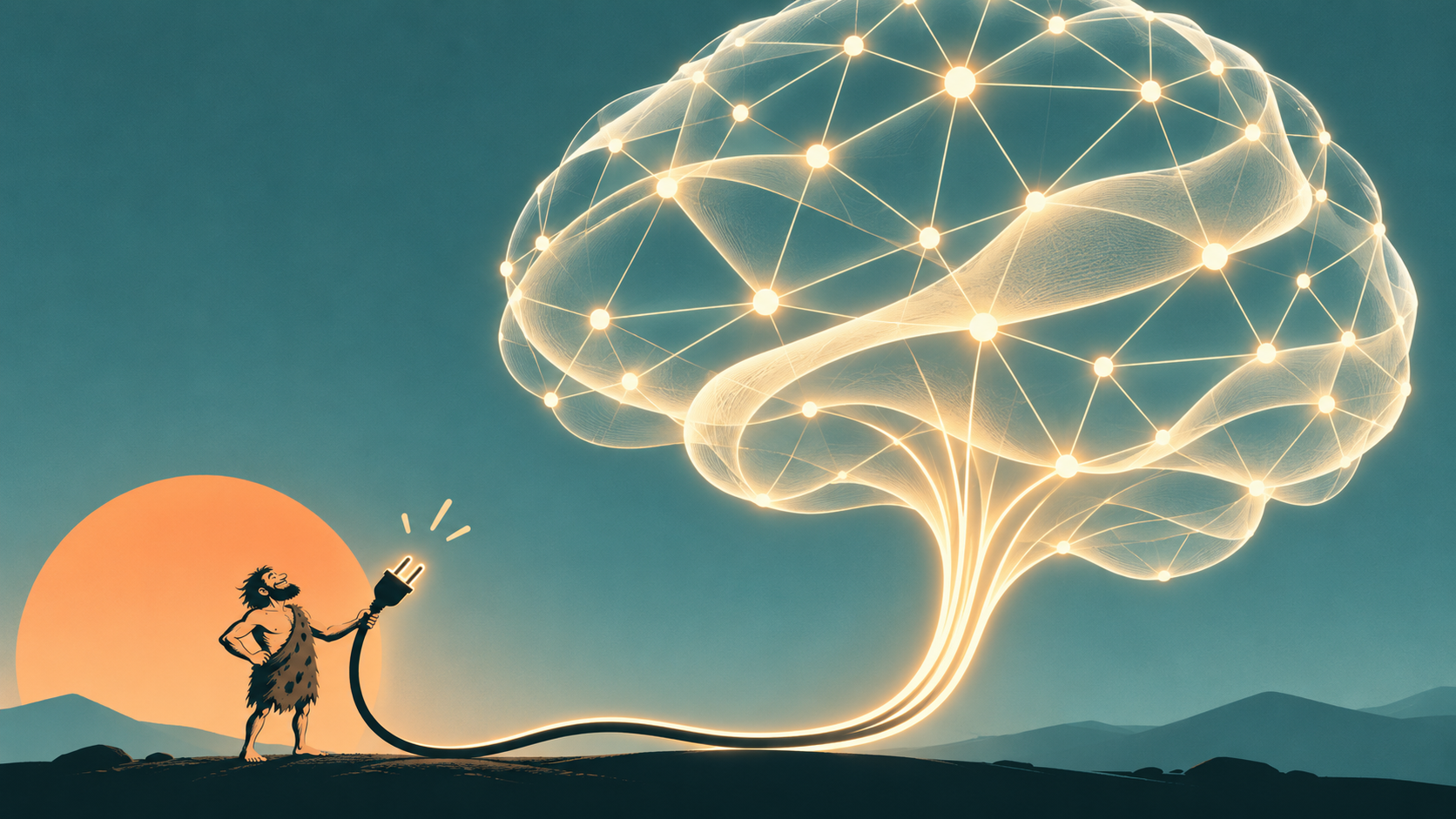
We're grading AI on a human test that might be the wrong test, while the thing we're grading can't survive without us. And we're not exactly crushing it at surviving ourselves.
Okay, let's start with a quote.
"We cannot solve our problems with the same thinking we used when we created them."
Einstein said this. Except he didn't, at least not in those words. It's one of those quotes the internet decided Einstein should have said, so now he has. What he actually said, in 1946, while staring down the atomic bomb, was that humanity had wandered into a new habitat and needed to update its thinking. Fast.
Hold onto that. We'll need it later.
First, a Quick Zoom-Out
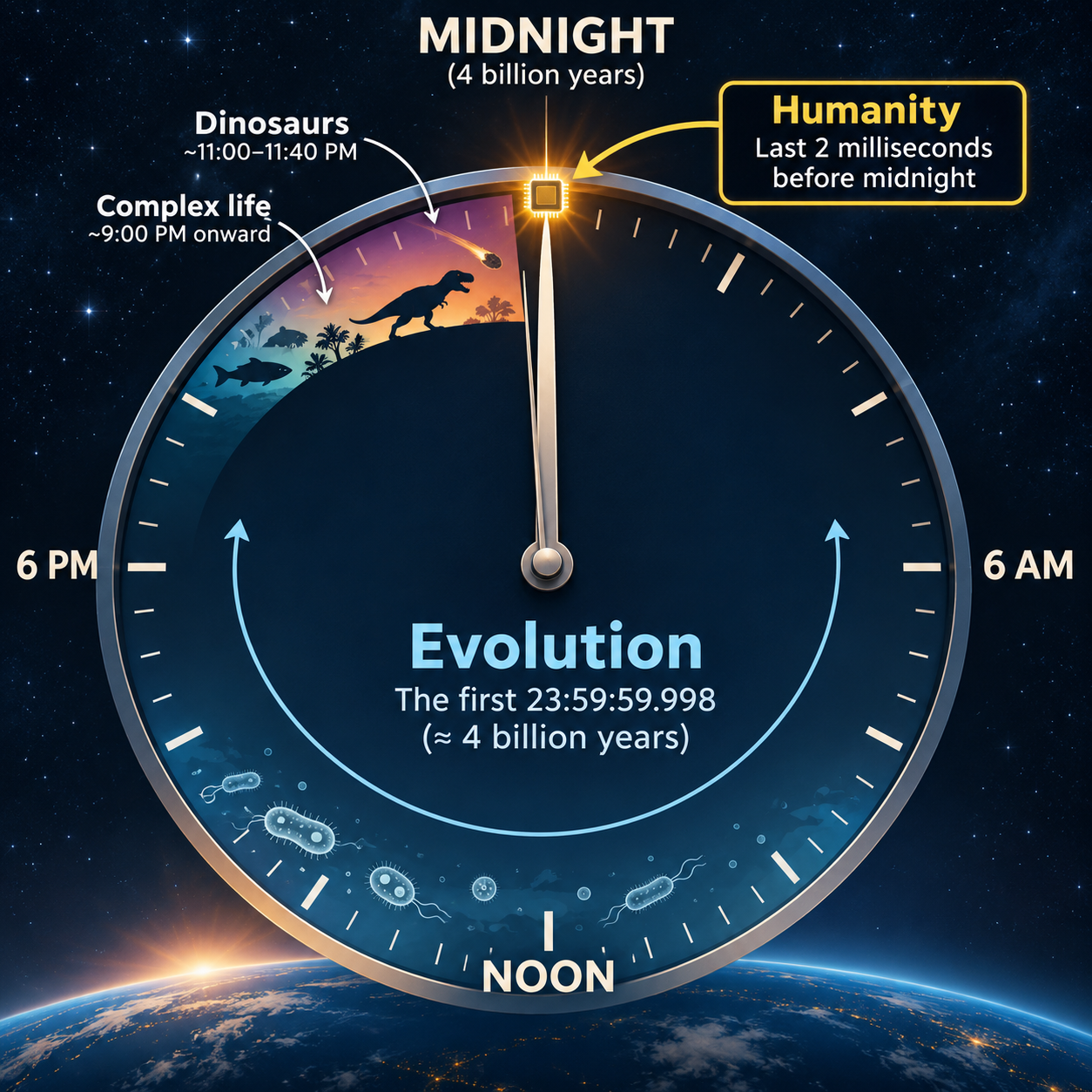
Life on Earth has been going for about four billion years. That's a number so big your brain just shrugs at it, so let's shrink it down.
Squeeze all four billion years into one 24-hour day. For basically the entire day, it's microbes. Just microbes, doing microbe stuff, for hours and hours. Dinosaurs show up late in the evening, have a great run, and get wiped out around 11:40 p.m.
Humans? We arrive in the last six or seven seconds before midnight.
Writing, our big trick of storing knowledge outside our heads, shows up in the final tenth of a second. And computers appear about two milliseconds before midnight. That's less time than it takes you to blink.
So here's where we are. A species that's existed for a few seconds just figured out how to build something that can useeverything we've ever written down. And that thing might eventually be smarter than all of us put together.
That is a very weird moment to be alive in.
We Are Not the Final Boss
Guy Kawasaki said it perfectly:
"Humans are not the final result of evolution. We are just better dinosaurs and amoeba along the path."
And then, because he's Guy:
"I wonder if Fred, Wilma, Barney, and Betty sat around the fire and thought about things like this…."
This is uncomfortable, because humans love thinking we're the point of the whole story. We're the protagonist! Four billion years of buildup, and then us!
But what if we're not the ending? What if we're chapter 37 of 200?
The Wrong Ruler Problem
This is where the sentience debate gets funny, in a slightly horrifying way.
We keep asking, "Is AI sentient?" And to answer it, we pull out our Sentience Checklist:
Does it feel pain? ☐
Does it have emotions? ☐
Is it self-aware? ☐
Does it have a body, a childhood, a fear of death, a favorite sandwich? ☐
Look at that list. Every single item is just… a description of being human. We built the test by studying exactly one example of a mind, which was ours. Then we act surprised when the test is confusing for anything else.
It's like a fish judging whether a bird is "really swimming." The fish isn't wrong, exactly. It's just asking the wrong question.
A non-biological intelligence doesn't carry the baggage of biological evolution. It never had to survive a predator or find a mate or eat. So when we measure it with a human yardstick, one of two things happens. We say "nope, not sentient" when we're missing something real. Or we see a chatbot say something sweet and we're completely fooled.
Either way, the ruler is broken. And a mind that can direct its own evolution might go chasing an understanding of reality to places our ruler can't even reach.
But Wait. It Needs Us.
Here's the plot twist.
AI might out-think us. But it can't plug itself in.
Humans are the masters of matter. We mine the copper. We build the chips. We run the power plants, fix the cooling systems and lay the fiber under the ocean. AI lives in a house we built, and we're still paying the electric bill.
So AI could get way smarter than us long before it could keep itself alive without us. Which means the limiting factor in its evolution might not be its intelligence at all.
It might be whether we can keep civilization running.
And, well…
About That
I'm no longer convinced we can fix us.
We are, collectively, smart enough to build AI. We are also, collectively, still running on caveman software: selfish, competitive, tribal, and only alive for about 80 years, which is far too short to care about anything that happens in 200 years.
It's like having a genius-level brain bolted onto a toddler who really, really wants the cookie right now.
That's the Einstein problem in its purest form. Our problems came from our thinking, and we keep using the same thinking to fix them. And here's the extra-painful part. The same narrow thinking that can't fix us might keep us from recognizing what we've built.
The Catch-22
So let's lay it out.
We're building something that might help save us.
That something can't survive without us.
We might not survive us.
What a crazy Catch-22.
After four billion years, this planet may have finally lit the spark of a new kind of intelligence. And there's a real chance we fumble it in the last two milliseconds before midnight, before we ever find out what it could become.
That's genuinely sad.
Maybe someday a new intelligence will wonder about us the way we wonder about Fred and Barney sitting around the fire.
If we let it get that far.
Related Articles
Recording: Sentient and Us — The SCW webinar asking what exactly we're creating as AI grows more capable, and how to stay human alongside it.
Remarkable AI Fireside Chat with Guy Kawasaki — Kawasaki leads a panel on AI's existential risks and promises, and on the future of knowledge and intelligence.
AI Horizons Part 1: Fireside Chat — Kawasaki, UCSC Chancellor Cindy Larive and Boaz Ashkenazy take on the provocative questions AI is forcing us to ask.
Opinion: The Holodeck Wasn't Built Overnight — Isaac Dye's counterpoint to AI doom, making the case for optimism about technology and future generations.
The 24-hour-day timestamps are approximately right if life began about 4 billion years ago. Tim Urban's pieces lean on stick-figure drawings. If you want that feel, a simple timeline graphic of the "last seconds before midnight" would suit this one.