

Interim Trail Survey Results
Santa Cruz Works members didn’t exactly whisper their opinion about the Regional Transportation Commission’s (RTC) decision to advance an Interim Trail (vs. the Ultimate Trail) alignment. The survey results show a clear, lopsided preference for moving forward now, with the infrastructure and funding reality we actually have, rather than waiting on a long-term vision that has repeatedly stalled out.
In the article, Santa Cruz Works describes the RTC vote as a long-overdue pivot: not a clean “everyone agrees” moment, but a practical decision that breaks years of paralysis and directs staff to advance a trail that can be designed and built within real constraints. The argument is straightforward: the “Ultimate Trail” approach has struggled to pencil out against corridor limitations, timelines tied to grants, and hard engineering obstacles in the most complex segments. The Interim Trail, by contrast, is framed as a buildable path that prioritizes safety and near-term public use while keeping future options alive.
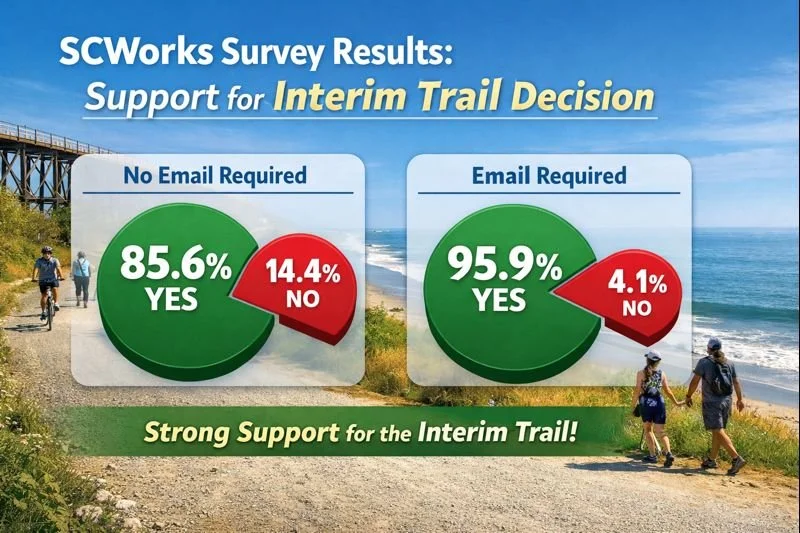
That framing seems to match where respondents landed. In the survey version that required no email address, 85.6% supported the Interim Trail decision, while 14.4% did not. In the version that required an email address (used only to reduce bots and repeat responses, per the article’s survey note), support rose to 95.9%, with 4.1% opposed.
Even without over-interpreting the gap between the two versions, the takeaway is consistent: members are signaling strong alignment with the RTC’s move toward a “do the feasible thing now” approach. Practically, that looks like prioritizing a safe, functional trail on an accelerated timeline, protecting existing grant funding, and reducing the risk that Santa Cruz County ends up with no trail, no rail, and another decade of meetings that generate heat instead of progress.
The article also emphasizes why this moment matters beyond the vote tally. It describes how the Interim Trail approach provides clearer expectations for residents living along the corridor, acknowledges “showstopper” constraints like the Capitola trestle and Beach Street, and shifts the corridor conversation from abstract futures to real access and connection. That resonates in the survey’s intensity: members are not just mildly supportive, they are overwhelmingly supportive, even when the survey adds a basic friction layer to deter low-quality responses.
Bottom line: SCWorks members appear ready for momentum. The Interim Trail is viewed less as a compromise and more as a long-delayed step into practical delivery, where timelines, budgets, and public benefit finally get to outrank ideology.
Related Articles (SCWorks News)
A Clear Path for Santa Cruz: The RTC Finally Moves Toward a Reality-Based Interim Trail (Santa Cruz Works)
RTC’s $4B Dilemma: A Reality Check on Santa Cruz’s Rail Fantasy (Santa Cruz Works)
Stubborn facts derail the train in Santa Cruz County (Santa Cruz Works)
How Santa Cruz's Rail Trail Reflects a Broader Democratic Problem (Santa Cruz Works)
The Story Behind the Santa Cruz County Rail-trail (Santa Cruz Works)