

Murray Street Bridge: Two-Way Fix, One-Way Thinking
What? Why? Huh?!?!?!?
Breaking news from the Department of Almost: the Murray Street Bridge is going to reopen temporarily, but only as a one-way, eastbound lane for cars and bikes, while pedestrians get two-way access, because apparently feet have earned more trust than engines. Then, just when summer rolls in and everyone actually needs the thing, it shuts down again. But do not worry, the city is “evaluating options,” including a possible two-way pilot, which is a bold experiment in the radical idea that traffic can take turns. And the simplest fix, a two-way automated traffic light, remains “under consideration,” like it is an alien technology we found in a crater. Join over 2,000 people, sign the petition NOW!
This What? Why? Huh?!?! moment brought to you by the common sense of Santa Cruz Works
This article submitted by Will Mayall
When the Facts Keep Changing: Transparency Failures Around the Murray Street Bridge
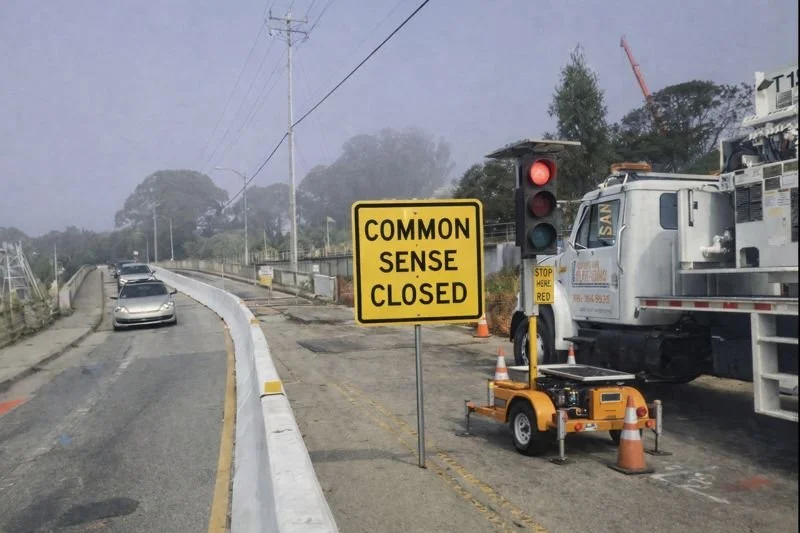
The Murray Street Bridge crisis is often framed as a series of difficult technical decisions — about safety, liability, cost, and construction constraints. But for the community living with the consequences, the more fundamental problem has been something else entirely: the persistent inability to get clear, consistent, and verifiable facts from City decision-makers.
This is not only about traffic management. It is also about the City Council’s handling of a proposed temporary pedestrian and bicycle path on the adjacent rail bridge — a solution that was publicly encouraged, actively pursued for months, and then abruptly abandoned.
In both cases, the pattern has been the same: the City appeared to move toward a solution, community members invested time and trust in that process, and then the solution was withdrawn based on explanations that shifted over time and were difficult to reconcile with available evidence.
The rail bridge path: raised, pursued, then discarded
In response to severe economic harm to Seabright and Harbor businesses during the full bridge closure, the City Council directed staff to explore using the unused rail bridge as a temporary pedestrian and bicycle crossing. This direction was not casual. Multiple design options were proposed publicly. Cost estimates were developed. The City worked with the Regional Transportation Commission and discussed right-of-entry agreements. Business owners and residents were repeatedly told that the option was being seriously pursued.
Then, after months of discussion, the City Council unanimously voted to abandon the rail-bridge path, citing legal risk, engineering concerns, insurance challenges, funding difficulties, and opposition from the rail operator.
Each of these factors may be real. What was missing was a clear, transparent accounting of how they were weighed — and why obstacles that initially appeared manageable later became deal-breakers. From the public’s perspective, the City moved from “this is possible” to “this was never viable” without adequately explaining what changed.
The traffic signal issue follows the same pattern
A similar lack of clarity has surrounded the decision to rely on limited-hours human flaggers rather than automated two-way traffic signals when one lane of the bridge reopens.
City communications have described automated signal systems as prohibitively expensive and impractical. Yet multiple private parties independently obtained written quotes from established traffic-control vendors showing that long-term portable automated signal systems could be deployed for well under $150,000 over the full construction period.
By contrast, the cost of staffing human flaggers for comparable coverage over the same timeframe is substantially higher, while providing less consistency and fewer hours of operation.
These are not abstract disagreements. They are concrete numbers that have never been publicly reconciled by City staff. No side-by-side cost comparison has been released. No explanation has been offered for why independent vendor pricing differs so dramatically from figures cited by the City. As a result, the public is left unable to evaluate the rationale behind the decision.
Why this matters
The problem is not that the City faced difficult choices. The problem is that the factual basis for those choices has been opaque and unstable.
Residents and business owners should not have to crowdsource engineering estimates, insurance assumptions, or traffic-control pricing in order to understand decisions that directly affect their livelihoods. When solutions are encouraged and then withdrawn, or dismissed as infeasible without clear documentation, trust erodes — even if the final decision might otherwise be defensible.
This is a city of roughly 60,000 people managing a local construction project. The expectation is not perfection, but transparency: clear assumptions, consistent explanations, and an honest accounting of tradeoffs.
The Murray Street Bridge situation has shown how damaging it is when those basics are missing. Until the City commits to laying out the facts plainly — for both the rail bridge path and the traffic management decisions — frustration will continue, and confidence in local governance will remain shaken.
Related Articles