

Subsense and the Quest to Read the Brain Without Surgery
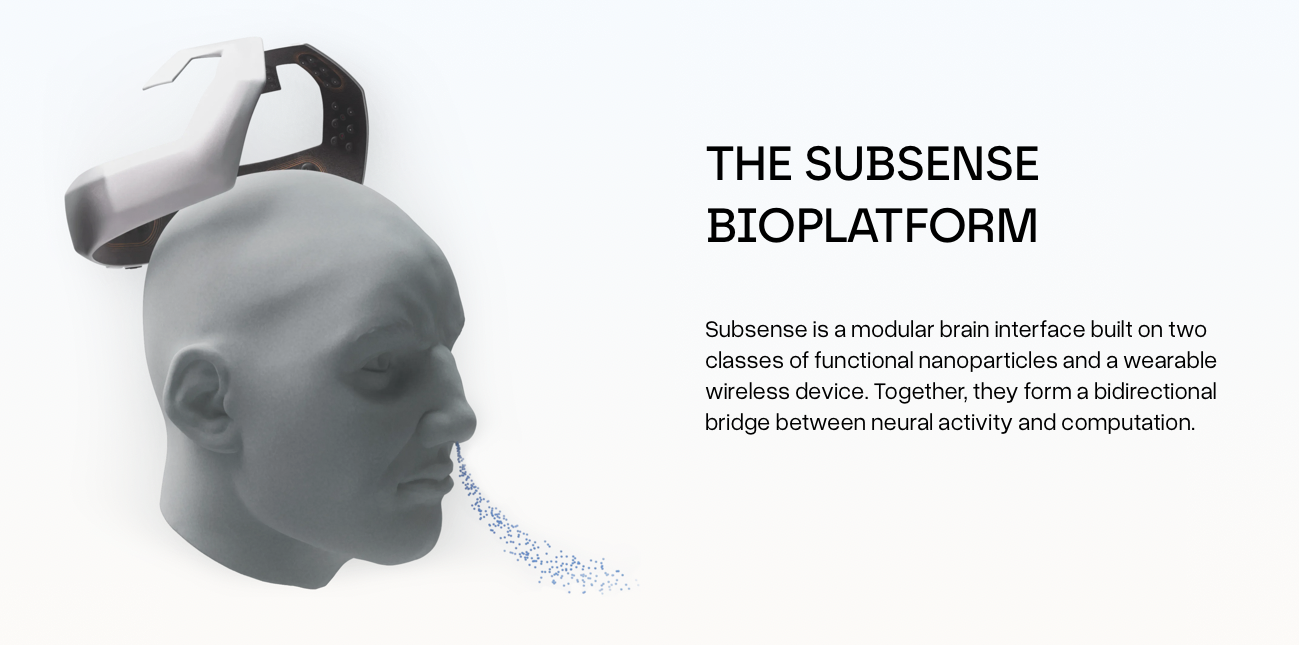
Subsense is chasing one of the most ambitious ideas in medicine and technology: a brain-computer interface that does not require opening the skull. The company describes its approach as a non-surgical, minimally invasive bioplatform that combines functional nanoparticles in the brain with a wearable wireless device to read and write neural signals. That is a striking departure from the better-known image of BCI as implanted hardware, and it is exactly why Subsense is worth watching.
At the center of the platform are two kinds of nanoparticles paired with external hardware. According to Subsense, one part of the system is designed for optical neural readout, while another is aimed at targeted neuromodulation using magnetic fields. The company says this could enable brain access without implanted electrodes, with the long-term goal of creating a bidirectional bridge between neural activity and computation. Subsense also states that its products are not authorized, cleared, or approved by the FDA for marketing in the United States, which matters because this is still a frontier technology moving through research and early regulatory engagement, not a finished clinical product.
The near-term focus is medical, and that makes the story far more compelling than the usual sci-fi haze around neurotechnology. Subsense says its first product is aimed at accessible neurostimulation and neural-reading solutions for neurological disease, with Parkinson’s disease and drug-resistant epilepsy among the early targets. The company frames medicine as the foundation, with broader possibilities later in communication, perception, and human-AI interaction once safety and precision are proven. That is the sane order of operations, rare and refreshing in a sector that too often wants to skip directly to mind-meld marketing.
The company has also built momentum around its growth. Subsense says it has raised $27 million in seed funding plus an additional $10 million, opened a lab in Palo Alto, and begun early engagement with the FDA on its regulatory approach. Its leadership team includes CEO and co-founder Tetiana Aleksandrova, alongside senior leaders in R&D, regulatory, clinical, hardware, and machine learning.
Prof. Ali A. Yanik of UC Santa Cruz, a Subsense research partner, sees the company’s approach as a meaningful step forward for neuroscience. He says integrating nanoparticles into brain-computer interfaces could improve the precision of neural communication, opening new possibilities for treating neurodegenerative diseases while also expanding the long-term potential of human cognitive capabilities.
Readers curious about where brain interfaces may actually be headed should attend Santa Cruz Works New Tech on April 1 at Chaminade. The event features networking, live music, food, and rapid-fire startup presentations beginning at 7:00 p.m. It is exactly the kind of room where big ideas get tested in public, and where a company like Subsense can turn futuristic promise into a conversation about real-world impact.
Related Articles
Santa Cruz Works New Tech April 1, 2026
An Organoid’s View of the Future of the Lab
How Open Culture Science Is Rewriting the Future of the Petri Dish
Titans 2025 Nominees
Santa Cruz Launchpad 2026