

Save The Waves: A Wave is Never Just a Wave
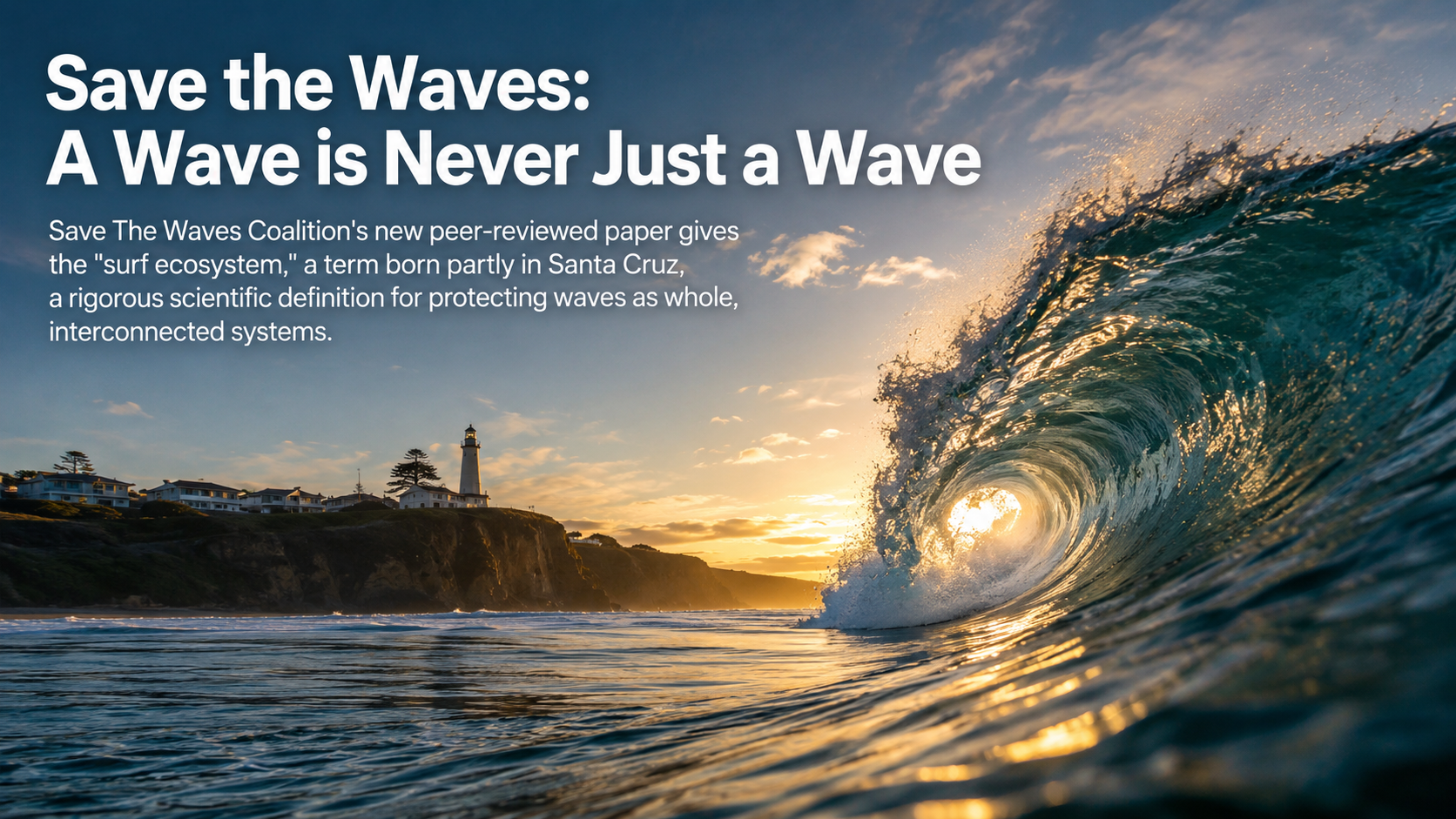
Save The Waves Coalition's new peer-reviewed paper gives the "surf ecosystem," a term born partly in Santa Cruz, a rigorous scientific definition for protecting waves as whole, interconnected systems.
I have spent enough hours staring at a lineup, waiting for a set that may or may not come, to have developed a private theory about waves: that a wave is not a thing so much as a temporary agreement among a dozen forces that mostly have nothing to do with each other. Swell born in a storm a thousand miles offshore. A reef or a sandbar shaped by decades, or millennia, of sediment nobody was watching. A river mouth upstream doing something to the water quality that will decide, months later, whether anyone wants to paddle out at all. Regulators, understandably, have never known what to do with an agreement like that. They write permits for shorelines, not for systems that begin in a distant storm cell and end in someone's memory of a particular afternoon.
A new paper in NPJ Ocean Sustainability tries to close that gap. Nik Strong-Cvetich of Save The Waves, along with Diego Sancho-Gallegos, Mara Arroyo, Cliff Kapono, and Dan Reineman, has done something that sounds almost clerical and is not: they have given the phrase "surf ecosystem" an actual definition. The term has been floating around for years, used by the World Surf League, used by conservation groups, used by planners in Peru and New Zealand, each of them meaning something slightly different. The paper fixes that. A surf ecosystem, in their formulation, is the interaction of three components, geophysical, ecological, and social, that together produce a breaking wave and the human experience of riding it. Disturb any one component and the wave itself can degrade, sometimes past recovery.
The paper's real contribution is not the definition, though. It is the typology underneath it, six categories of surf ecosystem, reef, point, beach, river mouth, rocky reef, and artificial structure, each mapped against its own threats and vulnerabilities, and four management orientations that range from watershed-level regulation down to community stewardship at a single break. The authors draw a comparison I found genuinely moving: the Hawaiian ahupuaʻa system, which managed land from mountaintop to reef as one continuous unit, understood this integration centuries before anyone needed a peer-reviewed paper to say so. Fittingly, Hawaii is also where modern surfing came from.
There is money in this too, real money, the kind that gets a coastal agency's attention when the ecological argument alone does not. The paper cites global surf tourism value in the tens of billions annually, with individual breaks worth tens of millions to their local economies. That number does useful work. It turns a wave from a scenic amenity into a line item.
Whether any government adopts "surf ecosystem" as a formal protected category remains an open question, and these things move slowly, one threatened break at a time. But the vocabulary now exists, tested and citable. That is not nothing. It gives the next person fighting for a river mouth or a reef pass something more solid to stand on than a feeling.
Related Articles
Blue Innovation: Save The Waves Santa Cruz World Surfing Reserve — How the Santa Cruz World Surfing Reserve is applying surf ecosystem thinking to sea level rise and coastal adaptation along West Cliff and Capitola.
Onda Sports: Personalizing the Surf Experience — A Santa Cruz startup using AI-driven forecasting to help surfers read local conditions with more precision.
Surf's Up, Waste's Down: How One Santa Cruz Startup is Revolutionizing Surf — Swellcycle's effort to turn recycled plastic into 3D-printed surfboards, part of a broader push toward a cleaner surf supply chain.