

UCSC, Santa Cruz and Water: The Deal Was Made a Long Time Ago
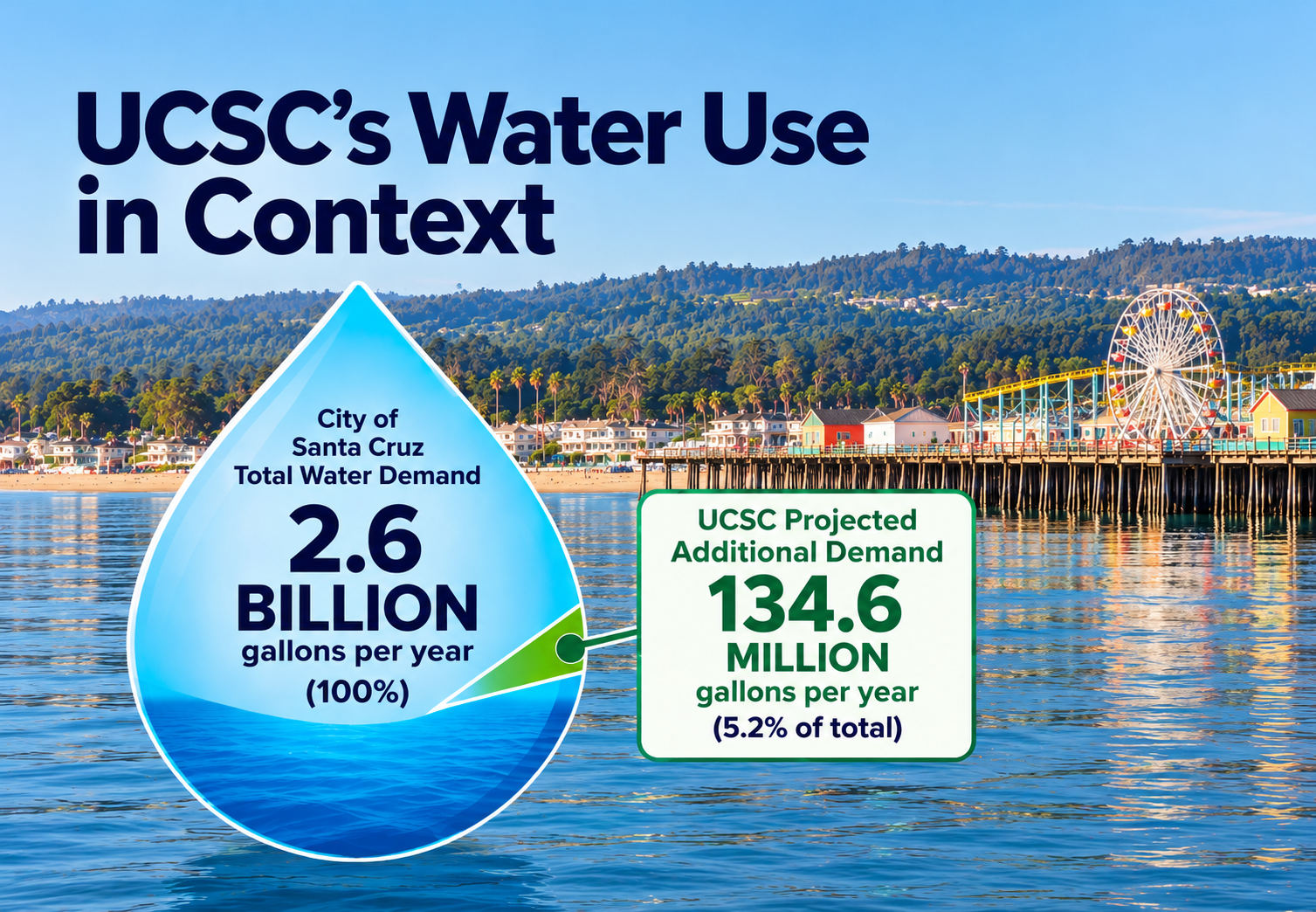
Santa Cruz promised UCSC water in the 1960s to win the campus, and an appeals court has upheld that deal. The real question isn't whether UCSC gets water. It's how growth can use less.
The debate over how much UC Santa Cruz should grow, and how much water that growth will require, is hardly new. But one fact often gets lost: when Santa Cruz fought to bring a University of California campus here in the early 1960s, everyone knew it was supposed to become a very large university.
Santa Cruz wanted the campus. The City made commitments to help persuade the UC Regents to choose the Cowell Ranch over competing locations. Among those commitments was water.
In 1962, the City and Regents signed an agreement requiring Santa Cruz to provide water and sewer lines, at no expense to the university, to the campus boundary as necessary for campus development. A 1965 agreement required the water system serving UCSC to be capable of supplying up to 2 million gallons in 24 hours for fire flow and ordinary use. Those agreements remain at the center of today's dispute. (2024 Court of Appeal decision)
And this wasn't an agreement made for a tiny liberal-arts college hidden in the redwoods.
UCSC's original 1963 Long Range Development Plan envisioned 27,500 students by 1990 and 15 to 20 residential colleges and professional schools. Today's 2021 LRDP plans for up to 28,000 full-time-equivalent students by 2040. That is remarkably close to the scale envisioned when UCSC was created. (UCSC 2021 LRDP)
What has changed? Water use.
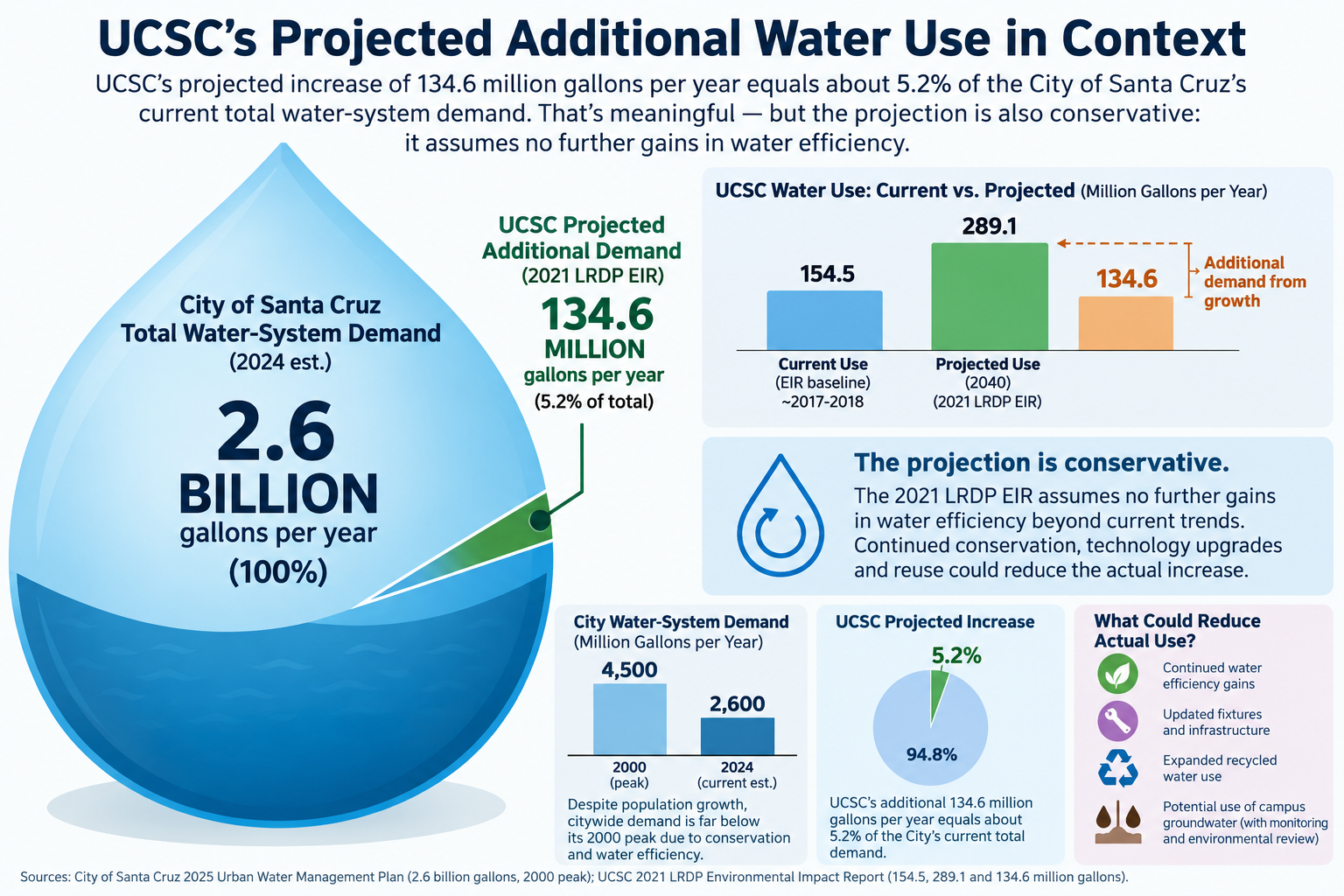
The City of Santa Cruz water system currently uses approximately 2.6 billion gallons annually. That's dramatically below its historical peak of roughly 4.5 billion gallons around 2000, despite population growth. The City's 2025 Urban Water Management Plan projects demand increasing relatively slowly, to approximately 2.9 billion gallons annually by 2045–2050. (City of Santa Cruz 2025 Urban Water Management Plan)
UCSC has also dramatically reduced its water consumption through conservation. Main-campus use fell from 179 million gallons in 2012–13 to about 154 million in 2017–18, even as enrollment grew.
Growth, however, will push campus demand upward. UCSC's water supply evaluation projects demand for the main campus and Westside Research Park rising from a 2017–18 baseline of 154.5 million gallons to 289.1 million gallons by 2040. The Coastal Science Campus, planned separately, adds roughly 10 million more at buildout.
That's an additional 134.6 million gallons annually, or about 369,000 gallons per day. (UCSC LRDP Environmental Impact Report)
For perspective, that additional 134.6 million gallons equals approximately 5.2% of today's entire 2.6-billion-gallon City water-system demand.
That's meaningful. But the projection is also conservative: it assumes no further gains in water efficiency. Given UCSC's conservation record, there's room to beat it.
UCSC has water beneath its feet
UCSC has studied the karst aquifer beneath the campus for decades.
Its WSW#1 well, near the Center for Agroecology in Jordan Gulch, underwent a seven-day pumping test in 1989 at 100 gallons per minute. In 2007, UCSC conducted another 72-hour test averaging 92.5 gallons per minute.
The university's water supply evaluation describes 92.5 gallons per minute as a sustainable rate, with very limited drawdown and no observable effect on off-site spring flows. That rate is equivalent to about 48.6 million gallons per year.
There's an important limit, though. UCSC plans to use the well for non-potable water: irrigating the campus farm and Arboretum, reducing City demand during droughts, and backstopping supply if City water isn't available to some parts of campus. Those two irrigation uses consume about 10 million gallons a year today, rising to roughly 12 million by 2040.
Most projected growth is drinking water for people. Residential use alone is projected to more than double, from 75 million to 169 million gallons. Untreated well water can't meet that need.
Still, the well points to a more productive conversation. Groundwater for irrigation, recycled water, and continued conservation could all shrink what UCSC ultimately draws from the City system.
Can the City simply say no?
That's where history, and the courts, become important.
In November 2024, California's Sixth District Court of Appeal interpreted the 1962 and 1965 agreements and directed the trial court to declare that Santa Cruz is obligated to provide water service to the UCSC campus boundaries.
Once water is delivered, UCSC may distribute it through its own infrastructure to any portion of the campus, including new development and portions outside City jurisdiction.
The court also rejected the argument that LAFCO approval was required before City water could serve North Campus. At the same time, it upheld the trial court's finding that the City did not breach the agreements by seeking LAFCO approval in the first place. (Court of Appeal decision)
There's additional history reinforcing that relationship. In the City's 2008 Comprehensive Settlement Agreement with UCSC, the parties expressly stated that the agreement did not "change, modify, or alter" the 1962 and 1965 contracts. That settlement was tied to UCSC's 2005 LRDP, which the 2021 plan replaced. But it confirms both parties treated the original contracts as intact. (City water-supply assessment containing settlement history)
The 2024 appellate opinion is unpublished and therefore generally cannot be cited as precedent in unrelated California cases. But between these parties, it resolved the central contractual dispute and directed entry of declaratory relief defining the City's water-service obligation.
That doesn't mean every future water question has been decided. The court did not determine that UCSC has an unlimited right to any quantity of water under every circumstance. As a City customer, UCSC remains subject to drought allocations and demand-reduction measures. Questions involving system capacity and the 2-million-gallon-per-day infrastructure provision could present different legal issues.
But a City Council attempt to simply reverse the basic water-service obligation faces a formidable legal barrier: agreements Santa Cruz voluntarily made more than 60 years ago, and a Court of Appeal decision interpreting them.
The more useful question today isn't whether Santa Cruz can turn off UCSC's water.
It's how the City and university can accommodate growth while using less of it.
Sources
UCSC 2021 Long Range Development Plan — The university's official plan for accommodating as many as 28,000 students through 2040, including housing, infrastructure and sustainability planning.
Read the UCSC LRDPUCSC 2021 LRDP Water Supply Evaluation (EIR Appendix J) — Projected campus water demand through 2040, the WSW#1 groundwater well, and the history of the 1962 and 1965 agreements.
Read the UCSC water supply evaluationCity of Santa Cruz 2025 Urban Water Management Plan — The City's current assessment of water demand, supplies, drought reliability and projected future needs.
Read the City's water planRegents of the University of California v. City of Santa Cruz (2024) — The Sixth District Court of Appeal decision interpreting the City's obligations under the 1962 and 1965 UCSC water agreements.
Read about the Court of Appeal decisionUCSC Hydrology and Water Quality Analysis — The university's environmental analysis describing the campus karst aquifer and results of groundwater pumping tests.
Read the groundwater analysis
Related Articles
Update on 2021 Water Shortage in Santa Cruz County — Former Water Director Rosemary Menard explains why Santa Cruz's real water problem is storage and supply variability, not demand.
Transforming the Future of Water: Pure Water Soquel Purification Center — An inside look at the purified-recycled-water project protecting mid-county groundwater from seawater intrusion.
The UCSC Advantage — Banana Slug founders and researchers on why UC Santa Cruz matters to the region's innovation economy.