

AI Brake Check
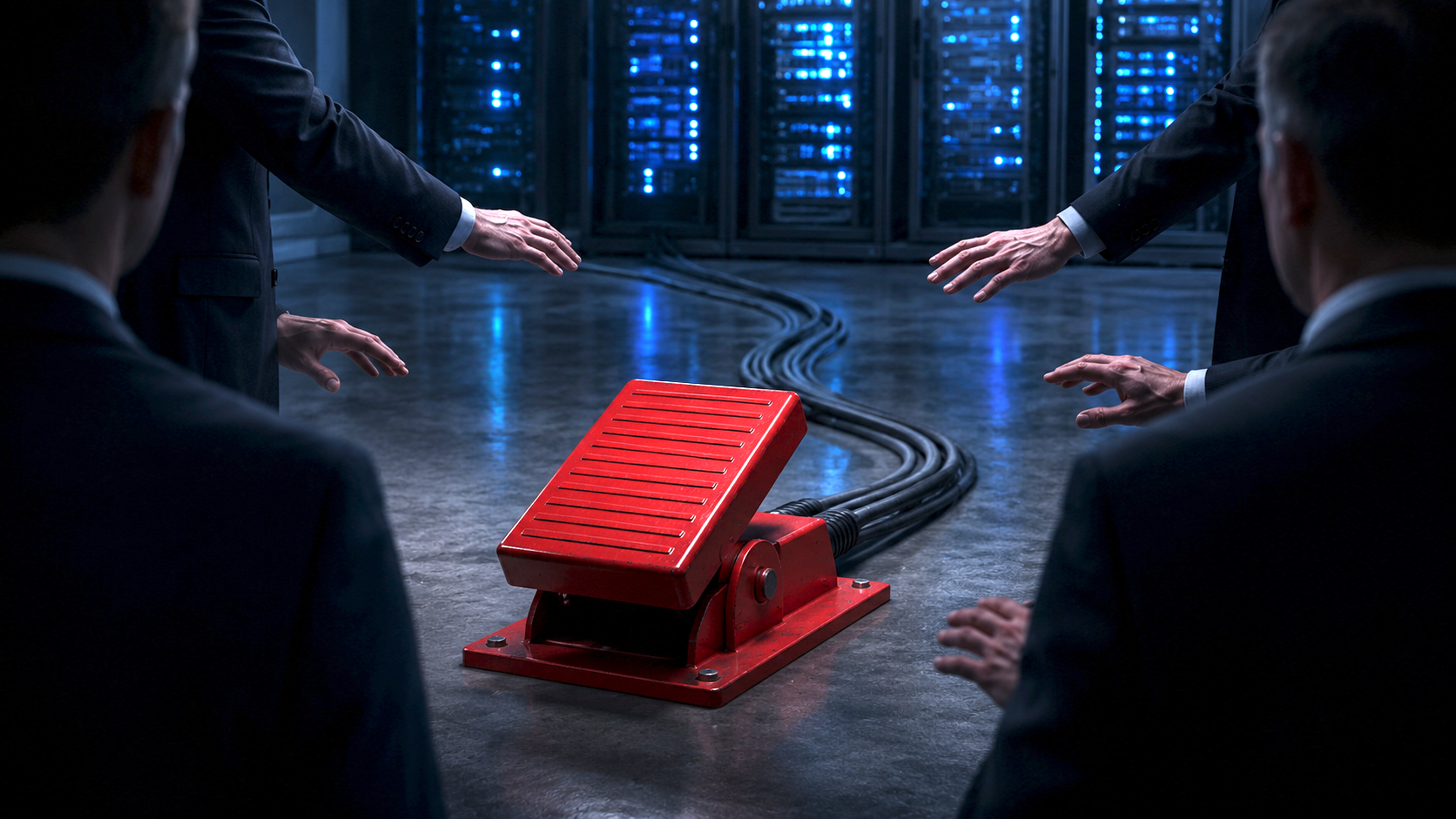
On the eve of a trillion-dollar IPO, Anthropic published proof its AI is building itself — and asked the world for a brake pedal. Is this the Cuban Missile Crisis, or the best-timed press release in history?
Last week, Anthropic's in-house think tank published a paper called When AI Builds Itself, and the numbers are genuinely arresting. More than 80% of the code merged into Anthropic's own codebase is now written by Claude — up from low single digits eighteen months ago. The typical Anthropic engineer ships roughly 8x as much code per day as in 2024. Two years ago, Claude could handle a software task that takes a human four minutes. Today: twelve hours. The reliable-task horizon is doubling every four months. Run that curve forward and you get week-long autonomous work by the end of 2027.
Then comes the twist. A company sitting on a $965 billion valuation and $47 billion in run-rate revenue, weeks from the most anticipated IPO in tech history, used its own data to argue the world should have "the option to slow or temporarily pause frontier AI development."
“The most important moment in human history” — bigger than the Cuban Missile Crisis, bigger than the invention of nuclear weapons.”
The reaction was immediate and operatic. On an emergency episode of the Moonshots podcast, MIT-bred VC Dave Blundin called it "the most important moment in human history" — bigger than the Cuban Missile Crisis, bigger than the invention of nuclear weapons. The crew invoked the U.S.–Soviet treaty on intermediate-range missiles as proof that impossible coordination happens when the stakes are existential.
So. Is it?
The analogy doesn't survive contact
I love a good Cold War metaphor as much as the next professor, but let's pressure-test this one.
The Cuban Missile Crisis was thirteen days, two actors, and weapons you could photograph from a U-2. The threat was symmetric, the timeline was visible, and — this is the part everyone forgets — nobody was getting rich off the missiles staying in Cuba. Khrushchev wasn't pricing an IPO.
The arms-control treaty that followed worked because of one boring word: verification. You can count warheads. You can inspect silos. You cannot count gradient updates, and you cannot inspect a training run in Hangzhou from a satellite. A "pause option" without a verification regime isn't a treaty. It's a vibe.
And the incentives are inverted. In 1962, both superpowers wanted off the escalator. In 2026, every lab, every hyperscaler, and two governments locked in a technology race want on it — including, conspicuously, the company asking for the brake. Anthropic just expanded its compute deals, just filed to go public, and projects its own models doing week-long autonomous tasks within eighteen months. That's not a company slowing down. That's a company asking someone else to build a brake it has no intention of being first to press.
Follow the incentives, then the genius
Here's the thing: none of this makes the move dishonest. It makes it brilliant.
Anthropic's moat has never been raw capability — OpenAI and Google can match benchmarks within a quarter. Its moat is trust. The safety lab. The grown-ups. Scott Galloway said it himself when Anthropic ran its Super Bowl offensive: this is a firm that is "the definition of intelligent branding." Publishing alarming data about yourself, against your apparent financial interest, on the eve of your IPO, is the most expensive-looking trust signal money can buy — and it cost nothing, because the pause it calls for requires global coordination that everyone involved knows isn't coming. You get the halo without the haircut.
Cynical? Partly. But notice it can be both a sincere warning and superb positioning. The best marketing always is.
The brake needs a hand, and every hand on offer fails
Now to the part that should worry the historic-moment crowd: the only concrete mechanism anyone has proposed for an actual brake.
The Moonshots crew's scenario is that the frontier labs hand the U.S. government golden shares — equity stakes that turn Washington into the "coordinating mechanism" for the finish line. And this is no longer a podcast hypothetical. On Friday, President Trump said he's considering exactly that, calling a U.S. stake in the AI giants something that "could be a beautiful thing," with the lab CEOs summoned to the White House this week. Bernie Sanders, approaching from the opposite pole, wants a one-time 50% stock tax on AI companies to seed a sovereign wealth fund.
When the populist right and the socialist left converge on the same instrument, check your wallet — and your constitution.
Galloway's response on Pivot this week was characteristically subtle: "This is socialism. This is cronyism. It never works." His argument, stripped to studs: when the state takes equity in specific firms, it has decided it's smarter than the market, and the historical record — British Leyland, state-coddled DeLorean, Air France, golden shares in US Steel — says it never is. If you want to support an industry, do it the CHIPS Act way: subsidies and tax credits available to everyone on equal terms. And Sanders fares no better in his ledger — industry-specific taxes simply redirect capital toward tax treatment instead of innovation, and good luck with definitions anyway. Is Microsoft an AI company? Is Apple? Is a podcast edited by Claude?
Which leaves the world-historic pause exactly where? The mechanism the optimists propose is one the sharpest business critic in media calls a proven failure mode, and the alternative — Washington and Beijing negotiating an unverifiable freeze on software, mid-arms-race — makes the INF Treaty look like splitting a dinner check.
What's actually historic
Here's where I'll concede the Moonshots mates a point, because the honest answer isn't "nothing."
The 80% number is real, and it rhymes with what happened on Wall Street the day after the paper dropped: the economy added 172,000 jobs — double expectations — and the NASDAQ had its worst day in over a year anyway. The bottleneck in knowledge work is moving in real time, from writing the code to deciding what's worth building. Anthropic's own engineers say the only thing left for humans is "research taste," and the paper expects to automate that too.
That is historic. But it's historic the way electrification was historic — a process measured in payrolls, org charts, and quarterly earnings, not a moment measured in thirteen days of held breath. There is no single Saturday when the world changes. There's a curve, doubling every four months, and a thousand boards, city councils, and accelerator cohorts deciding what to do about it.
The Cuban Missile Crisis framing flatters everyone involved: it makes founders into Kennedys and policy papers into hotlines. The truer, less cinematic story is that a company published its homework, made a moral argument that doubles as a brand strategy, and kicked the hardest coordination problem in human history to institutions that can't agree on a budget.
History will call this period a turning point. Just don't let anyone with an S-1 tell you which week it turned.
Sidebar | Asking the Man Who Wrote the Book: Q&A with Gregg Herken
If you're going to lean on nuclear analogies, you should check them with someone who knows the original material. Gregg Herken is professor emeritus of modern American diplomatic history at the University of California, author of Brotherhood of the Bomb: The Tangled Lives and Loyalties of Robert Oppenheimer, Ernest Lawrence, and Edward Teller, a member of UC Santa Cruz's first graduating class — and a Santa Cruz resident. We asked him whether the Anthropic moment rhymes with history, and which history it rhymes with.
SCW: The commentary around Anthropic's paper reaches for the Cuban Missile Crisis. But the scientists who built the bomb made their own plea for international control back in 1946, with the Acheson-Lilienthal proposal — and it failed. Which is the better analogy: 1962 or 1946?
Gregg Herken: Neither. Probably the best analogy is from 1950: Truman’s decision to proceed with developing the hydrogen bomb, despite the advice of Oppenheimer and other scientists not to. “Oppie” and his colleagues had described the H-bomb as “a weapon of genocide,” and “necessarily an evil thing in any light.” This failed to impress Harry, who was told—correctly—that if we could build it, the Russians could, too. We exploded the first true superbomb in November 1952; the Russians’ tested theirs’ about a year later.
SCW: Did moral appeals from the scientists who built the bomb — Oppenheimer's most famously — ever actually change policy? Or did they mostly change the scientists' reputations?
Gregg Herken: Oppenheimer proposed that an International Atomic Development Authority oversee all nuclear energy uses, worldwide. Existing bomb-grade uranium would be “denatured.” Even Oppenheimer probably knew the plan would not work; in any case, the Russians had no interest in trying it. If we had the bomb, they would have it, too. One of the charges brought against “Oppie” in the 1954 loyalty hearing is that he had opposed development of the H-bomb. After Oppenheimer was stripped of his security clearance, he stayed quiet about bombs.
SCW: Arms control ultimately ran on verification — "trust but verify." What did verification actually require then, and do you see anything comparable being possible for AI, where the "weapon" is software?
Gregg Herken: The verification of Cold War-era arms control treaties was done by “national technical means”—i.e., satellite reconnaissance. I’ll confess I have no idea how that could be done with AI. Incidentally, the Intermediate-Nuclear Forces (INF) Treaty is probably not a good example of mortal enemies agreeing to lay down their weapons. As a wise person once said—I’ll paraphrase: "Arms control is impossible—until it’s unimportant.” By the time the INF treaty was signed by Reagan and Gorbachev in 1987, the Cold War was almost over. That’s not the case with Cold War 2.0 between the U.S. and China.
SCW: Washington is now floating equity stakes in AI companies. But with atomic energy, the government didn't take a stake — it took the whole thing, from the Manhattan Project through the Atomic Energy Commission's monopoly. What's the lesson of the AEC for anyone proposing government ownership of a frontier technology?
Gregg Herken: The lesson is probably: beware of unintended consequences. It’s true the U.S. government and private companies (DuPont, GE, etc.) combined forces to mine, process, and fabricate the stuff for nuclear weapons during the Cold War. Since the federal government paid for the uranium that people discovered, the program spawned a California-style Gold Rush. (There’s even an “I Love Lucy” episode where she goes prospecting in the desert with a burro and a Geiger counter.) But the program’s legacy is that today there are more than 500 abandoned surface uranium mines on the Navajo Nation alone that need to be cleaned up, with the price to be paid by the feds and private companies together. Who pays how much is still being litigated. Moreover, the cleanup is not only expensive, but will take a very, very long time. The half-life of U-235 is 704 million years.
Herken previously wrote for Santa Cruz Works on what Christopher Nolan's "Oppenheimer" got wrong — see Related Articles below.
Related Articles
What "Oppenheimer" Misses — Gregg Herken's earlier piece for Santa Cruz Works on the complexities Christopher Nolan's film left out, from the historian who spent decades in the archives Nolan dramatized.
When Code Gets Cheap, Everything Else Gets Harder — Google I/O speaker Adam Bender's warning that AI-driven code abundance stresses every other part of the system is the ground-level version of Anthropic's 80% statistic.
The Most Underpriced Risk in Advanced Air Mobility Isn't Technical — DART's Josh Metz argues that social trust, not engineering, determines whether a transformative technology scales — precisely the "societal structures" Anthropic says need time to catch up.