

Light Links: Why Santa Cruz Ventures Just Bet on Invisible Light

Santa Cruz Ventures makes Light Links its 11th portfolio investment — a Santa Cruz Works accelerator graduate and Launchpad 2025 winner using infrared light to give robots what Wi-Fi never could: certainty.
The most valuable companies in history weren't built on new ideas. They were built on new infrastructure. Railroads. Electricity. Fiber optics. The pattern is boring, and boring is where the money is.
Which brings me to Santa Cruz Ventures' 11th portfolio company: Light Links, a deep-tech hardware startup that launched out of Santa Cruz in early 2024 and is sending data through the air with invisible infrared light. Not lasers in space. Not vaporware. A robotics networking company that is already generating revenue under a paid, fully executed contract with a large robotics company, after clearing more than six months of that customer's engineering vetting.
Let's register the local receipts first, because they matter. Light Links is a graduate of the Santa Cruz Works accelerator: Santa Cruz Accelerates. They took first place at Launchpad 2025, the annual startup competition co-produced by Santa Cruz Works and UCSC's Center for Innovation and Entrepreneurial Development, with support from UCSC's Baskin Engineering, the Innovation & Business Engagement Hub, QB3, Career Success, and Cabrillo College. The pipeline — accelerator to pitch stage to venture check — is working exactly as designed. And with this investment, Santa Cruz Ventures has now deployed over $1 million into local startups. That's not Sand Hill Road money. That's better: it's patient, proximate capital that shows up before the tourists do.
The Problem: Robots Got Smart. Their Network Stayed Dumb.
Here's the uncomfortable truth about the robotics revolution: the robots' brains have outrun their nervous systems. AI and sensors improved at warp speed. The wireless connecting them didn't. Wi-Fi and private 5G are built on a polite fiction — devices take turns by colliding, retrying, and waiting random intervals. Latency swings from instant to a tenth of a second. A robot that needs an answer in milliseconds doesn't tolerate "eventually." It freezes. It safety-stops. It costs money.
This is architectural, not incremental. Even Wi-Fi 8 keeps the same contention design. You can't out-spend physics with marketing.
The Solution: Own the Channel
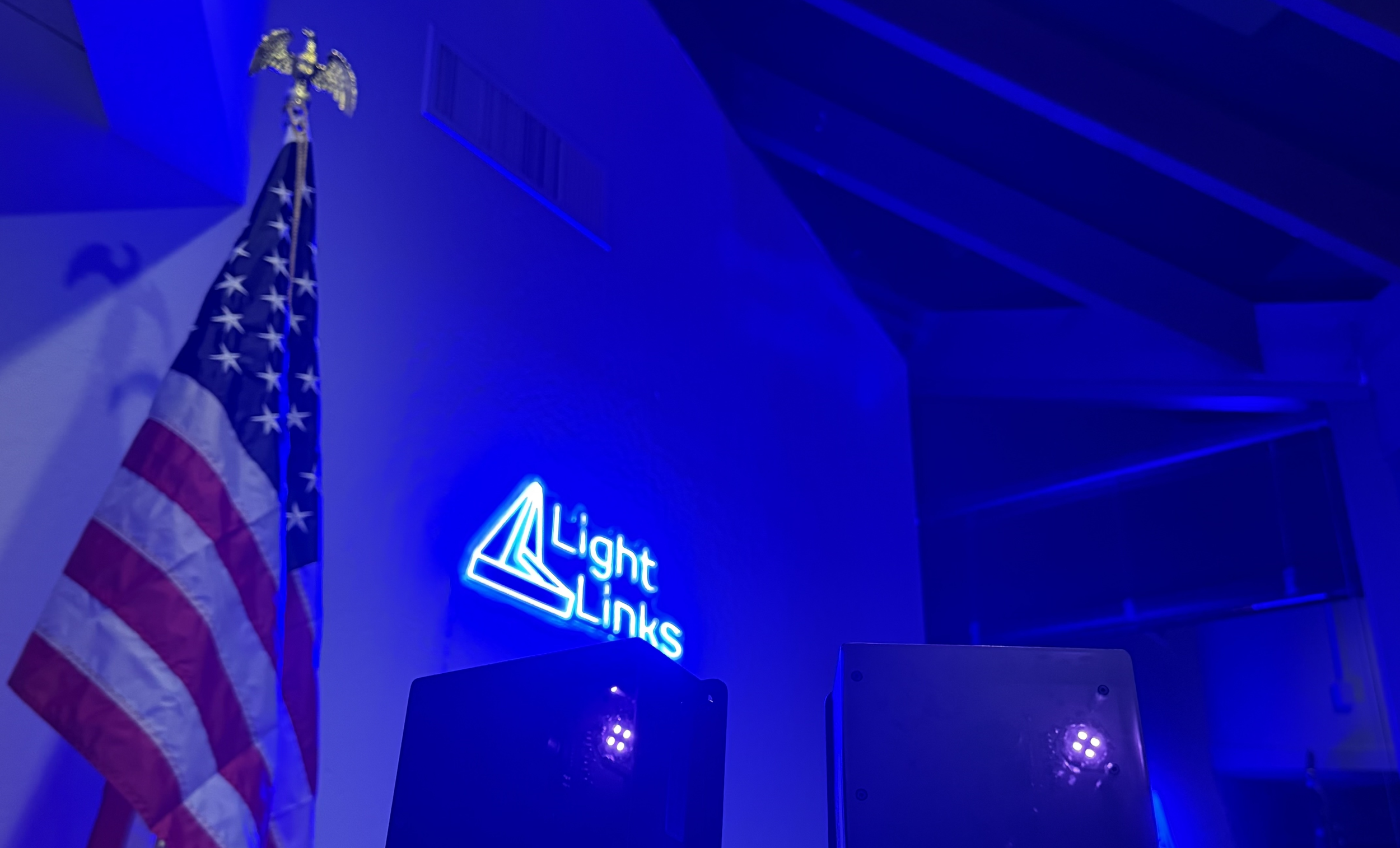
Light Links transmits data as infrared light instead of radio. Earlier "Li-Fi" companies needed clear line of sight, which is why you've never heard of them. Light Links' signal bounces off walls and ceilings, so it works when the direct path is blocked. And because light stays in the room, the company controls the entire channel — every robot gets a guaranteed, scheduled turn. Wireless that behaves like a cable.
The numbers from field testing on the customer's robotic arm: worst-case round-trip of roughly 0.43 milliseconds versus roughly 54 milliseconds — with spikes over 100ms — on the facility's existing Wi-Fi. About 125x more consistent, with throughput holding around 900 Mbps while the Wi-Fi repeatedly dropped to zero. It plugs in like a dongle, speaks standard Ethernet, and is built on the same mass-produced 1550nm telecom components already sitting in every data center. A wavelength, incidentally, that the human eye physically blocks — so no worker-safety certification purgatory.
The team fits the problem: UCSC PhD and Santa Cruz local Firouz Vafadari as founder/CEO, optical-wireless pioneer Heinz Willebrand as CTO, Berkeley alum Jeremy Chan-Youker running operations, and distinguished UCSC networking professor emeritus J.J. Garcia-Luna-Aceves as CSO. The Santa Cruz thread isn't incidental. It's the thesis.
The Bet
Roughly four million warehouse and manufacturing robots are expected to be installed by 2030. Tens of millions of XR headsets ship annually. Robotaxis and defense platforms need networks that can't be jammed or detected. If reliable wireless becomes infrastructure — and I'd argue it must — the companies that own the hardware and the standards win disproportionately.
Is there risk? Obviously. Near-term revenue is concentrated in one customer, and performance at scale in dusty, sunlit warehouses is unproven. But venture returns come from being right about something the consensus hasn't priced yet. Copper gave way to fiber. Radio may give way to light. Let the light shine!
Related Articles
Illuminating Connectivity: Light Links' Vision for a Hybrid Wi-Fi/LC Future — Our early profile of Light Links and its Wi-OW system, written back when Light Communication was a bold idea rather than a revenue line.
What Happened to Our 2025 Startups to Watch — Light Links headlines the year-end scorecard with a breakout year of real commercial pull.
Santa Cruz Companies to Watch in 2026 — Light Links makes the 2026 watch list as optical wireless moves from invention to execution.
Santa Cruz Ventures Doubles Down on Dispatch Goods — Its 10th Portfolio Company — A follow-on investment in the reusable-packaging pioneer just as California's landmark plastics law takes hold.
Santa Cruz Ventures Updates — The firm expands its thesis to mid-to-late stage deals, adding a newly minted unicorn and AIO's $17M Series A as portfolio companies #7 and #8.
Santa Cruz Ventures Closes Round 1 with farm-ng — The fund's inaugural investment backs a $10.05M Series A in sustainable agriculture robotics.