

GOODLES Just Beat Barilla at Its Own Game — And Barilla Had to Buy It to Find Out
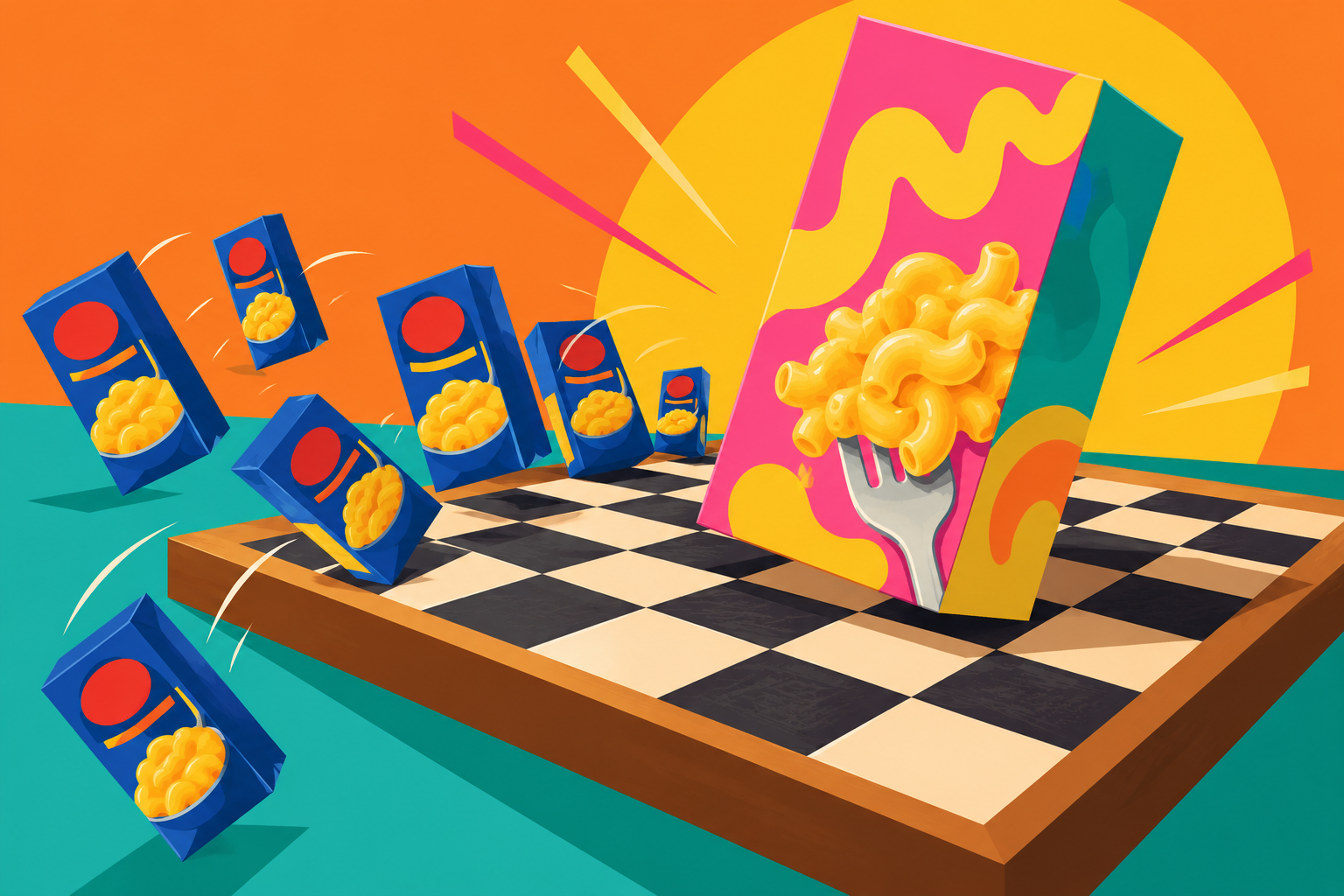
A Santa Cruz mac-and-cheese startup just got acquired by a 149-year-old Italian pasta giant. The real story isn't the deal, it's what it says about legacy brands, category disruption, and why $88 million buys you something money can't build.
Here's the thing about big, old companies: they're extraordinary at defending market share and terrible at creating new demand. Barilla has been making pasta since 1877. It has scale, distribution, and a balance sheet that could buy Santa Cruz County outright. What it doesn't have, what it can't manufacture in a boardroom, is a 5-year-old brand that makes people get tattoos of a mac-and-cheese box.
So it bought one.
The numbers, because that's the whole point
GOODLES went from 0.8% to 7.8% of U.S. shelf-stable mac-and-cheese spend in three years. That's not stealing share, that's expanding the category. Zeszut says 80% of sales come from people who weren't buying mac and cheese before, or are buying more of it now. In consumer packaged goods, that's the unicorn metric. Everyone claims they're growing the pie. Almost nobody actually is.
Profitable in 2024. Valued at $88 million in 2023. A 73-person team that gets to keep their jobs, their HQ, and, this is the unusual part, their decision-making authority over product, suppliers, and marketing. Barilla isn't buying GOODLES to gut it and wear its skin. It's buying it to leave it alone and fund its expansion. That's the tell that this was a smart acquisition, not a desperate one.
Why incumbents can't build this themselves
Legacy food companies are optimized for one thing: not losing what they already have. That makes them structurally incapable of the kind of risk GOODLES took: 1,000 noodle iterations, a category nobody had touched nutritionally in decades, packaging loud enough to get people to dress as it for Halloween. A company Barilla's size runs that idea through eleven rounds of committee review and kills it by round three.
This is the same pattern you've watched play out in tech, beauty, and beverages for twenty years: the incumbent doesn't out-innovate the startup, it acquires the startup and rents its relevance. Unilever did it with Dollar Shave Club. L'Oréal did it with half the indie beauty aisle. Barilla just did it with noodles.
The Santa Cruz angle
More than 90% of Americans still haven't tried GOODLES. That's not a weakness, that's the entire investment thesis. Barilla isn't buying current revenue; it's buying a growth curve and international shelf space GOODLES could never afford on its own. Six years from a pandemic-era garage idea to acquisition by one of the largest pasta companies on Earth, without leaving the county it started in.
That's the model every founder in this town should study: don't out-market the incumbent. Out-grow the category, and let the incumbent come find you.
Related Articles