

CEO Works Luncheon: Relational Intelligence: Relationship Strategy in a Machine World
In every great dining room, there’s a moment you can feel before you can explain it. The lights hit just right. The room hums. The staff moves with purpose. Guests lean in. Something clicks. It’s not the menu, not the reservation system, not the POS terminal that cost more than a used car. It’s the human choreography underneath the machinery.
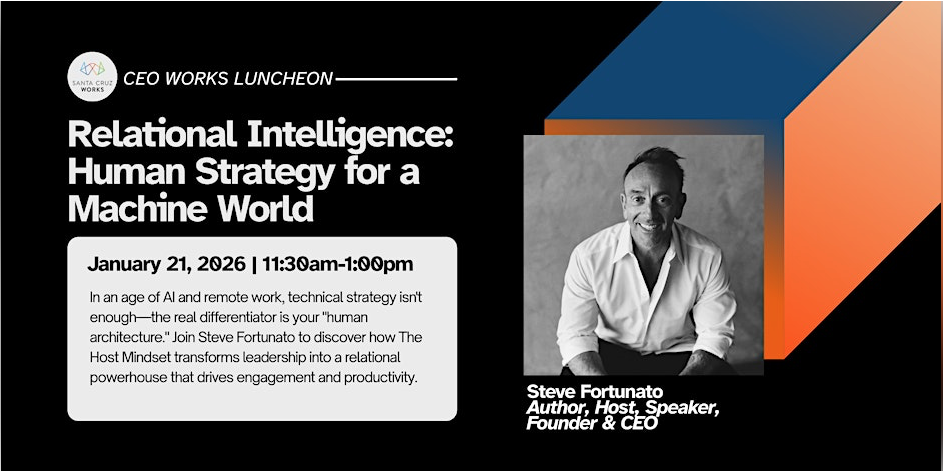
That is why CEO Works Luncheon is starting the year with “Relational Intelligence: Strategy in a Machine World.” Because the world is getting faster, more automated, more optimized, more remote, and somehow also more awkward. And if you’re leading a company right now, you’re probably watching the same thing every seasoned restaurateur has watched for decades: systems can run the business, but people run the systems. When the people don’t trust each other, don’t communicate well, or don’t feel they belong, the whole operation starts to taste like cardboard.
In hospitality, we have a phrase for this: the room knows. You can print a perfect seating chart, but if the host stand feels cold, guests feel it. You can build a flawless kitchen line, but if the team is tense, the plates come out sloppy. You can be “efficient” and still lose the table. You can be “data-driven” and still miss the human being sitting right in front of you.
Now take that same truth and drop it into a remote-first world, where your “dining room” is a grid of faces and your “table touch” is a Slack message. When automation accelerates, the differentiator is no longer technical. The differentiator is relational. Engagement. Trust. Belonging. Meaning. The stuff leaders claim to value, right up until they’re busy.
Santa Cruz-native Steve Fortunato gets this because he’s lived it. As a lifetime student and teacher of hospitality, and the founder and CEO behind one of Los Angeles’ leading hospitality organizations, he’s not coming to talk about leadership as a concept. He’s coming to talk about leadership as a practice, the kind you repeat daily until it becomes culture. He calls it The Host Mindset: the idea that hospitality is more than an industry, it’s a way of leading.
A great host doesn’t just manage logistics. A great host reads the room. Sets tone. Makes people feel seen. Anticipates needs without making it weird. Creates a space where people want to contribute. In business, that’s the difference between a team that complies and a team that commits. Between employees who show up and employees who bring their best thinking. Between “we’re fine” and actual momentum.
And here’s the part most executives are finally admitting out loud: as the impact of remote work and AI becomes more visible, the strategy has to move beyond data and systems. Human architecture matters. Communication is infrastructure. Trust is a moat. Belonging is retention. If that sounds soft, try building something hard without it.
CEO Works is your first seat of the year. Whether you are an owner of a restaurant or a company event planner, come ready to learn what hospitality has always known: the most scalable advantage isn’t a tool, it’s the way people feel when they work with you.