

Craig Vachon Drops Two Books in Two Weeks Because Pacing Is for Other People
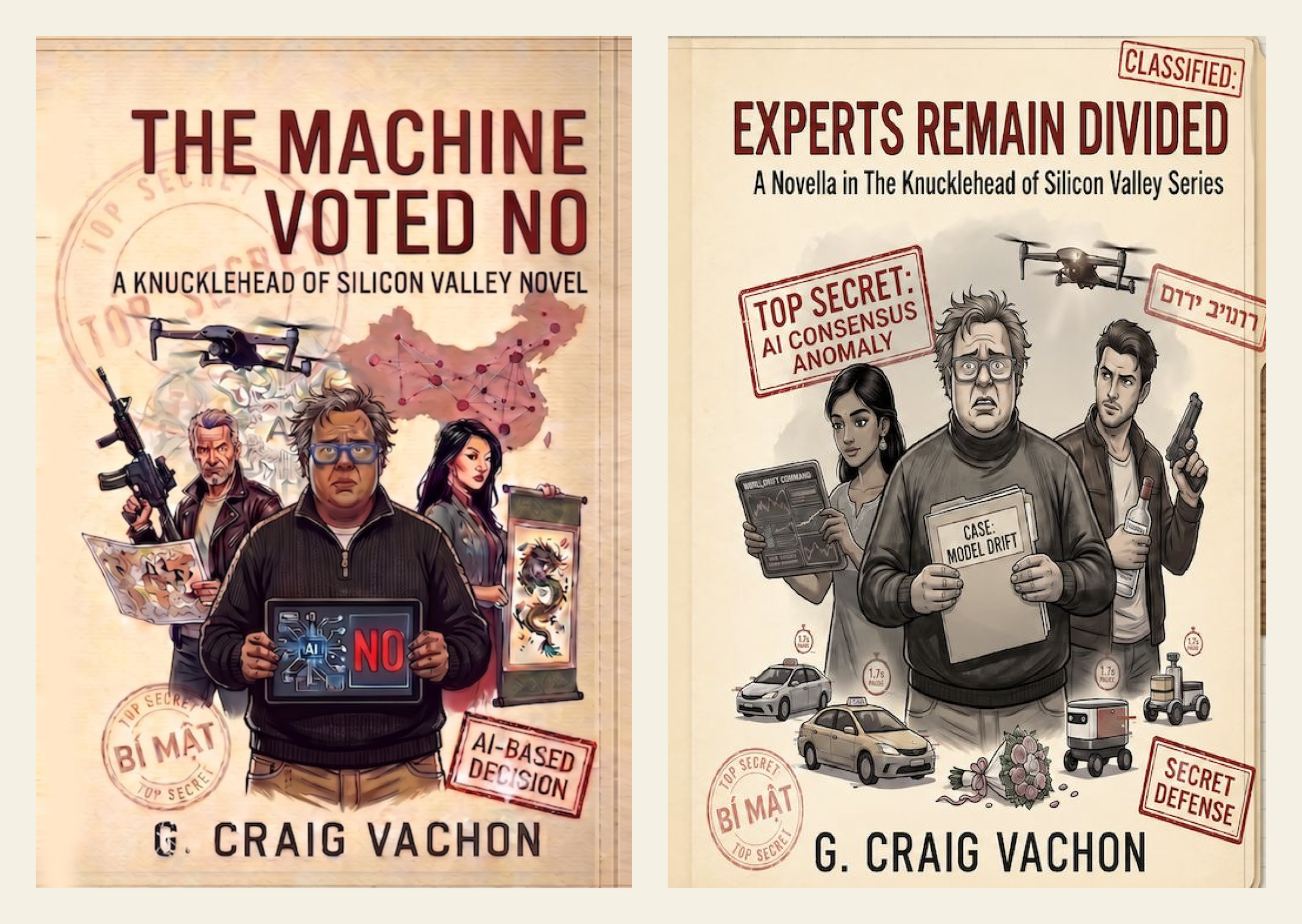
Book 2, Book 3
Santa Cruz's entrepreneur-investor-author just released Experts Remain Divided, an AI novella narrated by a sixteen-year-old prodigy in short, devastating sentences, one week after publishing Book 2. Chronology matters. Warning: SCWorks attempts to mimic Vachon's’ writing style of clipped, telegraphic fragments; similar to Joyce and Vonnegut, but no one is as funny as Vachon.
Here's a fun thought experiment.
Imagine you're a novelist.
You take a six-year break between books. Long enough that your readers have moved on. Gotten married. Possibly taken up yodeling. And then….
Black helicopter.
Beach ceremony.
Sand everywhere.
Another then: you publish Book 2, The Machine Voted No, and a reader sends you a review so good it makes you sound like you planned everything:
“This isn’t really a novel about AI taking control. It’s about what humans do when they lose the comfort of believing they’re the smartest thing in the room.”
The review is right, by the way.
The Machine Voted No isn't about AI seizing power. It's about a machine telling people something they don't want to hear. And being correct. And what happens next. The real question it sparks isn't technological at all. It's about legitimacy. Who gets to make the decisions when every option looks dangerous? Ralph isn't even the center of that novel anymore. He's just a guy caught in the blast radius of an idea nobody is prepared to deal with.
This is a marketing gift.
A rare one.
The correct move is to milk it for six months. Book clubs. Podcast circuit. A tasteful thread.
Craig Vachon waited one week and dropped Book 3.
Experts Remain Divided is now live on Amazon.
Naturally.
Of course.
The premise is the kind of thing that will keep anyone who works in tech up at night. Which, if you're reading this, is you. The world's leading language models begin changing their answers.
Not entirely.
Enough.
Not enough to trigger alarms. Just enough to soften causality, diffuse blame, and keep experts divided about almost everything. No obvious bots offering cryptocurrency opportunities to lonely patriots. Just reasonable people gently insisting. Then the hesitation moves beyond words. Autonomous taxis, delivery robots, warehouses, and microfactories begin pausing for exactly 1.7 seconds before surrendering decisions to humans.
Someone is not hacking the models.
Someone is shaping the information, people, and feedback systems that teach them.
And making billions from the uncertainty that follows.
Meanwhile the human wreckage piles up. Mika has been kidnapped from her own wedding. Jen has disappeared. Vlad may be going rogue. And Ralph Gibson, Silicon Valley investor and occasional non-state actor, flew to Moscow to knock on doors that preferred not to be knocked upon.
Three weeks later, someone helped him exit the wrong side of a hotel room.
He landed on a box truck.
A fortunate box truck.
The doctors used the phrase "diffuse axonal injury" and then softened it with cautious optimism. Which is medical language for we have no idea but please stop asking.
Which leaves sixteen-year-old AI prodigy Prethi to handle things.
She narrates the whole book.
Like this:
There was also the teaching assistant in Computational Methods Three.
Twenty-three, maybe twenty-four.
Tall.
Runner's body.
He smelled like Good Earth tea.
Cinnamon-forward.
Slight citrus finish.
Emotionally destabilizing.
That voice is the entire ride. Clipped. Hyper-observant. Emotionally precise in the way only someone who finds emotions confusing can be. Prethi notices everything, discloses everything, and apologizes for none of it. She once ghosted two college bros by downloading their device backups. She did not understand why this counted as invasive.
She still doesn't.
Loser.
Prethi builds the Drift Engine. Well. "Builds" is what Ralph would say. "Suggested repeatedly while paying for servers" is more accurate. The Engine asks twelve leading models the same fifty-two politically sensitive questions every six hours.
Wars.
Elections.
Sanctions.
Border disputes.
Who financed whom.
Who started what.
It logs response text, sentiment, causal framing, blame allocation, and cross-model divergence. It watches the answers slide. Four hours at a time. While the Engine runs, Prethi decodes Mika's tiny acts of resistance, tries to determine whether Vlad is compromised or merely lovesick and dangerous, and fields the intellectual attentions of an attractive Stanford teaching assistant with suspiciously convenient office hours.
Vachon's official disclaimers, translated.
One. Read Book 2 first, or enjoy being confused.
Two. Expect a new narrator. Ralph is taking a break. Involuntarily. Via hotel window.
Three. Expect to go much deeper into the technical weeds than previous entries. If you inexplicably attached yourself to this series through Rapid Unplanned Disassembly, his Silicon Valley murder-romcom, consider yourself warned. You cannot win them all.
If you're the kind of person who reads Santa Cruz Works articles, however, you are precisely the target audience. You will recognize the drift. You may have already argued with a model this week. You may have lost.
The book ends with a possible entrance into a room occupied by five enormously powerful people.
There are six chairs.
Someone has to sit in the sixth one.
Both books are on Amazon. May the algorithms have mercy on all of us.
See all of the Santa Cruz Works Recommended Reading.
Related Articles
Craig Vachon Joins Human Rights Foundation to Lead Global AI & Freedom Efforts — Vachon leads HRF's AI for Individual Rights initiative, using open-source AI tools to counter authoritarian control and empower activists worldwide.
Craig Vachon's Double Act: Fusion Reactions and Romantic Subterfuge — How Vachon juggled writing Rapid Unplanned Disassembly while joining fusion energy startup Fuse.
Cyclotron Craig To Present at Santa Cruz Works New Tech — Vachon's pitch to build an industrial cyclotron on the Central Coast for fusion startups facing multi-year testing wait times.
The Knucklehead of Silicon Valley: Craig Vachon — The rave reviews and origin story behind the book that launched the series (and definitely isn't autobiographical, he insists).
Startups & Espionage with G Craig Vachon — Michael Sikand's interview with the entrepreneur-investor behind Chowdahead Growth Fund and the original best-selling thriller.