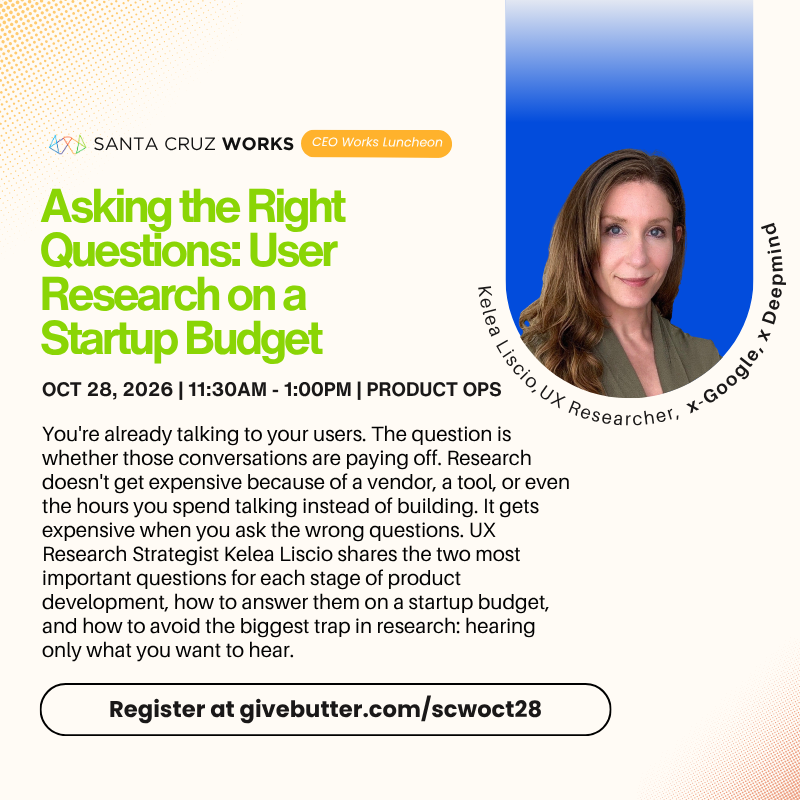
Santa Cruz local Kelea Liscio has spent 12 years leading UX research strategy, from helping teams take products from 0-1, to helping newly launched features grow to millions of users. She'll share the two questions that matter most at every stage of product development at the CEO Works Luncheon on October 28th.
Every founder has heard Paul Graham's advice: "Build stuff and talk to users." It's wonderful advice, but as a company grows and the pace picks up, it can easily fall by the wayside.
One of the biggest barriers to running research is believing you can’t afford it, either in actual cost or in time taken away from product development. That concern is only growing now that AI enables teams to move rapidly from concept to prototype to beta, sometimes in less than a week.
And the skeptics have a point: research can be expensive. But the most expensive part isn't a vendor, a tool, or even the hours spent talking to users instead of building. It's asking the wrong questions.
The questions that matter most change as a product matures, and asking the wrong one at the wrong time (or not asking at all) can be extremely costly. Luckily, there are only two questions you really need to answer at any given point, whether you’re building hardware or software, B2B or B2C, in any industry. And this isn't only true for early-stage startups. Even companies with years of customer traction need to answer these same questions every time they place a big new bet (like building a major AI feature, a new product line, targeting a new user base, or a pricing change) - the kinds of decisions where being wrong could cost you months of engineering, money, or a chunk of your user base.
Each stage of product development also has a common research pitfall that can leave founders confirming their assumptions instead of learning what users really need. These range from asking people if they’d use a hypothetical product in the concept stage, to walking users through your prototype instead of watching them figure it out alone, to testing your beta in one sitting instead of over time, or drawing conclusions about user behavior from log data alone without digging into the reasons behind it. Each one leaves teams believing they understand their users while quietly pointing them in the wrong direction.
The good news is that research doesn't have to be time-consuming or expensive. Most of it can be done through conversations with five people and tools you already have. What matters most is knowing which question to ask, when to ask it, and how to get a reliable answer.
I'm presenting "User Research on a Startup Budget" at the CEO Works Luncheon on October 28th. Come learn the two most important questions for your next big bet, the cheapest way to answer them, and how to avoid the trap that comes with each one.