

Kai Lenny Just Rode a 200-Foot Wave. Mathematically Speaking.
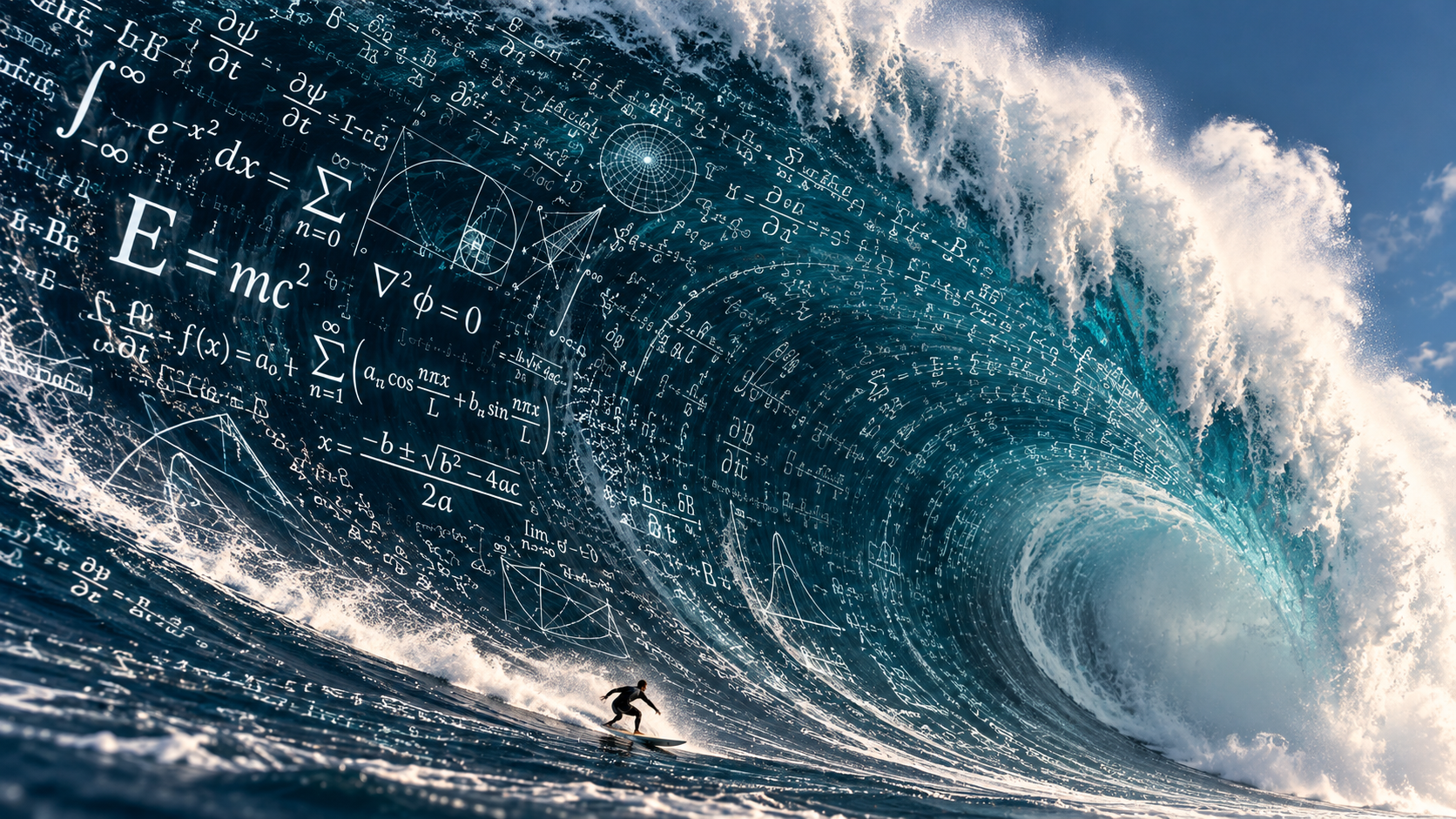
OpenAI just dumped 722 math manuscripts on a field that can't read them fast enough. Picture Kai Lenny backflipping out of a 200-foot barrel. Now picture trying to judge it.
I'll start with a confession: I do not understand the math. I'm not being modest. I've read the summaries the way I read the safety card on an airplane: nodding gravely, retaining nothing, and assuming someone qualified is in charge.
Here's what I do understand.
On October 6, OpenAI posted 722 manuscripts, grouped into 372 "families" of results, all from an internal model the public can't use. Most came from a single prompt handed to a single AI agent. The haul includes claimed advances tied to three of the five unsolved Millennium Prize Problems, including the Riemann hypothesis. It also includes claimed proofs of results mathematicians have chased for decades, like the Unique Games Conjecture.
Rutgers mathematician Alex Kontorovich looked at one of them and said that if a human had done it, it would be an "instant Fields Medal." That's math's Nobel Prize. By most counts, there are a dozen or so results in the pile that could make that claim.
There aren't enough experts on Earth to check it all. And nobody has said it's slowing down.
So let's not talk about math. Let's talk about surfing.
Meet Kai
Kai Lenny grew up on Maui doing everything a person can do on a wave, plus several things a person shouldn't. At Jaws and Nazaré, he's thrown airs and spins on waves where other elite big-wave surfers are mostly trying not to die. He's the guy the best surfers in the world watch on their phones before saying a word I can't print here.
For context, the biggest wave ever officially ridden, at Nazaré, measured about 86 feet. For most of us, a waist-high wave with a friendly name is a spiritual test.
Now Imagine This
Nazaré. A swell no buoy was built to measure. A 200-foot wall of water stands up off the cliff like the Atlantic is personally offended. That's a 20-story building, moving.
Kai doesn't get towed in. He paddles in. He drops down a slope that isn't so much a wave as a geological event, pulls into a barrel you could fly a regional jet through, and disappears.
Ten seconds pass. The crowd on the cliff starts drafting condolence emails.
He comes out with the spit. Launches a double backflip. Lands it. Throws a full rotation on the face, then pulls a maneuver that has no name, because no surfer in history imagined a body could do that.
Then he paddles back out and does it 371 more times. Before lunch.
Meanwhile, on the Beach
The world's best surfers aren't cheering. They're arguing.
Not about whether it happened. There's footage, and much of it has been checked frame by frame. In math, that's machine-verified proofs, and OpenAI shipped them for a big chunk of the results. They're arguing about what it means.
Some want to see the board. OpenAI kept the model, the exact prompt, and the per-problem compute private. That's despite a mathematicians' advisory group asking AI labs to disclose all three. MIT's Andrew Sutherland says that until people can replicate it, the one-prompt, one-agent story should be treated as unverified.
Others want to know how. A ride nobody can explain doesn't teach anybody to surf. That's the mathematicians' deeper complaint: math exists to build human understanding, not to stack up papers. Watching a wave is not riding one.
And then there are the judges. For any given ride, maybe a few dozen people on the planet are qualified to score it, and they have day jobs. Terence Tao, roughly the Kai Lenny of human mathematicians, has called the pace of this stuff insane.
A Brief Note on Litts
The universe has a sense of humor. David Litt is the Obama speechwriter whose surfing memoir It's Only Drowningchronicles a grown man's war with very small waves. He has a near-namesake: Daniel Litt, a University of Toronto mathematician who has become one of the clearest voices on the AI flood.
Daniel once bet that AI wouldn't produce top-tier math papers by 2030. He now expects to lose that bet, and he's warned that a torrent of AI output could swamp the very people needed to understand it.
One Litt fears drowning. The other is watching his whole field get a lesson in it.
Why Founders Should Care
The lesson isn't really about math. When generating becomes nearly free, verifying becomes the scarce resource. That's already happening in code, and it's coming to biotech, legal work, and anywhere else an AI can produce more than humans can review.
The valuable seat isn't on the board. It's on the judging stand: the person, tool, or company that can tell a real ride from a wipeout edited to look like one.
Kai will keep paddling out. Somebody has to build the beach.
The rest of us will be on the sand, clutching our coffee. It's only drowning.
Related Articles
Sentient and Us: A Live Conversation on AI's Next Leap — Tony J. Hughes and Craig Vachon on how AI is reshaping humanity, agency, and responsibility.
AI Horizons Part 2 — Our standing-room-only deep dive into AI's impact across industries, moved to the Cocoanut Grove.
Santa Cruz AINative Studio: Built for Builders, From the Ground Up — A local team quietly shipping AI infrastructure with no venture money and no press tour.
AI News: ChatGPT – Separating Fact from Fiction on AGI Capabilities — An earlier SCW reality check on what AI can and can't actually do.