What Does a Joby Aircraft Actually Sound Like?
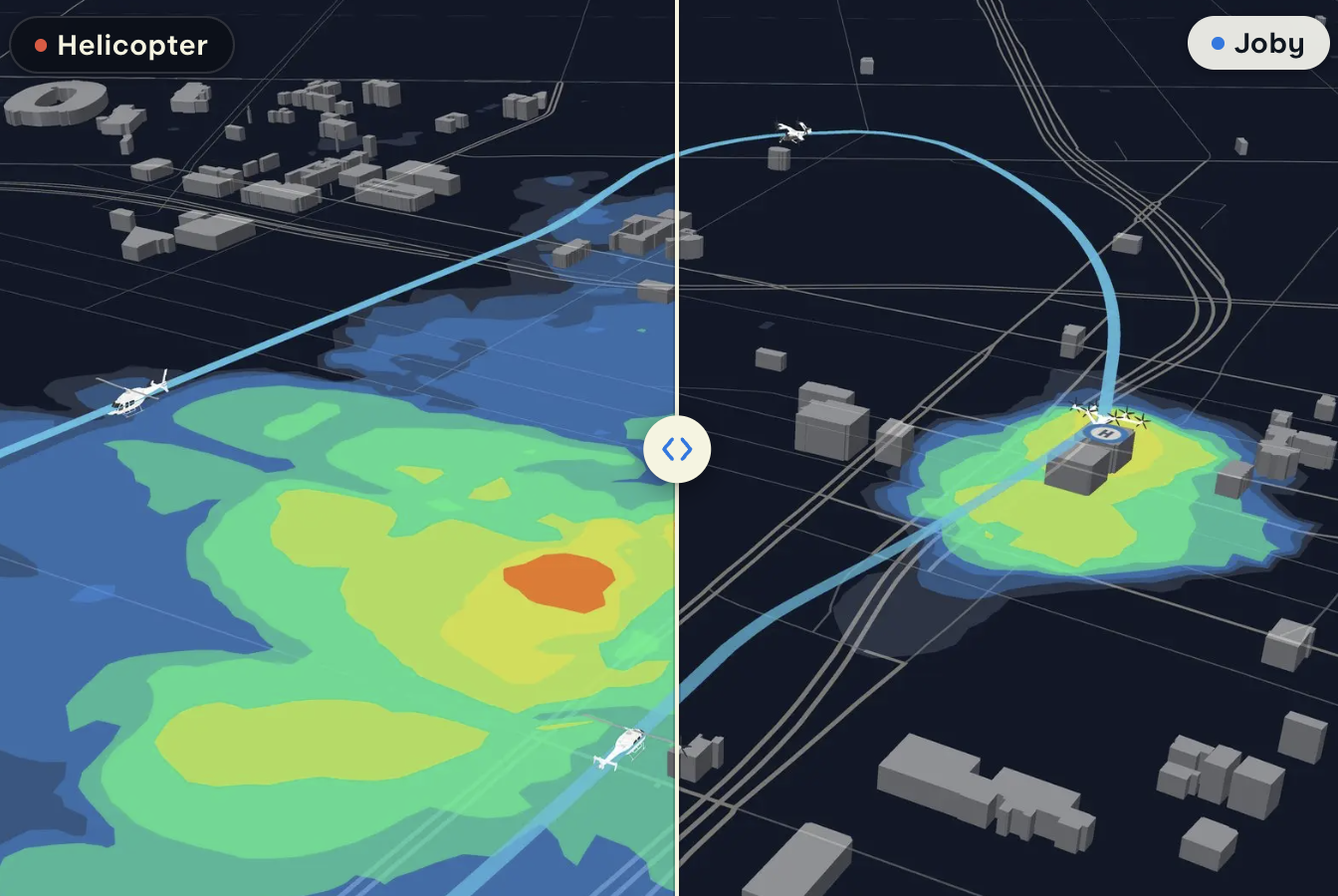
Joby Aviation recently launched a free interactive tool letting anyone hear what its electric air taxis actually sound like, addressing one of the biggest public concerns about urban air mobility.
As electric vertical takeoff and landing (eVTOL) aircraft move closer to reality, one question keeps coming up in community meetings and public forums: how loud will these things actually be? Noise pollution has long been a sticking point for urban air mobility, with memories of helicopter noise shaping public skepticism about adding more aircraft to city skies.
Joby Aviation is trying to change that conversation with proof people can actually hear for themselves.
The Noise Problem With Urban Air Travel
Helicopters have operated in cities for decades, but their noise has come at a cost. Many cities restrict helicopter flight paths, operating hours, and usage specifically because of community noise complaints. That history has left a shadow over eVTOL development, with residents near proposed vertiports wondering if they're about to trade quiet neighborhoods for constant aircraft noise overhead.
Joby set out to answer that question directly. The company partnered with Blue Ridge Research and Consulting to model how its eVTOL aircraft would sound against a real city's everyday noise, including traffic, sirens, and construction, rather than testing in a controlled lab environment alone.
The results were striking. Modeling a roundtrip flight between a vertiport near the Los Angeles Convention Center and one at John Wayne Airport, Joby's aircraft noise exceeded ambient noise levels for just 0.17 square miles during the full flight. During cruise, that number dropped to 0.004 square miles. A traditional helicopter flying the same route stayed above ambient noise levels across 45 square miles, a difference that could affect thousands of residents.
Even near sensitive sites like schools, a university, and parks along the flight path, Joby's modeling showed operations at or below background noise levels.
Hear It For Yourself
Rather than asking the public to simply trust the promises made on paper, Joby has made its acoustic findings accessible through a free interactive webpage at jobyaviation.com/sound. The tool lets visitors experience simulated flyovers and compare Joby's aircraft noise to familiar sounds, offering a direct answer to a question that's often hard to grasp from numbers alone.
This transparency effort builds on Joby's acoustic testing through NASA's Advanced Air Mobility National Campaign, where the company demonstrated low noise performance under controlled conditions. Combining that NASA-validated data with a machine learning model trained on ambient noise from 789 U.S. locations, Joby created a new method for predicting how its aircraft would actually be perceived within a real urban soundscape.
Why This Matters for Communities
Noise has historically been one of the biggest barriers to expanding aerial transportation in cities. If eVTOL aircraft can operate at or near ambient noise levels, it opens the door to more integrated transportation networks without repeating the acoustic tradeoffs that have limited helicopter usage for decades.
Joby says it continues measuring ambient noise around proposed vertiport sites and refining its acoustic models with new flight test data, an ongoing effort to build trust with the communities it hopes to serve.
For an industry still working to win over skeptical residents, letting people hear the difference themselves may prove more persuasive than any spec sheet.