

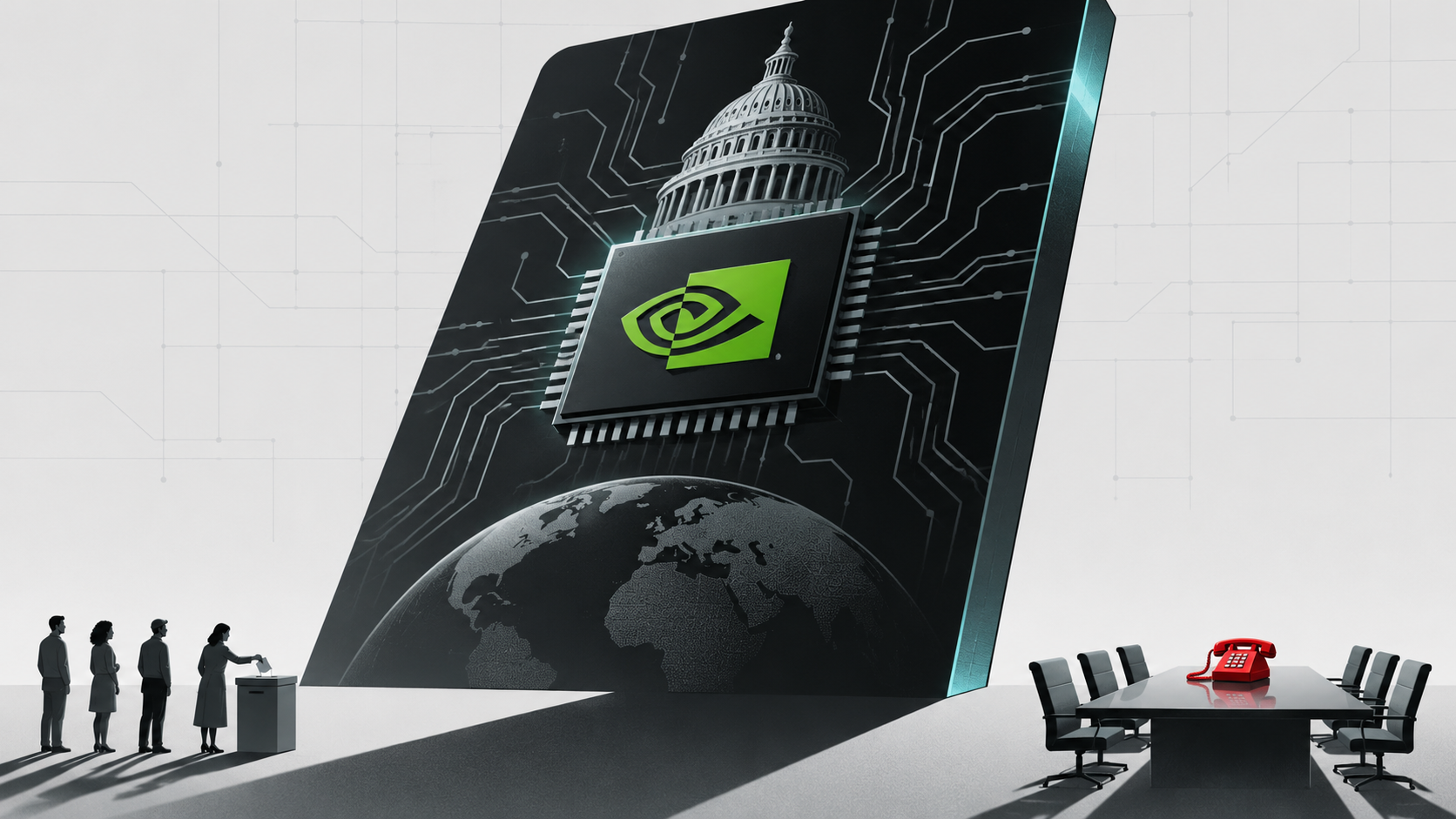
Data centers and billionaire-backed candidates lost on November 3. Three weeks later, the President says he persuaded Nvidia's board to rehire its CEO. Power is shifting, just not toward voters.
In his 2027 outlook for The Economist, deputy editor Edward Carr argues that AI is warping international relations the way Einstein warped Newtonian physics. Time speeds up. Distance disappears. Power shifts toward whoever moves fastest. His conclusion is the part worth holding onto: geopolitics will still depend on the wisdom of people.
November gave us a live test of that idea. It came in two numbers.
The first is 40 of 41. That's how many local data-center ballot measures went against the industry on November 3. Voters favored limiting data center development in 40 of the 41 local ballot measure contests, according to Ballotpedia. In a national exit poll, seventy-six percent opposed a new facility in their community.
The second is eleven. That's how many days passed between Jensen Huang's resignation as Nvidia's CEO and his return. In between, the President of the United States says he personally talked the board into it.
Put those numbers side by side and you have the story of tech in America right now. The public has turned. The power hasn't. It has just moved somewhere else.
The $79 Million Lesson
This was supposed to be the cycle when the AI industry bought itself a Congress. AI super PACs spent $79 million across 68 House and Senate seats. Elon Musk alone put nearly half a billion dollars into Republican causes. Much of it went up in smoke.
Be careful about what this proves. Data centers weren't the top issue. In the exit poll, the issue came behind government corruption, cost of living, immigration enforcement, and the war in Iran. But 23 percent of respondents called AI data centers crucial, 33 percent a major factor. For a technology most voters couldn't have described two years ago, that's remarkable.
Voters' objections were specific: water, power bills, noise, land use and distrust of developers. Beneath those concerns lies a larger question about concentration: who gets to decide where the infrastructure goes, who pays for it, and who benefits?
That isn't left or right. Texas Governor Greg Abbott, a Republican, became one of the most prominent skeptics of the buildout. Musk spent at least $5 million to try to reelect Republican Gov. Greg Abbott, who lost. He lost to Democrat Gina Hinojosa, who promised a construction moratorium and an end to data-center tax breaks. In New York, Governor Kathy Hochul had already ordered a pause of up to a year on new hyperscale projects. When Austin and Albany agree on something, it isn't a fringe position. It's a market signal.
Eleven Days in Santa Clara
Then came Nvidia.
Huang resigned on November 12 after a personal scandal with a national-security twist. Reports linked him to a Chinese businesswoman reportedly under scrutiny by US authorities. The board accepted his resignation, opened an independent investigation, and on November 17 said flatly that it "does not intend to reinstate Jensen as CEO."
Then the pressure started. Silicon Valley's heavyweights lobbied. A petition passed 180,000 signatures. The stock fell more than 16%. And the White House got involved.
The President had been in the middle of it from the start. Two days before the resignation, he called Huang to urge him to fight for his job, the New York Times reported. Afterward, he floated Tim Cook as a replacement, then said he would "certainly not mind" seeing Huang back.
Then he went to the board. Trump says he spoke "directly and indirectly" to Nvidia board members about bringing Jensen Huang back as CEO. He did not name which directors he spoke with. He said the board asked for assurances that Huang was not a national security threat, and that he gave them those assurances based on what the government knew. He told CNBC: "I spoke to them. Let me put it this way: And I convinced them. I made the deal." He added that "it was a lot easier to convince them yesterday than it was a week ago."
On November 23, the board voted unanimously to reinstate Huang. Nvidia's own announcement acknowledged that the Board received input from senior levels of the United States government, and based on that input, the Board is confident that Mr. Huang's reinstatement poses no national security risk. It did not name Trump. The President, however, left little doubt about his involvement.
Notice the gap between those two accounts. Nvidia describes a check: the board asked whether Huang was a security risk, got an answer, and decided. Trump describes a negotiation. The public record doesn't tell us which is closer to the truth.
To be fair, there's a real case for what happened. Huang built one of the most valuable companies in history. Trump said Attorney General Todd Blanche confirmed the government has no evidence Huang engaged in unlawful conduct. When the question is national security, a board asking the government for an assessment is arguably responsible governance. And if you believe America is in an AI race with China, keeping the architect of its most strategic company on the job looks like national interest.
The problem isn't that the board talked to Washington. It's three things together. The assurance was private: Trump said there was no security risk but gave no details. The official giving the assurance also says he brokered the deal. And it all happened before any findings from the board's investigation were made public, and before Congress had asked a single question. Huang and Nvidia's general counsel faced closed-door questioning from three House committees on December 1 and 2, more than a week after he was back in charge. The verdict came first. The process came after.
Carr's Physics, Applied
Carr's framework helps here, with an uncomfortable twist.
Time. Carr warns that AI time is outrunning government time. Institutions, he notes, build in delays such as consultation periods, hearings and rights of appeal, so that competing interests get a hearing. Nvidia shows another way to close the gap. The White House moved at AI speed, influencing a corporate decision before the established investigative processes had concluded. The board still deliberated and voted. But speed bought this way isn't government catching up. It's government getting ahead of its own checks.
Space. Carr says every link in the AI supply chain is a source of leverage, and that Washington is pressing allies to commit to the American stack. Nvidia occupies arguably the most important position in that stack. When the President calls its CEO "a Great Patriot and National Treasure," and the government vouches for his security status, Washington is treating the company less as a private business than as a strategic asset. That's how China treats its champions. It may be the logic of an AI race. It's also a long way from the free market Silicon Valley says it believes in. By the company's own filing, Washington had a seat at the table. By the President's account, it ran the meeting.
Gravity. This is the big one. Carr borrows Henry Kissinger's point that stable orders balance legitimacy and power. In November, America showed us both sides of that balance in the same month. Voters supplied the legitimacy signal: they want a say in how AI gets built and who pays for it. The White House supplied the power, through a private assurance and its talks with the board. When legitimacy and power point in opposite directions, Carr's lesson is that the arrangement doesn't hold. That's true between nations, and it's true at home.
Concentration Is the Risk
Here's the uncomfortable math. The AI economy runs through a few chip designers, a few model labs and a few cloud providers. Now add a political chokepoint: the most important of those companies has a direct line to the Oval Office.
That's good for Nvidia for now. It's bad for everyone over time. When one company's leadership is a matter of presidential deal-making, every competitor, customer and ally has to price in politics. Today's favor is tomorrow's leverage. A future president of either party will have the same phone.
The financial risks pile up too. If the AI trade unwinds, the giants with substantial cash flow are better placed to weather the correction than heavily leveraged developers, and far better placed than the towns that went all in on them. Voters sensed this before Wall Street did. They looked at the boom and asked a simple question: what's in it for me?
Expect the backlash to keep coming: state rules, local moratoriums and tougher questions from Congress. Some of that is overdue accountability. Some of it will crush the wrong companies. The giants can afford compliance departments and direct lines to the White House. A six-person startup in a converted warehouse can't.
You Can't Fix It Locally. You Can Decide Which Side You're On.
Let's be honest: no county is going to break up Nvidia, or set the terms between Washington and Santa Clara. Concentration gets addressed through antitrust, grid policy, campaign finance and, apparently, presidential phone calls. Or it doesn't get addressed at all.
But regions decide something almost as important: whether they're beneficiaries or casualties. Some communities will host data centers. They'll gain construction jobs and tax revenue but relatively few permanent jobs, and they may take on substantial burdens on power and water. Others will host the founders, the spinouts and the payrolls.
Santa Cruz has spent 20 years trying to be the second kind of place. That doesn't solve concentration. Even our wins often end in acquisition by bigger players. Unnatural Products, a UCSC spinout, agreed on November 9 to be acquired by argenx in a deal worth up to $1.15 billion. Argenx says UNP's team of more than 50 employees and its leadership will stay in Santa Cruz once the deal closes.
We've heard that promise before. When Google bought Looker for $2.6 billion in 2019, the company said Looker would remain in its Santa Cruz office on Church Street and operate from there. Technically, it did. But two years after joining Google, Looker's support team was laid off. Google has since posted Looker engineering jobs in Sunnyvale and San Francisco. The address stayed. Much of the growth went over the hill.
That's the real test for the argenx deal. Not whether the sign stays on the building, but whether the jobs, the hiring and the next round of founders do.
Takeaways
Voters pushed back, but power went around them. In November, voters turned against data centers, rejecting 40 of 41 local measures, and against billionaire-backed candidates. Weeks later, by the President's own account and with Nvidia confirming the government gave input, the White House helped put Nvidia's CEO back in charge. The backlash reached the ballot box but not the boardroom.
Carr's framework, applied at home. Carr describes AI bending time, space and gravity in geopolitics, and the Nvidia episode shows all three inside the U.S. The decision moved faster than the official process. The state treated a private company as a strategic asset. And power went one way while the signal from voters went the other, which is exactly the imbalance between legitimacy and power that Carr warns makes an order unstable.
Regions can't fix concentration, but they can choose their side of it. Antitrust, grid policy and campaign finance are federal fights. What a region controls is whether it becomes a casualty, hosting the infrastructure and paying the bills, or a beneficiary, keeping the founders, the jobs and the payrolls. Looker is the cautionary example: the address stayed in Santa Cruz while the growth moved elsewhere. That's the test for deals like Unnatural Products.
Related Articles
First Netflix, then Poly, now Looker? — SCW's 2022 look at the Looker layoffs and what they signaled about Santa Cruz's hold on acquired companies.
Santa Cruz Mints Its Fourth Unicorn: argenx to Acquire Unnatural Products for Up to $1.15 Billion — A UCSC spinout reaches a billion-dollar valuation and keeps its team and lab in Santa Cruz.
Most Companies Don't Die From Competition. They Die From Comfort. — Nvidia as a lesson: companies fail by staying good at business models that are going out of date.
The Problem Isn't Only Experience. It's Imagination. — Why local government needs leaders who can imagine better ways to work.
Joby, the Military, and the Facts — As Joby's defense business grows, what missions will it accept, and what should Santa Cruz ask?