

The Physics of Feel: A UCSC Thesis Puts Numbers to a Surfboard’s Soul
A new UC Santa Cruz thesis pairs wave-pool experiments with cloud CFD to prove what shapers have felt for decades: bottom contour quietly governs how a surfboard turns — and “feel” is measurable.
For as long as people have ridden waves, surfboards have been judged by feel. A board is “powerful,” “loose,” “locked-in,” or “skatey” — language passed between shaper and surfer, refined through trial, error, and a lot of saltwater. What’s rarely existed is data. Surfboard design has seen surprisingly few fundamental breakthroughs since Simon Anderson introduced the three-fin thruster in 1981, and the modern research that does exist has fixated mostly on rocker and fins. A new master’s thesis out of UC Santa Cruz sets out to change that — and it was built almost entirely by hand in our own backyard.
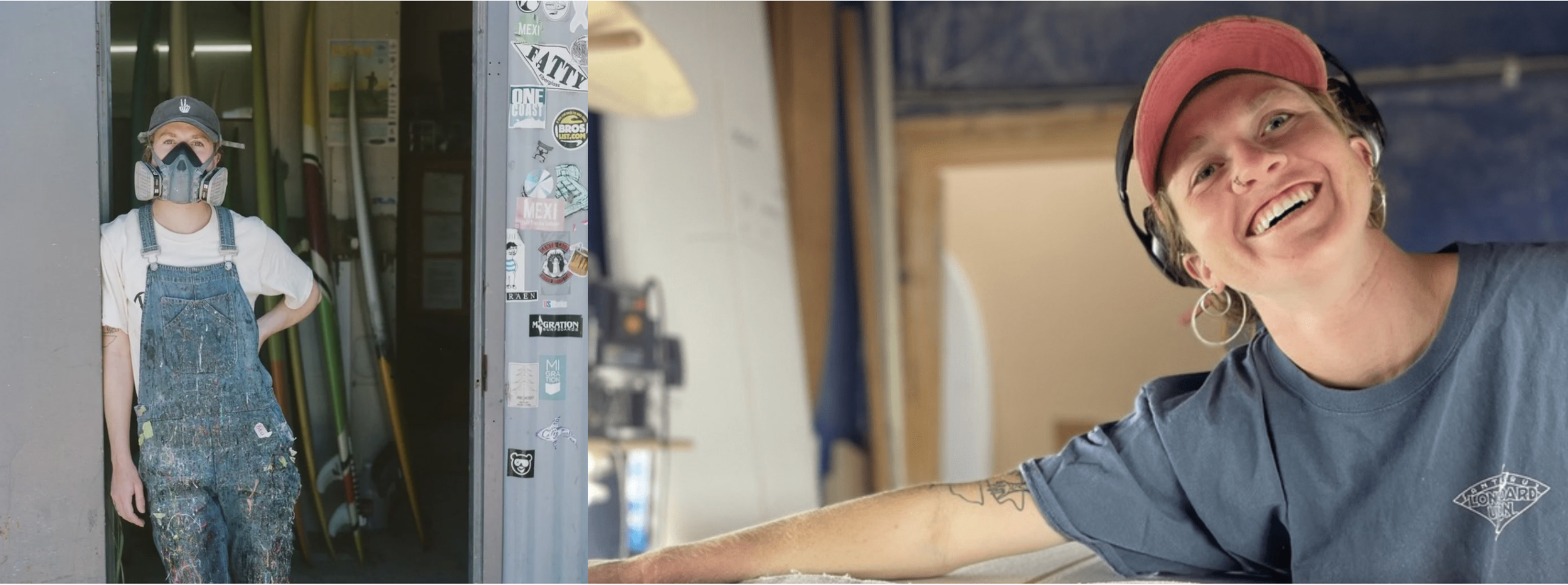
The work comes from Rebecca Benjamin, who completed her M.S. in Scientific Computing and Applied Mathematics at UCSC this June under advisors Nicholas Brummell (UCSC) and Frank Giraldo (Naval Postgraduate School), a lifelong surfer who signed on to the project the moment he heard the pitch. Benjamin is a shaper and surfer herself, and her question was disarmingly simple: do cheap, accessible CFD (Computational Fluid Dynamics) simulations actually correspond to what surfers feel under their feet — and does the under-studied bottom of the board matter as much as builders insist it does?
To find out, she built two high-performance shortboards identical in every dimension — length, width, thickness, rocker — except one. Board A runs a single-concave bottom, a contour pioneered by Dick Brewer and later popularized by Al Merrick for its speed and drive. Board B runs a vee, the McTavish-and-Nat-Young design prized for looseness and easy rail-to-rail surfing. Both were designed in Shape3D, CNC-cut in Santa Cruz, and hand-finished at the Santa Cruz Board Builders Guild. Local water photographer Ben Gerding shot surfer Scott Purdy riding each board through identical bottom turns at the Palm Springs Surf Club wave pool, complete with tuft-testing strands taped to the hull to visualize how water moved across it.
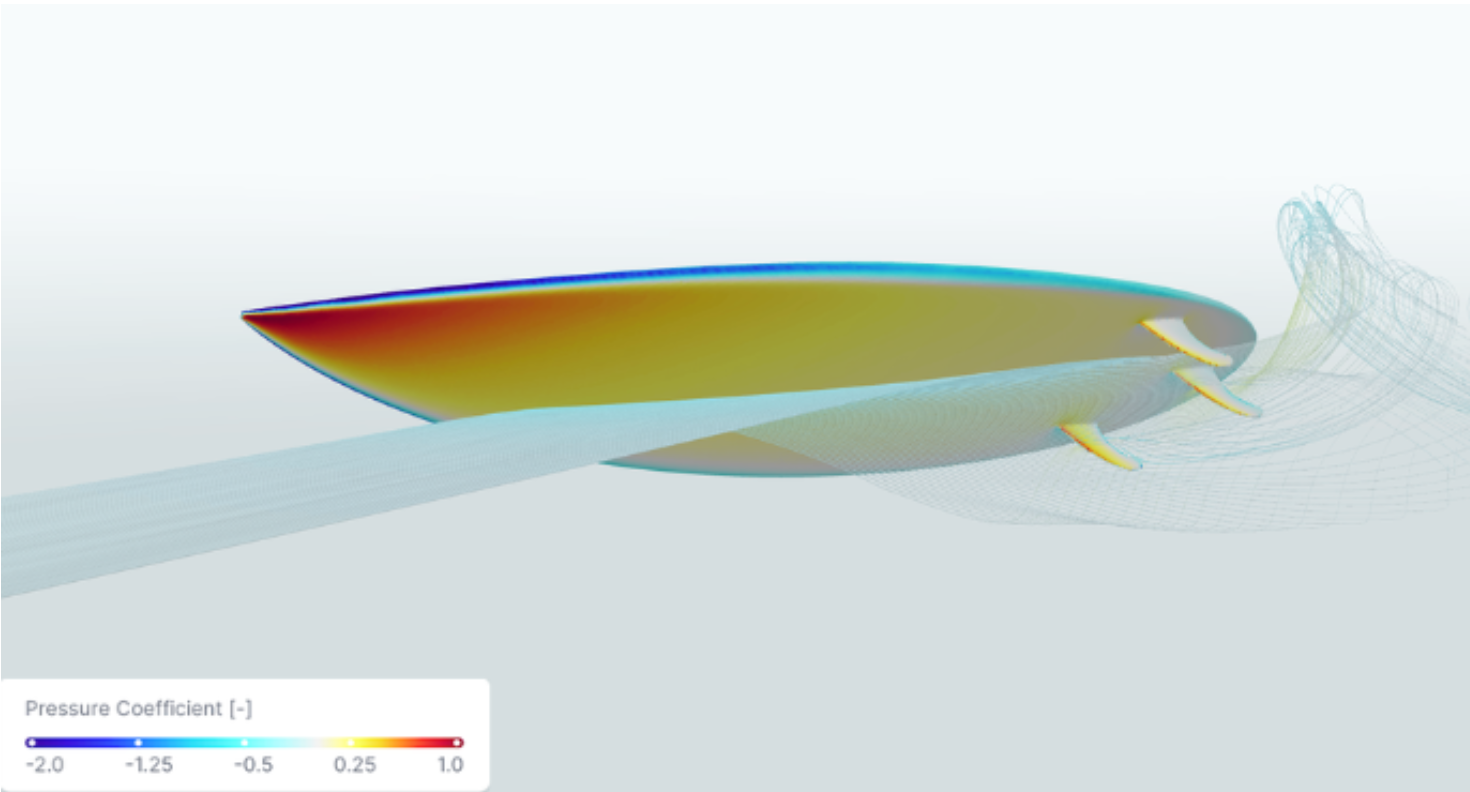
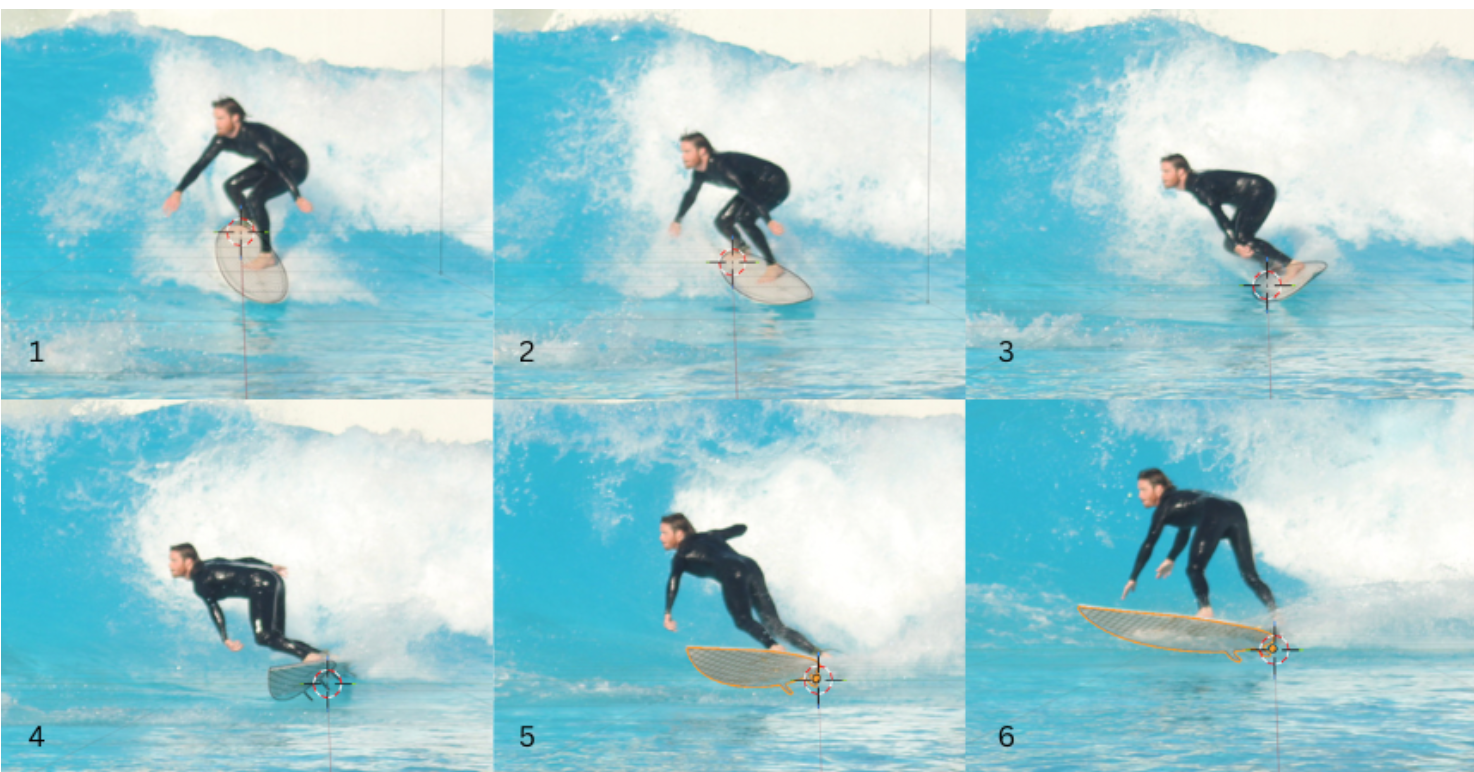
The bottom turn is the right maneuver to study because it’s where everything happens: the surfer converts the speed of the drop into a change of direction, compressing through the turn and driving back out. Benjamin examined two of them — a deep “power” turn set up for a cutback, and a shallower turn used to settle into the pocket and set up for the tube. The clever part is the bridge between the pool and the computer. Using land and underwater photography plus a measured grid, she reconstructed the board’s roll, yaw, and angle of attack at each phase of both turns inside Blender, then replicated those exact orientations in NablaFlow’s AeroCloud — a web-based CFD tool running a steady RANS solver with a k-omega SST turbulence model on roughly five million cells. Each turn became a sequence of quasi-steady snapshots she could measure for drag, lift, pressure, and moment forces, with the surfer’s speed clocked at around six meters per second.
The results line up with shaper lore. Forces peaked, predictably, near the heaviest part of each turn — around 35 degrees of roll and 45 degrees of yaw. The single-concave board produced higher drag, lift, and moments — stronger hydrodynamic loading that reads as “powerful” and “locked-in,” the board driving hard out of the turn. The vee bottom showed lower resistance and easier rail-to-rail transitions, with more negative roll and yaw moments: exactly the “loose,” forgiving feel surfers describe when they want the board to shift with a small move of the back foot. The differences were small but strikingly consistent — roughly 3–5% in drag and 2–4% in lift and moments — confirming that a single change in bottom contour, with everything else held equal, meaningfully reshapes how a board behaves. Tellingly, the simulated streamlines even echoed the tuft patterns from the pool.
Benjamin is careful about limits. Single-phase, steady-state simulation can’t capture the chaotic air–water interface of a real wave, the photo-based angle estimates ignore lens distortion, and stitching fins onto the boards took a clunky multi-software workflow. But that’s not the point. The point is that affordable cloud CFD can serve as a reliable comparative tool — letting shapers see how a minute tweak redistributes pressure before a single blank gets cut. For an industry that has never had an R&D budget, that’s quietly revolutionary.
And it happened here. NablaFlow’s Luca Oggiano donated more than $10,000 in simulation credits, US Blanks supplied the foam, Shape3D contributed software, and a roster of local supporters covered the build, including Santa Cruz Works — proof that a surfer-mathematician backed by her community can add something genuinely new to a craft that’s run on intuition for three thousand years.
RELATED ARTICLES
Where Water Touches Foam: Rebecca Benjamin and the Science of Surfboards
The Crowded Sky — Doug Erickson borrows the language of a crowded lineup to make sense of an airspace filling up fast.
New Tech Comes Home to the River — Seven founders show what hands-on innovation looks like when it grows straight out of this place.
Santa Cruz Works New Tech Returns March 4, 2026 — Benjmark exhibited at this New Tech night, bringing custom boards, tuft testing, and underwater imaging to the local crowd.