

The Rail Line's Real Problem Was Never Rail vs. Trail
A new Civil Grand Jury report reframes Santa Cruz County's 40-year corridor fight: the failure wasn't choosing between rail and trail, but making generational decisions without grounding them in engineering and financial reality.
Here's the thing about the Santa Cruz Branch Rail Line: we've spent forty years arguing about the wrong question.
The argument we think we're having is a values argument. Train people versus trail people. Climate idealists versus pragmatists. Nostalgia versus mobility. It's the kind of fight that feels existential, that turns neighbors into opponents, that produced a ballot measure voters rejected 73 to 27. And the new Civil Grand Jury report doesn't pretend that fight wasn't real.
But it gently insists we've been staring at the surface. The deeper failure, it argues, wasn't disagreement over what to build. It was that for over a decade, the county made enormous, irreversible decisions without actually knowing what those decisions cost.
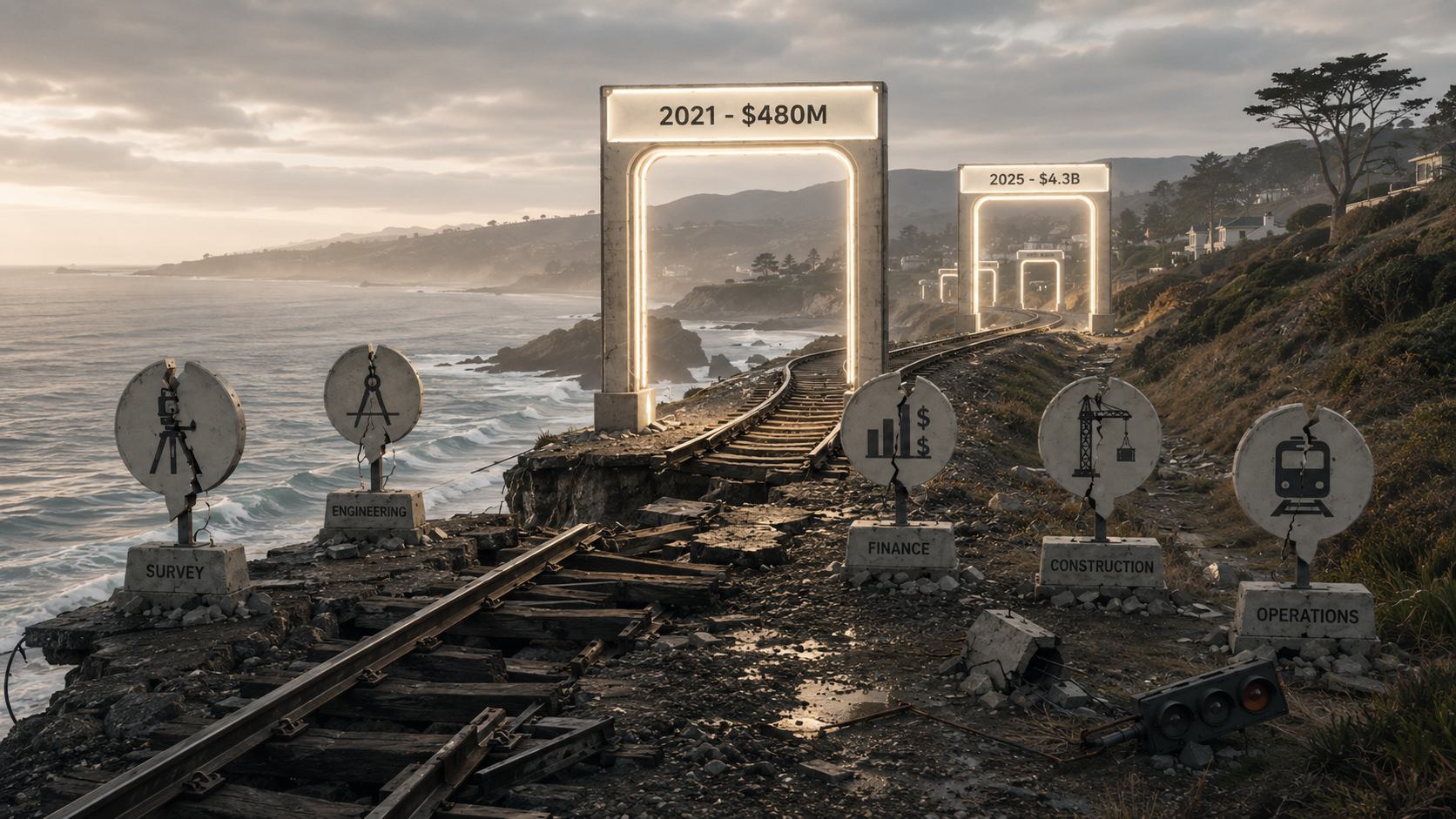
Consider the number that detonated the whole conversation. In 2021, a consultant put passenger rail at roughly $480 million. In 2025, the same consultant, doing actual engineering this time, put it at $4.3 billion. A tenfold jump—not because the corridor changed, but because someone finally measured it.
This is the part I find genuinely clarifying. The RTC was, for most of its life, a planning agency. It allocated money and imagined futures. It had no engineers on staff until 2017. So when it bought a 150-year-old rail corridor in 2012—a "retaining wall with tracks," as one source memorably put it—it kept doing the thing it knew how to do: producing aspirational, two-dimensional studies that described what could be built without confronting what building it would actually require.
Chasing Grants.
And here's where it stops being a Santa Cruz story and becomes an American one. The grant-funding model itself rewards this. To win competitive grants, you minimize projected costs and maximize promised benefits. Rigorous engineering up front costs scarce local dollars and surfaces inconvenient numbers. So the structural incentive is to stay optimistic, win the money, and discover the truth mid-construction—when it's too late to fund the gap. That's not a Santa Cruz pathology. It's how public infrastructure gets built across blue America, and it's a big reason so much of it gets built so badly.
The RTC’s amazing ability to chase grants — in fact, the county’s as well — is always viewed as success. It is not success. An effective implementation at reasonable cost is success, but that never seems to be the measure. The Grand Jury report also touched on the craziness of the grant chasing for the ATP grant where they got the biggest grant in the history of the program — a false success — and then massively failed to underestimate the cost of the ultimate trail.
The Grand Jury's recommendations are almost boringly procedural: gate projects at clear milestones, attach confidence levels to cost estimates, try modern contracting, write an actual strategic plan. But boring is the point. The lesson of the corridor is that the romance of the vision—rail and trail, the best of both worlds—was precisely what kept anyone from doing the unglamorous math.
The tragedy isn't the disagreement. It's that we spent four decades and a fortune arguing over options that the engineering would have ruled out in an afternoon.
Who or What Triggered this Investigation?
The 2025-2026 Santa Cruz County Civil Grand Jury initiated this investigation on its own—there's no outside complainant. In its Scope and Methodology section, the jury says it selected the Santa Cruz Branch Rail Line because of the longstanding public controversy over the corridor's costs, feasibility, and future use. The RTC's mid-investigation release of the ZEPRT report, with its $4.3 billion estimate, sharpened the jury's focus on how RTC decision-making had evolved.
California civil grand juries can open inquiries two ways: acting on a citizen complaint, or launching a self-initiated investigation into any local-government matter in their jurisdiction. This was the latter. The grand jury is a body of private citizens impaneled by the superior court for a one-year term, and they chose this subject themselves under their watchdog authority over county agencies.
What Next?
Grand jury findings aren't legally binding, but California law (Penal Code §§ 933 and 933.05) imposes a mandatory response obligation. As the governing body, the RTC must comment to the presiding judge of the Santa Cruz County Superior Court within 90 days; elected officers and agency heads get 60. Those responses are filed publicly, and they can't be vague. For each finding, the RTC must agree or disagree—explaining any disagreement. For each recommendation, it must report one of four outcomes: implemented, will be implemented, requires further analysis, or won't be implemented (with reasons). The grand jury can't compel compliance; §933.05 lets respondents decline. So the power is accountability, not enforcement: the RTC must go on the record, item by item, soon. A "will not be implemented" answer is allowed, but it becomes a documented public refusal—real leverage that is reputational and political rather than legal.
Related Articles
ZEPRT: Billion Dollar Dead End — A breakdown of the $4.28 billion concept report whose engineering rigor finally forced the corridor's costs into the open.
RTC's $4B Dilemma: A Reality Check on Santa Cruz's Rail Fantasy — How a single study's price tag reframed what the county could realistically expect from its rail corridor.
Rail Was Never Going to Work — An argument that the corridor's width, terrain, and aging bridges made the rail-and-trail dream impractical from the start.
The Story Behind the Santa Cruz County Rail-trail — A footnoted history of how acquisition, freight collapse, and competing visions brought the corridor to its current impasse.
Stubborn Facts Derail the Train in Santa Cruz County — A pointed look at the cost overruns and shifting promises that eroded public trust in the RTC and FORT.