

AI Is Not the Death of Creativity. It Is the Death of Mediocrity.
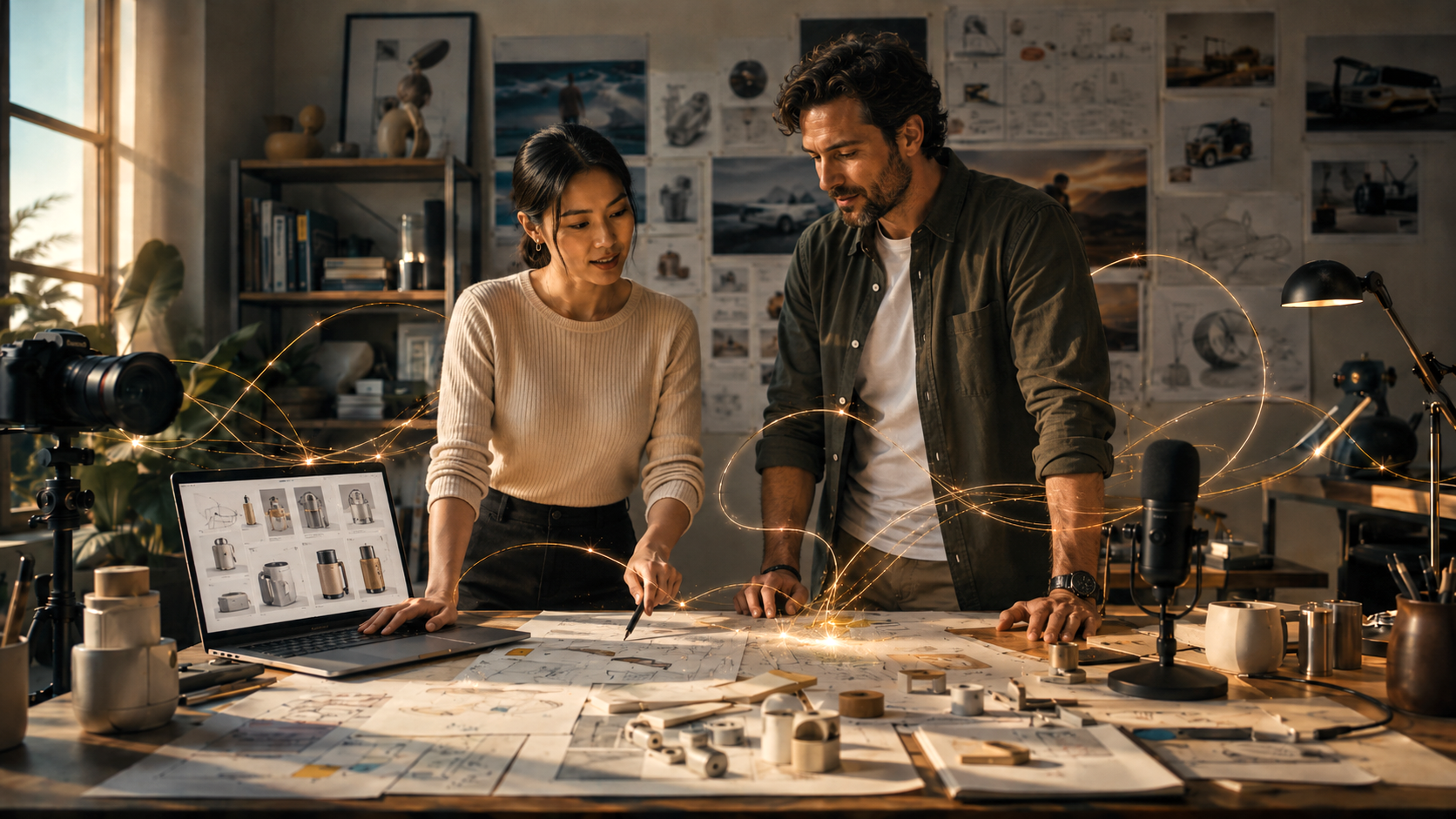
The fear is that AI replaces the artist. The better read is that it replaces friction — the blank page, the first draft, the forgettable middle. What it can't replace is judgment.
Every technological panic follows the same script. The printing press would ruin memory. Photography would end painting. The synthesizer would hollow out music; streaming would gut film. And now the chorus has a new verse: AI is coming for the artist, the writer, the designer, the founder, the kid building something in a garage. I understand the fear. I just think it's aimed at the wrong target.
Here's the argument I want to make. AI is not replacing creativity. It's replacing friction.
What it actually eats is the blank page, the rough mockup, the storyboard, the legal pad full of half-formed ideas, the $25,000 invoice for work that should have cost a few hundred dollars. That's not nothing. If your job is mostly producing competent, forgettable output — resizing the ad, formatting the deck, generating the serviceable draft — this technology is genuinely coming for the task, and I don't want to soften that. But it's worth being precise about what's being threatened, because "competent and forgettable" was never what we meant by creativity in the first place.
Creativity is judgment under uncertainty. It's taste. It's knowing which of a thousand ideas deserves to exist, what's derivative, what's emotionally true, what will make a customer stop scrolling. A model can generate the thousand options in seconds. What it can't yet do is tell you which one matters. That gap — between generation and judgment — is where the human work is moving, not where it's disappearing.
And the evidence, so far, doesn't support the cartoon version of the panic. The labor market hasn't collapsed. Scott Galloway made a version of this point on a recent episode of Pivot, and I think it's the sharpest framing I've heard:
"Where social media takes people to the extremes, AI takes everyone to the middle and it's very moderated. And so creativity has never been more important. Remember AI was going to produce commercials? There's more designers now at IBM as a percentage of their employment and creatives than there was last year. The creativity appears to have come back."
That last line is the part worth sitting with. The creativity appears to have come back — because once the floor of competence gets automated, the premium shifts to the one thing software can't manufacture: a point of view.
This is also why I think the real fight is being misdescribed. It isn't humans versus machines. It's owners versus operators. Who owns the rights, the audience, the workflow, the margin, when one talented person can suddenly do the work of five? Hollywood's unions understood this immediately — they aren't trying to ban the technology, they're negotiating consent, control, and who gets paid when a human voice or likeness or performance becomes training data. That's the actual contest, and it's a question about power, not productivity.
Which brings me to why this matters for a place like Santa Cruz. AI lowers the cost of experimentation, and when experimentation gets cheap, advantage shifts away from institutions with capital and toward individuals with conviction. A founder can now prototype, brand, write, analyze, and pitch with tools that looked like science fiction a decade ago. The gatekeepers are weaker. The distance between an idea and a market has collapsed.
But cheaper experiments also mean more noise, and the world does not need more content. It needs more judgment. More nerve. More people willing to own a point of view. AI makes average cheaper. It makes original more valuable.
So the winners won't be the people who "use AI" — that will soon sound like bragging that you use email. The winners will be the ones who pair it with something it can't supply: domain expertise, taste, distribution, trust. Artists who understand business. Engineers who understand story. Founders who understand people.
If that's the skill set the next decade rewards — judgment, taste, nerve, the willingness to own a point of view — then the obvious question is where it gets learned, and the honest answer is that we tend to start far too late. Which is what makes something like the 3DE Club's Entrepreneurship & Innovation Showcase worth paying attention to. On Saturday, July 18, at Abbott Square, kids as young as six will get up and pitch real ideas to a live audience — not as a novelty, but as practice in the thing that actually matters: deciding what's worth building and standing behind it. We spend a lot of energy worrying about whether AI will replace the next generation's work. We'd be better off teaching them, early, to do the part it can't.
AI isn't the end of creativity.
It's a leverage event. And leverage has always rewarded the brave, the disciplined, and the slightly weird. The future doesn't belong to AI. It belongs to the people who know what to do with it.
Related Articles
The AI Singularity of Entrepreneurship — How AI collapsed the startup timeline from years to days, and why the real value lives in the tools and models beneath the apps, not the apps themselves.
BrandCapsule Goes Live — and the Revenue Is Already Coming In — An AI discovery startup proving the thesis that AI no longer just helps buyers find brands — it decides which ones they ever see.
Your Company Has a Brain. Lucid Wants to Show You the Scan. — A solo engineer building an AI "organizational intelligence" system that scans a whole company like an MRI.
Santa Cruz AINative Studio: Built for Builders, From the Ground Up — A small, unfunded team quietly shipping AI infrastructure fast — the new economics of building with these tools.
Gabriel Garcia-Solis Has Been Failing Forward Since He Was Seventeen — The founder behind a viral AI food app, whose real product was nerve, not the algorithm.
Silicon Valley Outperforms, But for How Long? — The labor data behind the optimism: surging AI job postings and tech employment growing again, even amid real cracks.