

The Question Nobody in AI Wants to Ask
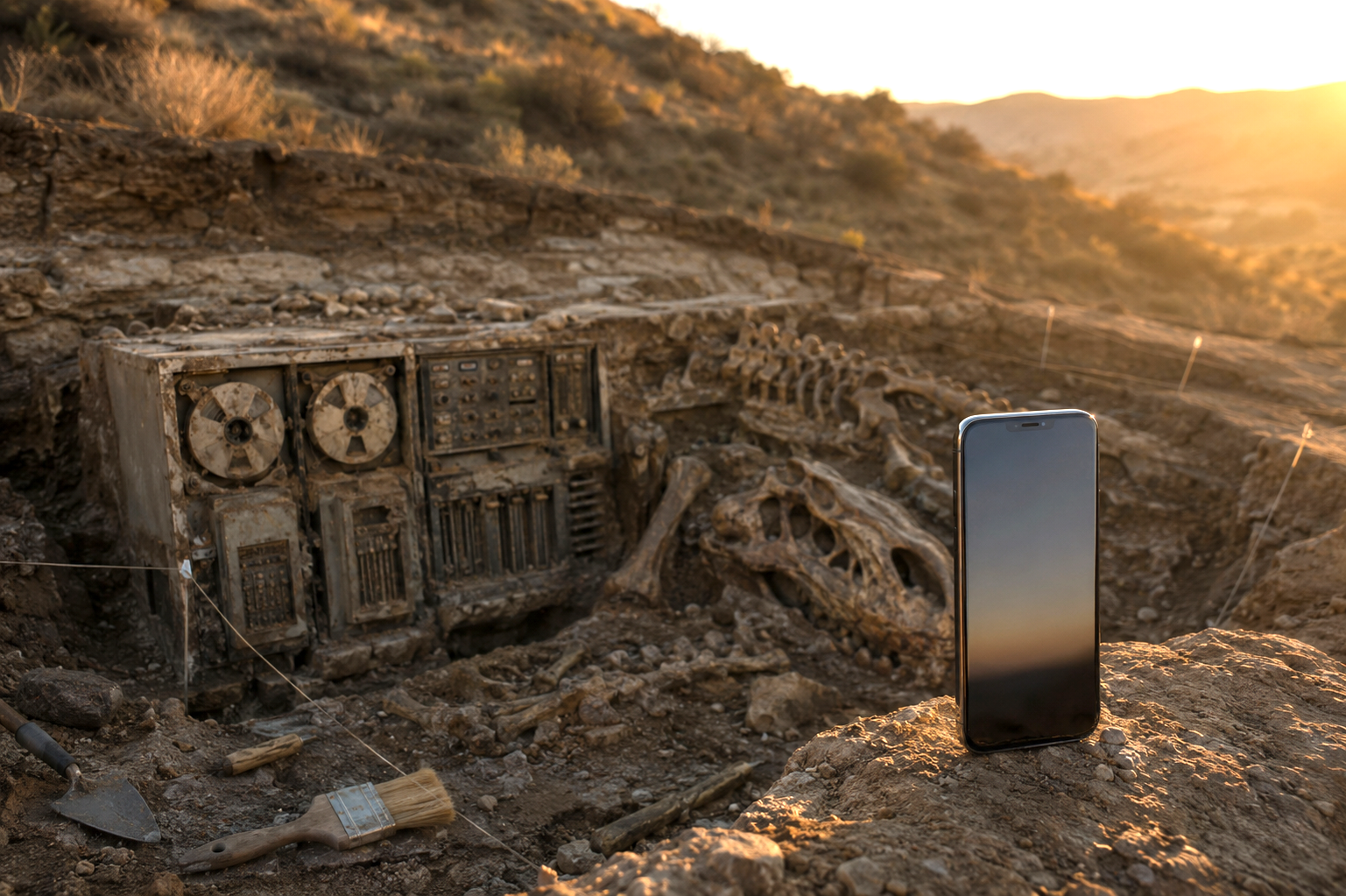
Forty years in tech, some of it alongside John Sculley and David Hancock, taught me one pattern: computing always migrates from the rented mainframe to the desk you own. Free frontier models, memory-rich Macs, and a $69 cable are repeating it now. The AI scoreboard is wrong. Apple is quietly winning.
I want to start with a confession, because I think it matters for how you read the rest of this. I have been obsessed with Apple for most of my forty years in technology. I never worked there. But I spent a good stretch of my career in its orbit — at Live Picture, where John Sculley was CEO and Chairman, and later at Presenter, which WebEx acquired and Cisco acquired after that, where Sculley was again a partner and where David Hancock became a close friend and mentor. So when I tell you I think Apple is the most important company in artificial intelligence, you should know I'm not a neutral observer. You should also know that I've spent a long time trying to distinguish between the Apple I want to exist and the Apple that actually does. This argument, I think, survives that test.
Here is the argument, stated as plainly as I can: the AI industry is keeping score on the wrong scoreboard, and the company that wins on the right one is the company almost nobody is talking about.
What the scoreboard measures
The way we currently rank AI companies is by two questions. Who has the best frontier model? And who sells the chips that train it? By those measures, Nvidia's position looks close to unassailable. It was the first company to cross a $5 trillion market capitalization. Its revenue is growing at 85 percent a year. Jensen Huang goes on stage and says there is "no chance" his GPUs end up idle, and the entire S&P 500 is, functionally, a leveraged bet that he's right.
But notice what that scoreboard actually tracks. It tracks the race to train models. And I think the history of computing is fairly unambiguous about what happens after the training race, which is that the thing you rent from a centralized provider becomes the thing you own. The mainframe became the personal computer. The timeshare became the laptop. The cloud is, right now, becoming the edge. This isn't a prediction so much as a pattern, and the people who argue it won't repeat this time are, reliably, the people whose business model depends on it not repeating.
So the question I keep coming back to is not "who has the best model?" It's a stranger question: when the models become free, whose hardware do they run on?
The models are becoming free
I want to be careful here, because "the models are becoming free" sounds like the kind of thing a person says before they get badly embarrassed. So let me just describe what has happened since February.
Alibaba released Qwen 3.5, a 397-billion-parameter model, weights public. DeepSeek released V4 in April: 1.6 trillion parameters, MIT-licensed, at the top of the open leaderboards. Moonshot shipped Kimi K2.6 the same week. In June, MiniMax, Moonshot again, and Zhipu each released models with million-token context windows and permissive licenses, trading blows with closed frontier systems on real coding benchmarks. And this week Moonshot announced Kimi K3, which early numbers place third in the world, behind only the best closed models from Anthropic and OpenAI, with weights promised by the end of the month.
What's striking isn't any one of these releases. It's the cadence. A near-frontier open-weight model now arrives roughly every three to six weeks. You can build a competitive moat against a rival. I don't know how you build one against a rhythm.
Where free models actually run
This is the part of the argument that is technical, and I think it's also the part that's most underappreciated, so bear with me.
Trillion-parameter models are not, mostly, constrained by raw computing power. A mixture-of-experts model activates only a small fraction of its parameters for any given token. What it needs is for the entire model, all of it, to sit in fast memory, waiting. The constraint is bytes, not operations.
Nvidia's answer to bytes is video memory, and its most capable workstation card carries 96 gigabytes. A 4-bit version of one of this summer's frontier-class open models is around 467 gigabytes. The card cannot hold it. Not slowly. Not at all.
Apple's answer is a different architecture entirely: a single pool of memory shared between the CPU and GPU. Apple sold a Mac Studio configurable with 512 gigabytes of it for about $9,500, drawing a couple hundred watts. That machine runs DeepSeek's 671-billion-parameter model at more than 20 tokens per second. Two of them run a trillion-parameter model. And it does this on a desk, quietly, with the network cable unplugged.
To match that memory with Nvidia workstation cards, you'd need five or six of them. That's somewhere between $60,000 and $75,000, drawing close to three kilowatts, at which point you are thinking about your building's electrical system and paying several hundred dollars a month in power. The Apple machine costs a sixth as much and uses a tenth of the energy. And the interconnect story is, if anything, more lopsided. Nvidia removed high-speed linking from its workstation cards, so multi-GPU setups outside the datacenter are shouting across a PCIe bus. Apple's interconnect is a $69 Thunderbolt cable. People are chaining four Mac Studios on a desk and running trillion-parameter models at 25 tokens per second.
I've watched this specific dynamic before. Live Picture's entire premise was that image editing requiring expensive workstations would migrate to ordinary machines faster than the incumbents believed. It did. It always does. The expensive computer becomes the cheap computer on a schedule the expensive-computer companies never quite accept.
The bet underneath the valuation
Now I want to zoom out, because I don't think this is really a story about hardware specs. It's a story about what a $5 trillion valuation is a bet on.
Nvidia's price assumes a world in which intelligence is permanently centralized, where every query, forever, routes through a hyperscale datacenter, and where the largest technology companies therefore have no choice but to spend something like $600 billion a year on chips indefinitely. The five biggest of them have guided to roughly $650 billion in capital expenditure this year. That spending is growing considerably faster than the revenue it is supposed to generate, a wider gap than the telecom buildout of 2001, which I lived through, and which did not end gently. Amazon's free cash flow is projected to go negative. In June, rental prices for Nvidia's newest chips fell 31 percent in three weeks. Nvidia's stock is down 18 percent from its peak despite record earnings.
That last fact is the one I'd underline. When record earnings can't hold a price, the market isn't pricing earnings anymore. It's pricing a story. And every trend I've described (free models, memory-rich consumer hardware, inference moving onto machines people own) leaks the story. It doesn't require every query to move local. It requires the margin to.
What Apple understood
“Apple is a luxury brand that happens to be in the technology business.”
Here is where my bias and my analysis converge, and I'll let you decide how much to discount it.
Sculley used to say, and he was mocked for it, having come from Pepsi, that Apple was not a technology company but a company that sold identity. He was right, and it was the source of both its brilliance and its near-death. Apple has always been a luxury business: scarcity, craft, and the quiet signal of being able to afford not to care. What's new is that the luxury object is now also the cheapest way to do the job. And the one feature luxury buyers value most, privacy, the assurance that what's yours stays yours, is precisely the feature a local model on Apple hardware delivers by architecture. There is no server to subpoena. For medicine, law, finance, government, that isn't a feature. It's the product.
I should acknowledge the strongest objection, which is that Apple pulled its 512-gigabyte configurations this spring because the same memory shortage that's raising Nvidia's prices hit Apple too. That's real. But Apple is qualifying cheaper Chinese DRAM and is reportedly testing a next-generation Mac Studio with up to 768 gigabytes. That doesn't look like a company leaving the memory business. It looks like one securing supply before the next push. And the most telling signal of all is Nvidia's own new "personal AI supercomputer," a small, quiet box with unified memory. It is, in every way that matters, a Mac Studio.
The obvious, said carefully
None of this means Jensen Huang is wrong about training. He isn't. Training will stay in datacenters, CUDA will remain a genuine moat with researchers, and the labs will keep buying Blackwell by the acre. But training is the cost center. Inference is the volume. Being the king of the cost center while the volume walks out the door is being the king of a shrinking share of a market you used to own outright.
David Hancock used to tell me that the most dangerous moment for any incumbent is the quarter it posts record numbers. I've thought about that a lot this summer. I don't know exactly how fast the shift I'm describing will happen. But I've been in this industry for forty years, and I've never seen the pattern break. The datacenter becomes the basement. The life of computing moves to the desk. It has every time.
This time, I think, the desk might be yours.
Related Articles
AI Brake Check — Anthropic asks the world for a brake pedal on the eve of a trillion-dollar IPO, and the question is whether the centralized frontier can slow itself down.
AI Isn't Killing SaaS. It's Rewriting the Budget. — Mash Ashley on why software spending hasn't shrunk so much as shifted, the same repricing dynamic now bearing down on hyperscale compute.
The AI Stack Every Enterprise Developer Needs in 2026 — A map of the layers beneath enterprise AI, most of which look very different once the model runs on a box under your desk.
AI Is Not the Death of Creativity. It Is the Death of Mediocrity. — What AI replaces is friction, not judgment, and judgment is precisely what a local, private model puts back in human hands.
Rent-a-Human: Because the Future Finally Realized It Still Needs Legs — A reminder that the endgame of AI keeps landing back in the physical world, on real desks, with real people.